
Data-Driven Marketing Strategies: A Guide to Sustainable Growth

Updated: Mar 17
Data-driven marketing isn't just a buzzword; it's a fundamental shift in how we connect with customers. Simply put, these are strategies that rely on hard data and analytics to inform every decision, taking the guesswork out of the equation and replacing it with measurable insights. This means collecting real information on customer behavior and market trends to build campaigns that are highly targeted, deeply personal, and far more efficient. The result? A much healthier return on investment.
Moving from Guesswork to Growth
Think of it like a ship's captain navigating treacherous waters. The old-school captain might rely on instinct and outdated paper maps. The modern captain, however, uses advanced sonar and real-time satellite data. Data-driven marketing strategies are the modern captain's instruments, transforming marketing from a game of chance into a predictable science.
It’s a philosophy where every choice—from how you allocate your ad spend to the exact words you use in your messaging—is backed by solid insights, not just assumptions. This shift empowers businesses to turn raw information from customer interactions, sales figures, and market trends into a clear roadmap for growth.

The Core Principles of This Approach
At its heart, this strategy is about understanding people. By digging into the data, you can uncover what your audience truly wants, how they behave online, and what actually motivates their decisions. This deeper connection is what allows for more meaningful engagement.
The whole approach rests on a few key principles:
Customer Centricity: Every decision revolves around the customer. You use data to understand their needs and preferences, placing them at the center of your world.
Continuous Optimization: You’re never really “done.” Performance metrics are used to constantly test, learn, and tweak campaigns for maximum impact.
Actionable Insights: It’s about translating complex data into clear, practical steps that directly drive marketing activities and, ultimately, business results.
To truly get a handle on these strategies, it's essential to understand the data-driven decision-making process that powers them. It’s the engine under the bonnet.
This approach lets you know your customers on a deeper level, personalize their experiences, and optimize your return on investment with genuine precision. Before we dive deeper, the table below really highlights the practical shift from traditional, instinct-based tactics to this powerful, insight-driven framework. The role of analytics is, of course, absolutely fundamental here; you can learn more about how analytics shape marketing decisions and discover how to apply these concepts.
Traditional vs. Data-Driven Marketing Approaches
This table breaks down the fundamental shifts in mindset, process, and outcomes when you move away from traditional marketing and embrace a data-driven framework.
Aspect | Traditional Marketing (Guesswork-Based) | Data Driven Marketing (Insight-Based) |
|---|---|---|
Foundation | Relies on intuition, assumptions, and experience. | Based on empirical data, customer behavior, and analytics. |
Targeting | Broad demographic segments (e.g., “women aged 25-40"). | Highly specific micro-segments and individual personas. |
Messaging | One-size-fits-all, generic campaigns. | Personalized, dynamic content tailored to individual needs. |
Measurement | Focus on vanity metrics like reach or impressions. | Focus on actionable metrics like conversion rates, LTV, and ROI. |
Optimization | Infrequent, based on campaign-end reviews. | Continuous, real-time adjustments based on performance data. |
Decision-Making | Subjective and often driven by the "highest-paid person's opinion." | Objective, evidence-based, and collaborative. |
The move to data-driven marketing is less about changing tools and more about changing your entire philosophy—from creating campaigns you think will work to building experiences you know will resonate.
"A data-driven marketing strategy ensures that efforts are not only evidence-based but also aligned with evolving consumer expectations, ultimately leading to better decisions."
By adopting these strategies, marketing teams move away from broad, generalized campaigns and towards precise, effective initiatives that resonate with individuals. This doesn't just improve campaign performance in the short term; it builds stronger, more loyal customer relationships over time.
Building Your Data-Driven Marketing Foundation
Any successful data strategy rests on a solid, well-organized foundation. It's a lot like building a house. You wouldn't dream of putting up walls without first laying the concrete slab and framework. In the world of marketing, your data sources, measurement frameworks, and governance policies are that essential structure.
Without this groundwork, your data-driven marketing strategies will be wobbly at best and destined to collapse at worst. Let's walk through the blueprint for constructing that framework, making sure every decision you make is built on solid ground.
Understanding Your Core Data Sources
Your data foundation begins with the raw materials—the different types of information you have access to. Just like in construction, each material has unique properties and uses. When you learn to combine them correctly, you create a much stronger structure.
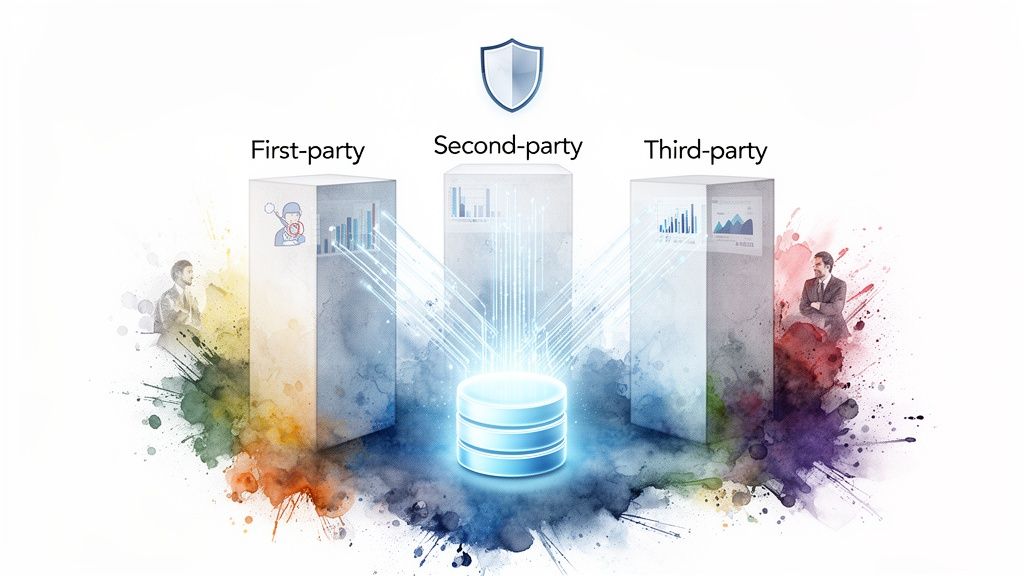
You'll mainly be working with three categories of data:
First-Party Data: This is the absolute gold standard. It’s the information you collect directly from your audience and customers—think website analytics, CRM data, purchase history, and email engagement. Because you own it and it comes straight from the source, it's incredibly accurate and gives you a direct line of sight into customer behavior.
Second-Party Data: This is simply someone else's first-party data that you get directly from a trusted partner. For instance, a B2B software company might team up with a non-competing industry publication to share audience insights. It's a fantastic way to broaden your reach with relevant, high-quality information.
Third-Party Data: This data is gathered by large aggregators who have no direct relationship with the consumers. They buy data from all over and compile it into broad audience segments. While it offers impressive scale, it’s often less accurate and is becoming less reliable due to the rise of privacy regulations.
The real goal here is to weave these sources together into a single, unified view of each customer. A key piece of technology for this is a Customer Data Platform (CDP), which acts as a central hub to unify all this disparate customer information.
Establishing Robust Measurement and Attribution
Once your data sources are organized, the next crucial step is figuring out what it all means. This is where measurement frameworks and attribution models come into play. Think of them as the instruments and blueprints that tell you whether your marketing efforts are actually hitting the mark.
An attribution model is the rule, or set of rules, that determines how credit for sales and conversions is assigned to touchpoints in conversion paths.
Without clear attribution, you might mistakenly credit the very last ad a customer clicked for a sale. You'd be thoroughly ignoring the blog post, email, and social media ad they engaged with weeks earlier. This skewed perspective leads to poor budget decisions and missed opportunities.
Some of the most common attribution models include:
First-Touch Attribution: This model assigns 100% of the credit to the very first interaction a customer had with your brand.
Last-Touch Attribution: The opposite of first-touch, this gives all the credit to the final touchpoint right before the conversion. It’s simple, but often very misleading.
Linear Attribution: This model spreads the credit out equally across every single touchpoint in the customer's journey.
Multi-Touch (Data-Driven) Attribution: This is the most sophisticated approach. It uses algorithms to assign value to each touchpoint based on its actual influence on the conversion. It's the most accurate but also the most complex to set up.
Choosing the right model really depends on your business goals and how complex your typical customer journey is. For a more profound look at this, our post on setting clear https://www.ryesing.com/post/marketing-kpis-objectives offers great guidance on what you should be measuring.
Ultimately, the key is to move beyond simplistic last-click thinking to get a complete picture of what truly drives results. That clarity empowers you to double down on your high-performing channels and confidently optimize the ones that are lagging.
Putting Your Data to Work: Channel-Specific Tactics
You’ve built the data foundation. Now it’s time for the fun part: moving from planning to action. This is where theory gets its hands dirty and starts delivering real results. We’re going to take those high-level strategies and apply sharp, data-driven tactics to the marketing channels that actually move the needle for your business.
Think of it this way: what works for SEO is different from what works in paid media, and the data that fuels your email campaigns isn't the same as what shapes your content calendar. The aim is to get each channel speaking the same language of data, creating a synchronized effort where every move is optimized.
Enhancing SEO with Search Intent Data
Modern SEO has little to do with stuffing keywords onto a page and everything to do with deeply understanding and satisfying what a searcher actually wants. Data-driven SEO uses clues from search queries, on-site behavior, and what your competitors are up to, allowing you to create content that answers your audience's questions—sometimes before they even realize they have them.
Instead of guessing what topics might land, you can analyze search trend data to spot emerging interests. For instance, a software company might see a spike in searches like "how to automate financial reporting." That's not just a keyword; it's a flare signal from the market. It tells you to create a comprehensive guide, a webinar, or a tutorial that tackles that specific pain point, positioning your brand as a helpful expert, not just a seller.
This approach means your content creation efforts are never wasted. By aligning every article, blog post, and landing page with proven user intent, you don't just climb the search rankings; you build real authority and trust with the people you want to reach.
Building Hyper-Targeted Paid Media Campaigns
Paid media is where a data-driven approach can deliver an almost immediate and significant payback. Forget casting a wide, expensive net with generic ads. It's time to use your own first-party data—from your CRM or website—to build laser-focused audience segments that boost performance and slash wasted ad spend.
Imagine an e-commerce brand launching a new high-end running shoe. The old way might be to target broad demographics like “men aged 25-40 interested in running.” A data-driven strategy goes miles deeper:
Segment 1: High-Value Customers—Go straight to the people who have previously bought premium running gear from your site. They already trust you.
Segment 2: Cart Abandoners—Gently nudge users who added similar shoes to their cart but got distracted before checking out.
Segment 3: Lookalike Audiences—Use the data from your most loyal customers to find new people who look just like them online.
This level of precision ensures your budget is working as hard as possible, targeting individuals who are most likely to convert. In a crowded market, this isn't just an advantage; it's essential for survival. The UK digital advertising market is booming, projected to hit USD 95,727.8 million by 2030. A giant slice of that—over 58%—is mobile advertising, where attention is scarce and precision is everything. To learn more, take a look at these UK digital advertising trends on grandviewresearch.com.
Driving Engagement with Behavioral Email Marketing
When you fuel it with behavioral data, email marketing sheds its skin as a simple broadcast tool and becomes a powerful nurturing engine. Instead of blasting the same newsletter to your entire list, you can create smart, automated sequences that are triggered by what people actually do (or don't do).
A behavioural email is a targeted, automated email sent to a contact based on their behaviour on your website, app, or in relation to your emails. It’s about reacting to their actions in a timely and relevant way.
For example, if someone downloads an e-book about project management, that's a clear signal of interest. An automated workflow can then send them a series of perfectly timed follow-up emails: a case study, some tips for choosing the right software, and maybe, down the line, a special offer for your product. This personalized journey meets the lead where they are, nurturing their interest and making a conversion feel like a natural next step.
Creating a Resonant Content Calendar
Your content calendar shouldn't be based on guesswork; it should be architected by data. By digging into engagement metrics like time on page, scroll depth, social shares, and conversion rates from your existing content, you can see exactly which formats and topics are hitting the mark with your audience.
If your data shows that video tutorials consistently get more engagement than written guides, you know exactly where to invest your creative energy and budget. If you notice that articles about a specific product feature are driving the most demo requests, that’s your cue to create a whole series of content around that theme. This feedback loop takes the guesswork out of content creation, ensuring you’re consistently producing stuff your audience actually values and acts upon.
Leveraging AI to Supercharge Your Marketing
Let's be clear: artificial intelligence isn't some far-off concept anymore. It's the engine driving the most effective marketing happening right now. If data is the fuel for your strategy, consider AI to be the high-performance engine that converts that fuel into incredible speed and precision. It acts as a force multiplier, finding opportunities in your data that would otherwise stay buried.
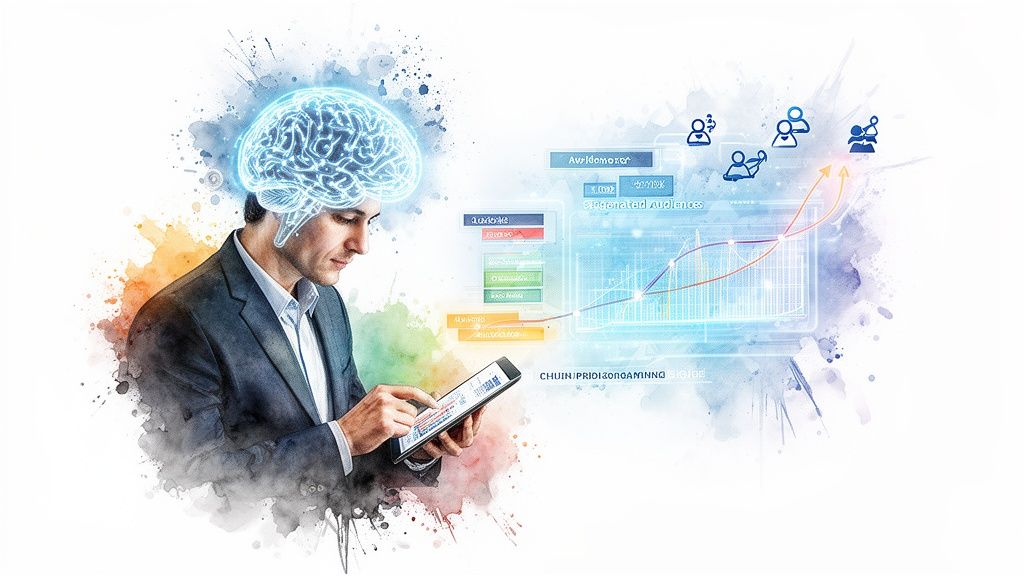
Think of AI as your team's most powerful analyst—one that never sleeps and can sift through colossal datasets in seconds. It’s brilliant at spotting the subtle patterns and correlations in customer behavior that a human team, no matter how skilled, might easily miss. This is how you shift from simply reacting to data to proactively predicting what your customers will do next.
From Manual Analysis to Automated Insight
One of the biggest game-changers AI brings is automating the discovery of high-value audience segments. While a data analyst might manually build segments based on a handful of variables, a machine learning algorithm can analyze hundreds of attributes at once. It can pinpoint clusters of users with a high likelihood to convert or churn, letting you build hyper-targeted campaigns with surgical accuracy.
This automation frees your team from the tedious, time-consuming grind of data processing. Instead of spending their days drowning in spreadsheets, they can focus on what they do best: strategic thinking, creative problem-solving, and building genuinely innovative campaigns. The result is a more efficient, agile, and impactful marketing operation. We dive deeper into this process in our guide on building an AI strategy for content creation.
Practical AI Applications in Marketing
AI isn't just about finding audiences; it's about engaging them in more meaningful ways. The practical applications are already transforming how brands connect with customers, making every single interaction smarter and more relevant.
Here are a few powerful examples of data driven marketing strategies powered by AI today:
Predictive Churn Modeling: AI can analyze customer behavior, support ticket history, and product usage data to flag which customers are at risk of leaving. This gives you a crucial window to step in with targeted retention campaigns before they walk away.
Dynamic Creative Optimization (DCO): Instead of blasting everyone with the same ad, DCO uses AI to assemble the best combination of headlines, images, and calls-to-action in real-time for each individual user, all based on their unique data profile.
Personalized Content Recommendations: Similar to how Netflix suggests what to watch next, AI can power recommendation engines on your website or in your emails, serving up the most relevant blog posts, products, or services to each visitor.
This isn't just a niche trend; it's rapidly becoming standard practice. UK brands are leaning in hard, with 37% of businesses already using AI for marketing automation and planning to do even more. This reflects a fundamental shift in how we optimize campaigns and target audiences. For more on this, refer to these UK digital marketing statistics at localiq.co.uk.
By integrating AI, marketers can move beyond historical analysis to predictive and prescriptive analytics, essentially forecasting future trends and recommending the best course of action to achieve specific business goals.
Ultimately, AI supercharges your marketing by making every decision smarter. It amplifies the impact of your data, automates complex work, and unlocks a level of personalization that was previously impossible to achieve at scale. It ensures your marketing isn't just data-informed, but truly data-intelligent.
Real World Examples of Data-Driven Success
Theory is great, but let's be honest—it’s seeing the tangible business results that really brings the power of data-driven marketing to life. Abstract ideas click into place when you can connect them to real-world growth. Let's break down how three very different companies turned raw data into a serious competitive advantage.
Each story is simple: the problem they were up against, the data-backed solution they put in place, and the impressive results that followed. These aren't just hypotheticals; they show how insights unlock growth, no matter your business model.
How a SaaS Company Tripled Conversions
A fast-growing SaaS company had a problem many founders know well: plenty of users were signing up for free trials, but only a trickle were converting into paying customers. Their onboarding was a one-size-fits-all tour of the product, and they quickly realized it was failing to connect with the diverse needs of their new users. It was the classic leaky bucket, and they were pouring marketing money into the top only to lose customers before they’d even had their “aha!” moment.
Instead of guessing what to fix, they dug into their user engagement data. By tracking in-app behavior during the trial, they started to see a pattern. They identified the specific actions that strongly correlated with a user eventually pulling out their credit card. They found that users who integrated a particular third-party tool and invited at least two team members within the first three days were 80% more likely to subscribe.
Armed with this critical insight, they completely tore down their old onboarding. They built out personalized email sequences and in-app tooltips that nudged new users directly toward these high-value actions. The solution was surprisingly simple but profound: stop showing everyone everything and start guiding each type of user to their specific moment of value.
The results were game-changing. By focusing on data-backed activation points, they tripled their trial-to-paid conversion rate in just six months, entirely changing their growth trajectory for the better.
Shortening the B2B Sales Cycle
A B2B tech firm was stuck with a long, inefficient sales process. Their sales team treated every lead the same, spending just as much time on a curious tyre-kicker as they did on a decision-maker ready to sign a contract. This lack of focus led to a bloated pipeline, a sales cycle that dragged on for over nine months, and countless hours wasted on leads that were never going to close.
The marketing and sales teams got together to build a predictive lead scoring model. They analyzed historical data from their CRM and marketing automation platform, pinpointing the common attributes and behaviors of leads that turned into their best customers. This included things like company size, industry, specific website pages visited, content downloads, and email engagement.
The model assigned a score to every new lead, giving the sales team an instant way to identify and prioritize the hottest prospects. Low-scoring leads went into automated nurturing campaigns, while high-scoring leads got immediate, personal outreach from a sales rep.
This data-driven focus let the sales team put their energy where it actually mattered. By engaging the right leads at the right time with the right message, they shortened their average sales cycle by 40% and saw a giant jump in overall sales productivity.
Achieving a 5x ROAS in Social Commerce
A direct-to-consumer (D2C) brand was pumping money into social media ads but getting lackluster returns. Their campaigns were aimed at broad audiences, which meant high ad spend for very few conversions. They knew they had to get smarter with their social commerce strategy to reach shoppers who were genuinely interested in what they were selling.
The team got to work integrating their e-commerce platform with social media audience data. This allowed them to create incredibly detailed customer segments based on purchase history, browsing behavior, and social engagement. They could finally move beyond generic ads and create hyper-relevant campaigns for specific micro-segments. For example, they could now run retargeting ads showing people the exact products they’d looked at but hadn't bought.
This is a channel you can't afford to get wrong; the UK social media advertising market is projected to hit £9.95 billion in revenue by 2025. And with purchase intent from influencer recommendations as high as 75%, a smart data strategy is non-negotiable. You can find more UK social media trends on sproutsocial.com.
By using this precise audience data, the D2C brand didn't just nudge their numbers up—they achieved a 5x return on ad spend (ROAS) and significantly boosted their customer lifetime value.
Your Roadmap to Data-Driven Mastery
Jumping into a data-driven strategy can feel like a massive undertaking, but it always begins with a single, manageable step. The real challenge is moving from theory to practice, and that requires a clear plan—one focused on small victories that build momentum and prove the value of your efforts. Forget trying to boil the ocean; start with a pilot project instead.
Pinpoint one specific, high-impact area where data can make an obvious difference. This could be anything from improving the conversion rate on a crucial landing page to chipping away at churn in a particular customer segment. Pour your resources into this one objective and lock in an early win.
A successful pilot does more than just prove the concept; it builds the business case for wider adoption. It's a straightforward process of turning a well-defined problem into a measurable result.
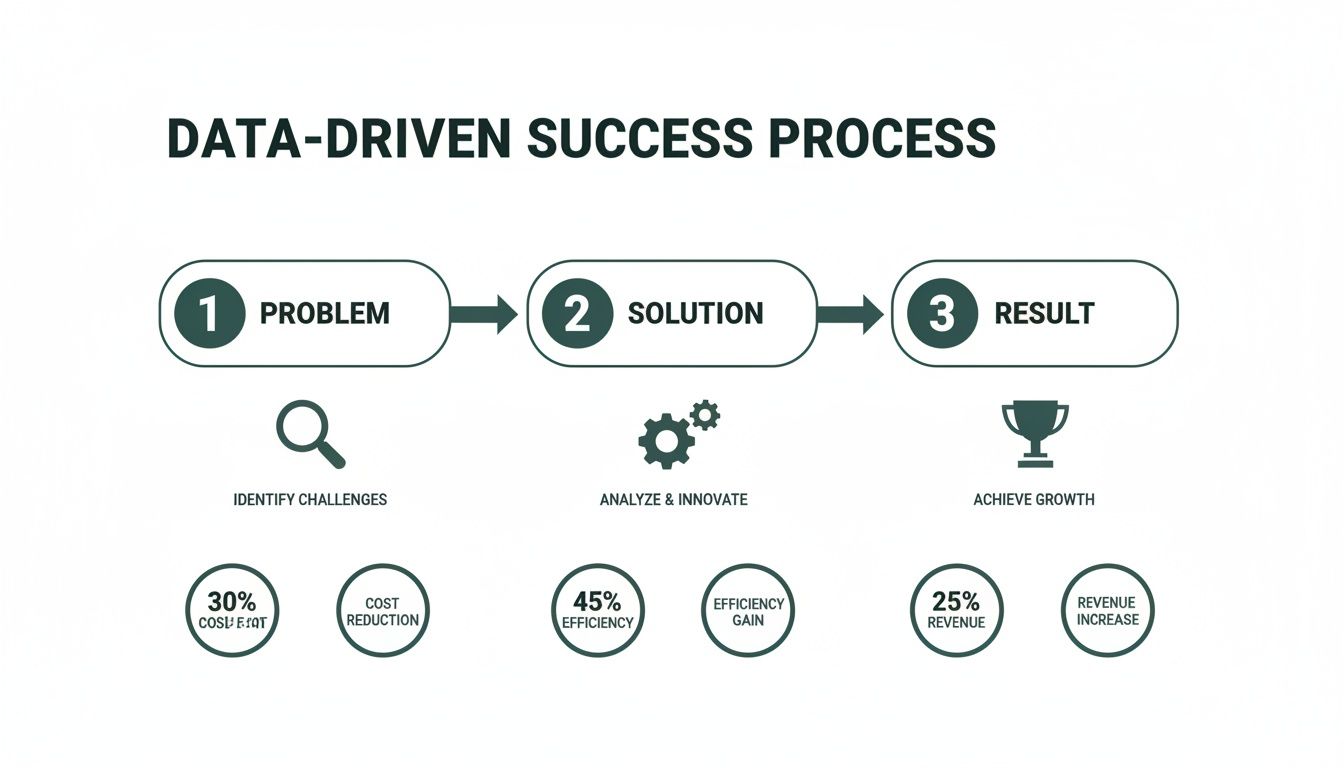
As the infographic shows, successful data-driven marketing strategies follow a simple flow: identify a problem, implement a solution, and achieve a tangible outcome. With that initial success under your belt, you can start building a true culture of experimentation.
Fostering a Culture of Experimentation
True data mastery isn't just about tools; it's a mindset. It’s about creating a culture where testing and learning are celebrated, even when a hypothesis doesn't pan out. Every outcome, win or lose, delivers valuable insights that make your next move smarter.
Encourage your team to ask tough questions and challenge long-held assumptions with hard data.
The goal is to move from "we think" to "we know." This cultural shift transforms your organization into a learning machine, where continuous improvement is woven into the fabric of every marketing activity.
Kick things off with a simple A/B testing framework for your email campaigns or ad creative. Share the results openly, highlighting what was learned from both the winning and losing variations.
As your team’s confidence grows, you can start scaling these initiatives. The successful experiments from your pilot project can be rolled out to larger audiences or applied to other marketing channels. This methodical approach—prove, learn, and scale—is the most effective way to build a powerful, intelligent marketing engine that consistently delivers exceptional results.
At Ryesing Limited, we build and execute data-driven growth programs that deliver measurable results. Our blend of strategic expertise and AI-enabled workflows helps impactful brands scale sustainably. Learn how we can build your growth engine.
Data-Driven Marketing Strategies Frequently Asked Questions
Jumping into a data-driven approach always brings up a few good questions. It's only natural. Getting these common concerns sorted out from the get-go is the key to building a strategy that actually works and lasts. Let's tackle some of the most common queries we hear from marketing leaders trying to implement data driven marketing strategies.
Think of this as your practical cheat sheet to get past the usual roadblocks and keep your team focused on what genuinely drives growth.
How Can We Start with a Small Team and Limited Budget?
Starting small isn’t just possible; it’s actually the smartest way to go. You don't need a giant team or a massive budget to start making better, data-informed decisions. The trick is to focus on low-cost, high-impact activities that show real value right away.
Begin with the data you already have—it's a goldmine. Your website analytics, CRM, and email platform are sitting there, full of insights.
Master Google Analytics: This free tool is incredibly powerful. Get comfortable with it to understand where your traffic is coming from, how people behave on your site, and what content is actually working.
Leverage Your CRM: Dive into your existing customer data. Figure out who your most valuable customers are and what they have in common.
Optimize Email Marketing: You can learn so much without spending an extra penny. Start A/B testing your subject lines and calls-to-action to see what your audience responds to.
By starting here, you build a rock-solid business case for more investment, backed by proven results, not just hopeful projections.
What Are the Most Common Pitfalls to Avoid?
Even with the best of intentions, a few common traps can sink a data-driven strategy before it even gets going. Just being aware of them is half the battle.
One of the biggest mistakes we see is getting obsessed with vanity metrics. Sure, high traffic numbers or a spike in social media likes feel great, but they don't pay the bills. You always have to tie your efforts back to core business goals like lead generation, customer acquisition cost, and lifetime value.
Three major dangers to keep on your radar are:
Data Silos: When your data is stuck in different departmental spreadsheets (sales has one, marketing has another), you never get the full picture of the customer journey. It’s like trying to solve a puzzle with half the pieces missing.
Analysis Paralysis: Drowning in data without clear questions leads to endless number-crunching and zero action. Always start with a specific business problem you're trying to solve.
Ignoring Data Quality: Making big decisions based on bad data is often far worse than just going with your gut. Inaccurate or incomplete information will lead you in the wrong direction, every time.
Which KPIs Matter Most for Different Business Models?
The key performance indicators (KPIs) you track absolutely must align with your business model. Measuring the wrong things is the fastest way to optimize for outcomes that do nothing for your bottom line.
For SaaS Companies: Your world revolves around recurring revenue. Focus on Monthly Recurring Revenue (MRR), Customer Churn Rate, and Customer Lifetime Value (LTV).
For E-commerce brands, it's all about transactions. Prioritize conversion rate, average order value (AOV), and Return on Ad Spend (ROAS).
For B2B companies, The sales funnel is king. Track Marketing Qualified Leads (MQLs), Sales Qualified Leads (SQLs), and the Length of the Sales Cycle.
Choosing the right KPIs keeps your team laser-focused on the activities that directly contribute to sustainable, profitable growth.


