
Go-to-Market Strategy Template: Your Essential Product Launch Playbook

Updated: Apr 25
Most GTM strategy templates fail at the moment you try to use them. They look comprehensive in a blog post and fall apart the second you open a blank Google Doc to fill one out, too abstract, too vague, with sections like "define your positioning" that offer no actual structure for doing that.
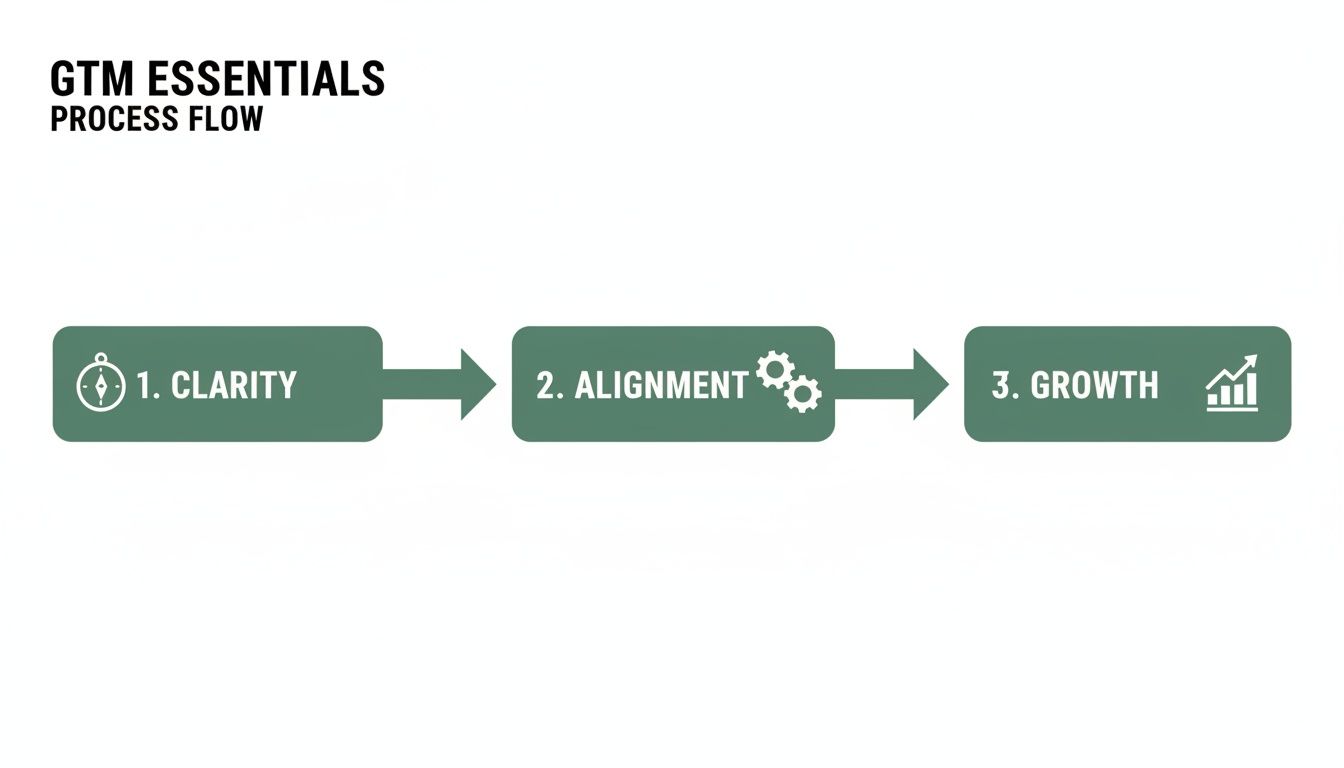
This template is different. Each section has a clear purpose, a set of specific questions to answer, and a format you can fill in directly. Work through it in order. The sections build on each other, your ICP informs your value proposition, your value proposition informs your channel selection, your channels inform your budget and KPIs.
If you want the strategic context behind the framework, why each section matters, how PLG vs SLG affects your choices, what NRR means and how to track it, the full SaaS GTM strategy guide covers all of that. This post is the working document. Start here.
How to Use This Go-To-Market Template
Work through each section sequentially. Do not skip ahead to channels or budget before the ICP and value proposition are complete, those two sections are what everything else is built on.
Each section has three components:
What it is: a one-line explanation of the section's purpose.
What to fill is: the specific questions to answer and the format for your answers.
Common mistake: the most frequent error teams make in this section and how to avoid it.
Plan for two to three working sessions to complete the full template. The ICP section alone usually takes a full session if done properly. That is not a design flaw, it is the most important section in the document, and the time spent there pays back across every other section.
Section 1: Ideal Customer Profile (ICP)
What it is: A precise description of the company and buyer most likely to get maximum value from your product and convert efficiently into revenue.
What to fill in:
Attribute | Your Answer |
Target industry / sector | |
Company size (headcount) | |
Company size (revenue or ARR) | |
Geography | |
Tech stack they already use | |
Job title making the decision | |
Job title influencing the decision | |
Primary pain they are trying to solve | |
Trigger event that makes them search now | |
Outcome they need to achieve this quarter | |
Top three objections before they buy | |
Where they go for professional information |
Completed example (UK B2B SaaS):
Attribute | Example Answer |
Target industry | Creative and digital agencies |
Company size (headcount) | 15-50 employees |
Company size (revenue) | £1M-£5M ARR |
Geography | UK — London, Manchester, Leeds |
Tech stack | HubSpot CRM, Asana, Xero |
Decision maker | Operations Director or Managing Director |
Decision influencer | Head of Client Services |
Primary pain | Inaccurate project budget tracking, scope creep eating into margins |
Buying trigger | Lost a major client due to delivery failure, or hired a new Ops Director |
Outcome needed | 15% improvement in project profitability within one quarter |
Top objections | "We already use Asana," "We don't have budget right now," "Our team won't adopt it" |
Information sources | UK Agency Owners Slack, The Drum, BrightonSEO |
Common mistake: Completing this section with aspirational answers rather than validated ones. Every row should be based on at least five conversations with real buyers, not on what your founding team assumes. If you have not spoken to ten potential customers yet, pause here and do that first. The template will not work if the ICP is built on guesswork.
Section 2: Value Proposition
What it is: A single, clear statement of why a buyer in your ICP would choose your product over every alternative including doing nothing.
What to fill in:
Use this structure to build your value proposition sentence by sentence:
Component | Your Answer |
For [describe your ICP precisely] | |
Who struggle with [name the specific pain] | |
Our product [name it] is a [category] | |
That [key benefit, specific and measurable] | |
Unlike [name the alternative, not a competitor by name, but the category] | |
We [what makes you genuinely different] |
Completed example:
Component | Example |
For | Operations Directors at UK creative agencies with 15-50 people |
Who struggle with | Scope creep and inaccurate project tracking that erodes margins |
Our product is a | Project profitability platform |
That | Shows live budget vs actuals on every project, so no delivery goes over budget unnoticed |
Unlike | Spreadsheet-based tracking or generic PM tools that were not built for agency billing models |
We | Surface margin data at the task level, not just the project level |
Once you have the six components, write them into a single paragraph and read it aloud to someone who matches your ICP. If they say "that is exactly the problem I have", you are close. If they look confused or unimpressed, go back and tighten the pain or the differentiation.
Common mistake: Writing a value proposition that every competitor could also claim. "Faster, easier, more intuitive" describes nothing. If you removed your product name and replaced it with a competitor's, would the statement still be true? If yes, it is not differentiated enough.
Section 3: Competitive Positioning
What it is: A clear map of where you sit relative to the alternatives your ICP is already using or considering.
What to fill in:
Competitor / Alternative | Their Strength | Their Weakness | How You Win Against Them |
Direct competitor 1 | |||
Direct competitor 2 | |||
Indirect competitor (e.g. spreadsheets, manual process) | |||
Doing nothing / status quo |
Important: Always include "doing nothing" as a competitor. In most B2B markets, inertia is the thing you are actually competing against most of the time. Your messaging needs to make the cost of inaction visible, not just the benefit of your product.
What this section produces: One or two sentences per competitor that your sales team can use when a prospect says "we already use X." Not a defensive response, a confident, specific answer about where you win.
Common mistake: Listing competitors without talking to customers about how they evaluate the alternatives. Your competitive positioning should come from what buyers actually say they considered, not from what you think the competitive set looks like.
Section 4: Growth Model
What it is: The primary motion you will use to acquire and convert customers, Product-Led Growth (PLG), Sales-Led Growth (SLG), or a hybrid of both.
What to fill in:
Answer these four questions. Your answers will point toward the right model.
Question | Your Answer |
Can a new user experience the core value of your product within 10 minutes without speaking to anyone? | Yes / No |
Is your average contract value under £10,000 per year? | Yes / No |
Is your ICP comfortable making software purchases without a demo or sales conversation? | Yes / No |
Is your product intuitive enough that a new user can onboard themselves without documentation? | Yes / No |
Reading the results:
If you answered Yes to three or four: your primary motion should be PLG — freemium or free trial, self-serve onboarding, product as the acquisition engine.
If you answered Yes to one or two: a hybrid model, PLG for top of funnel, sales-assisted for conversion. Use the free trial or freemium to generate Product Qualified Leads (PQLs), then have a sales rep engage when usage hits a trigger threshold.
If you answered Yes to zero or one: SLG is your model. Demos, consultative sales, longer cycles. Your product requires a human to guide the buyer to value.
Key PLG metrics to track if PLG is your model:
Metric | Definition | Your Baseline | 90-Day Target |
Time to Value (TTV) | Time from signup to first meaningful action | ||
Activation Rate | % of signups who complete the core onboarding action | ||
Free-to-Paid Conversion | % of free users who upgrade to paid | ||
PQL Definition | Usage milestone that triggers a sales conversation |
Common mistake: Choosing PLG because it sounds efficient without checking whether the product actually delivers value without a guided experience. A PLG motion with a product that requires a 45-minute onboarding call to understand is not a PLG motion, it is a broken sales process.
Section 5: Channel Strategy
What it is: The specific channels you will use to reach your ICP, ranked by expected ROI for your stage, with defined experiments for each.
What to fill in:
Select a maximum of two primary channels for your first 90 days. Fill in the experiment structure for each.
Field | Channel 1 | Channel 2 |
Channel name | ||
Why this channel for this ICP | ||
Hypothesis | "We believe we can generate [X leads] at [£Y cost] by [doing Z]" | |
Budget | ||
Duration | ||
Success metric | ||
Failure threshold | "If we do not hit [X] by [date], we pause and reassess" |
Channel selection reference:
Channel | Best fit | Avoid if |
LinkedIn Ads | B2B, targeting by job title or company size, ICP is senior decision-maker | Budget under £1,500/month — minimum viable spend is too high |
Google Ads (Search) | ICP actively searches for your solution category | Problem is not well-defined enough to generate search volume |
Content and SEO | Long-term authority, educating complex buyers | You need pipeline in under 90 days — it will not deliver that fast |
Cold outbound | Very precise ICP, short personalised sequences | ICP is senior enough to be resistant to cold contact — kills brand |
Community engagement | Niche sectors with active professional communities | Mass-market ICP with no concentrated community presence |
Common mistake: Selecting channels based on personal familiarity rather than ICP fit. The channel that worked at your last company, or that you are most comfortable running, is not automatically the right channel for this product and this buyer.
Section 6: Messaging by Funnel Stage
What it is: The specific message your ICP should receive at each stage of their buying journey, not one message for everyone, but the right message at the right moment.
What to fill in:
Stage | Buyer's Question | Your Message | Content Format |
Awareness | "I have a problem but I'm not sure what to do about it" | Blog, social, community post | |
Consideration | "I'm evaluating options — what makes you different?" | Case study, comparison page, webinar | |
Decision | "I'm ready to buy — give me a reason to choose you" | Free trial, demo, ROI calculator | |
Retention | "I'm already a customer — am I getting full value?" | Onboarding email, feature announcement, check-in |
Important rule: The awareness message should not mention your product. It should address the pain. The consideration message should show proof, not just claims. The decision message should remove friction, not add more information.
Common mistake: Using the same message across all stages. A buyer who has never heard of you needs something different from a buyer who has already watched a demo. Most early-stage teams send the same content to everyone because it is easier, and wonder why conversion rates are low.

Section 7: Marketing and Sales Alignment (SLA)
What it is: The shared definitions that prevent the most common growth killer marketing and sales operating from different assumptions about what a good lead looks like.
What to fill in:
Definition | Your Answer |
MQL definition — what action qualifies a lead for marketing follow-up | |
SQL definition — what criteria must sales confirm before accepting a lead | |
PQL definition — what product usage milestone triggers a sales conversation | |
Lead handover process — exact steps from MQL to sales outreach | |
Follow-up SLA — how quickly must sales act on a new MQL | |
Disqualification criteria — what makes a lead not worth pursuing |
Common mistake: Skipping this section because "we're a small team and we talk to each other." The SLA matters most at small teams, when marketing and sales are one or two people, undocumented assumptions create invisible friction. Writing it down forces clarity that verbal agreement does not. check out HubSpot marketing and sales SLA guide
Section 8: KPIs and 90-Day Review
What it is: The three to five metrics that will tell you in 90 days whether the GTM is working, and the review process to act on what you learn.
What to fill in:
The five metrics worth tracking at early stage:
Customer Acquisition Cost (CAC): Total sales and marketing spend divided by new customers acquired. The benchmark varies by model, PLG companies typically run significantly lower CAC than SLG because the product does more of the acquisition work.
Activation Rate: Percentage of signups who complete the action that signals they have experienced core product value. For a project management tool, that might be creating a first project and inviting a team member.
Free-to-Paid Conversion Rate: For PLG models, this is the clearest signal of whether the product is delivering enough value to justify payment. Industry benchmark for B2B SaaS freemium is 2-5%. Free trial conversion benchmarks run higher, typically 15-25%.
Pipeline Velocity: How fast deals move from first contact to close. If velocity is slowing, the problem is usually in messaging or qualification, not in the product.
Net Revenue Retention (NRR): Total revenue from existing customers including upgrades, downgrades, and churn. NRR above 100% means your existing customers are worth more this month than last month, a strong signal that your product delivers ongoing value.
90-Day review process: Schedule a review at day 30, day 60, and day 90. At each review, answer three questions: Which assumptions in the GTM have been confirmed by data? Which have been contradicted? What changes in the next period? Update the template after every review. A GTM strategy that has not been updated after 90 days of data is a document, not a strategy.
Conclusion: Your Essential Product Launch Playbook
This template gives you the structure. The quality of your output depends on the quality of your inputs, specifically on how much time you invest in the ICP section before moving on to everything else.
If you are working through this and want the full strategic context, why each section matters, how PLG and SLG interact, what good looks like at each growth stage, the complete SaaS GTM strategy guide covers all of it in depth. → Read the Complete SaaS GTM Strategy Guide
If you are a UK founder at pre-revenue or early stage and want a version of this framework built specifically for the British market, including channel benchmarks, budget guidance, and UK-specific buyer behaviour — the UK startup GTM guide has that. → Read the UK Startup GTM Guide
And if you want Ryesing to work through this with you directly, running the diagnostic, facilitating the ICP interviews, and building the positioning, that is what our GTM consulting engagement is built for. → Book a discovery call
How is a Go-to-Market (GTM) Strategy different from a Marketing Plan?
A GTM strategy is a focused, one-off campaign designed for a specific event like launching a new product or entering a new market, coordinating product, sales, and customer success. A marketing plan is an ongoing, continuous effort to promote your brand and products, typically on a quarterly or annual cycle.
How long should a GTM Strategy take to create?
The duration varies with scope. For a startup's first product, a solid GTM plan might take two to four weeks. For larger companies entering new international markets, it could extend to two or three months due to extensive research and stakeholder alignment.
When should we start building our GTM Strategy?
Ideally, GTM strategy planning should begin during the mid-to-late stages of product development. This allows insights from competitive analysis and early customer conversations to feed directly back into product development and refine the user onboarding experience.
What is the biggest mistake companies make with their GTM Strategy?
The most common mistake is a lack of true alignment between sales, marketing, and product teams. This often leads to different understandings of the Ideal Customer Profile (ICP), mismatched goals, and broken communication, hindering launch momentum.
What are the key metrics for measuring GTM success?
Crucial metrics include Customer Acquisition Cost (CAC), Customer Lifetime Value (LTV), and the LTV to CAC Ratio (ideally 3:1 or higher). Monitoring the CAC Payback Period is also vital for managing cash flow, with under 12 months generally considered excellent for venture-backed SaaS businesses.


