
How to Create a Content Calendar That Drives Growth

Updated: Apr 23
Before you even touch a spreadsheet or a fancy software tool, we need to talk strategy. A truly effective content calendar is built on a solid foundation, and skipping this part is the number one reason they fail.
Many teams fall into the trap of just… creating content. They chase vanity metrics like page views, pumping out articles without any real connection to business growth. It's what I call “random acts of content,” and it's a fast track to burnout with very little to show for it.
The strongest, most effective content calendars are anchored directly to measurable business goals—things like generating qualified leads, improving customer retention, or boosting demand. Getting this foundation right is the first step in creating a content calendar that actually moves the needle. It's the difference between a simple to-do list and a powerful growth engine.
Pinpoint Your Core Content Pillars
First things first, let's define your content pillars. These are the 3-5 big-picture topics your brand is going to own. Think of them as your core subject areas—the conversations you want to dominate. They should sit right at the intersection of your customers' greatest challenges and your product's solutions.
For a SaaS company that sells project management software, the pillars might look something like this:
Agile Methodologies: Covering everything from Scrum basics to advanced Kanban techniques.
Team Productivity: Focusing on efficiency, collaboration tools, and workflow optimisation.
Leadership & Management: Providing insights for managers on leading successful project teams.
These pillars become your filter. If a new content idea doesn't fit neatly under one of them, it’s probably a distraction. This laser focus is what helps you build topical authority, which is absolutely critical for SEO and for establishing your brand as the go-to resource in your space.
A classic mistake is choosing pillars that are way too broad or, even worse, just thinly veiled sales pitches for your product. Your pillars need to serve your audience first. Ask yourself: what problems do we want to be known for solving?
Map Pillars to the Customer Journey
Once you have your pillars, the next move is to map them across the customer journey. Someone in the UK who is just starting to realise they have a problem needs something very different from someone who is ready to buy. Your content has to meet them exactly where they are.
Let's break it down:
Awareness Stage: At this point, people are aware of their problem but not necessarily your solution. Your content should be educational and high-level. Think blog posts like, “Common Project Management Bottlenecks and How to Fix Them.”
Consideration Stage: Now, they’re actively looking for and comparing solutions. This is where you can get more specific with detailed guides, webinars, or case studies that show how similar companies solved their issues using your approach.
Decision Stage: Finally, they're ready to make a choice. This is where you can be more direct and product-focused. Content like demo videos, pricing comparisons, or implementation guides works brilliantly here.
This mapping process ensures you have a balanced diet of content that can nurture someone from a casual reader into a paying customer. It's a core piece of any high-performing content strategy. You can dive deeper into building out this kind of framework in our guide on developing a content strategy that builds authority.
Mapping Business Goals to Content Objectives
To make this even more concrete, it helps to explicitly connect your high-level business goals to tangible content objectives and the metrics you'll use to track them. This table provides a quick reference for how this might look for a typical SaaS or B2B company.
Business Goal | Content Objective | Primary KPI |
|---|---|---|
Increase Brand Awareness | Grow organic traffic and brand visibility | Organic traffic, keyword rankings, share of voice |
Generate More Leads | Capture qualified leads for the sales pipeline | MQLs, SQLs, content downloads, demo requests |
Improve Customer Retention | Educate and support existing customers | Customer churn rate, product adoption rate, support ticket volume |
Establish Thought Leadership | Build authority and trust within the industry | Backlinks, media mentions, social engagement |
Drive Product Sign-ups | Convert website visitors into new users | Free trial sign-ups, conversion rate from visitor to user |
Using a simple map like this ensures that every piece of content you plan has a clear “why” behind it. It keeps the entire team aligned and focused on activities that contribute directly to the bottom line, turning your content calendar from a document into a strategic asset.
Mapping Your Content Ecosystem and Cadence
Alright, with your strategy locked in, it’s time to zoom out and map your entire content ecosystem. This is where we move beyond a simple list of blog post ideas and start thinking like a media company. It’s about understanding how every article, video, and social post works together to create a cohesive brand experience that guides people from curious stranger to happy customer.
Think of your core strategy—your goals, pillars, and customer journey—as the sun in your content solar system. Everything you create should be in its orbit.
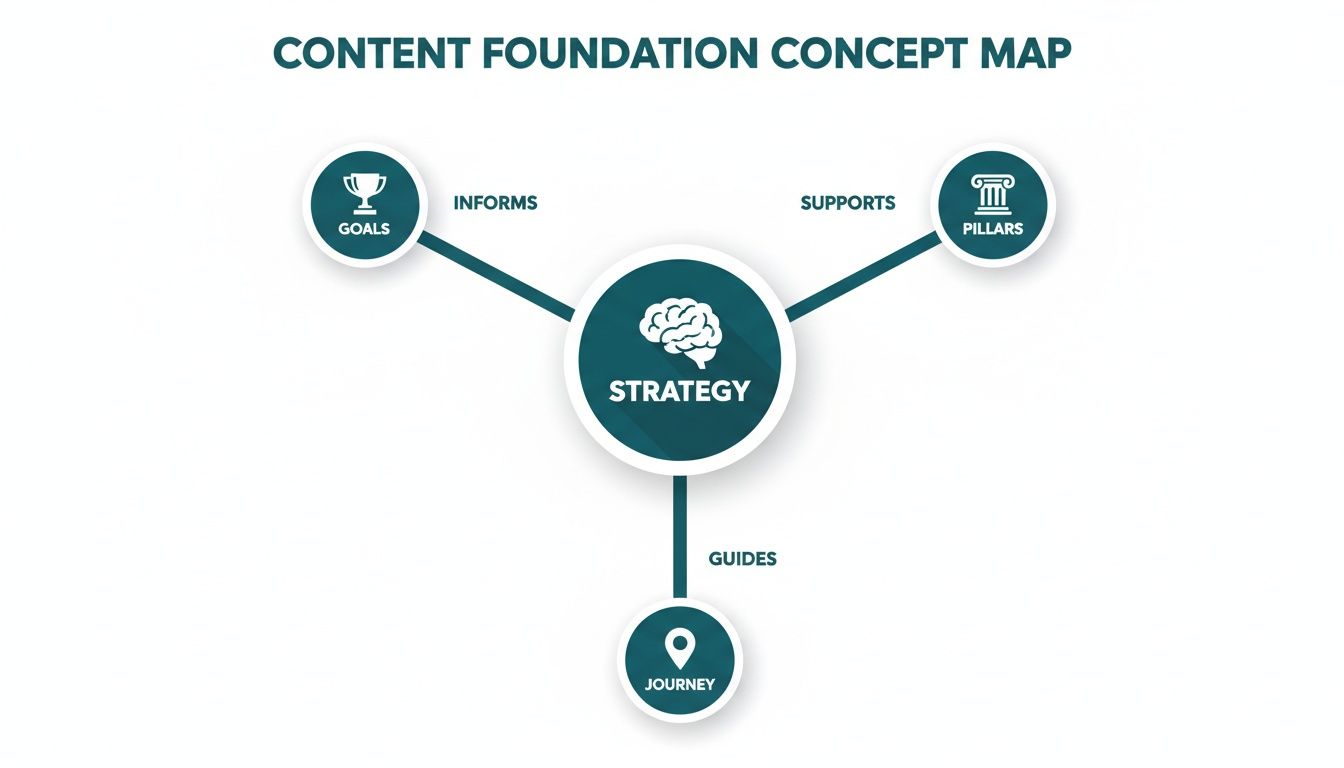
As the map shows, every piece of content needs a clear purpose. It must support a pillar, speak to a specific stage in the customer's journey, and ultimately, push you closer to your business goals. No exceptions.
First, Audit Your Existing Content Landscape
Before you jump into creating anything new, you need to take stock of what you’ve already got. A content audit isn't just a bit of spring-cleaning; it’s a strategic hunt for hidden gems and gaping holes. For a fast-moving SaaS team, this exercise is often surprisingly revealing.
Start by cataloguing your main assets: blog posts, case studies, webinars, white papers—the lot. For each one, tag it with its content pillar, the customer journey stage it targets, and any performance data you have (traffic, leads, social shares). This simple inventory will quickly show you where you’re strong and where you’re thin on the ground.
You might find your blog is packed with top-of-funnel, awareness-stage content, but has almost nothing for someone in the consideration stage. That’s not a failure. It’s a crystal-clear, actionable insight your new content calendar is going to fix.
An audit gives you permission to stop creating content that isn’t working and to double down on what is. It's also the perfect time to spot high-performing articles you can update or slice and dice into new formats, saving you a huge amount of time and effort down the line.
Aligning Content Formats to the Right Channels
Not all content is created equal, and neither are your distribution channels. The secret is to play to the strengths of each platform. When you map the right formats to the right channels, your message lands with so much more impact.
Here’s how that might look for a B2B tech company:
The Blog: This is your home turf, the library where you build topic clusters and prove your expertise. It’s perfect for long-form articles, deep-dive tutorials, and comprehensive guides that build SEO authority. We’ve written a whole guide on how to use topic clusters in your content strategy if you want to go deeper.
LinkedIn: The place for sharp, professional insights. Share key takeaways from your blog posts, short video clips, and text-based posts that kickstart industry conversations.
YouTube: This is your stage for long-form video. It’s ideal for hosting webinar replays, product demos, and in-depth tutorials that bring your expertise to life visually.
Email Newsletter: Use this channel to nurture your audience. Send a curated mix of your best content, exclusive insights, and company news directly to their inbox.
For businesses here in the UK, getting this channel strategy right is crucial. The social media advertising market is projected to hit £9.95 billion by 2025. UK firms that blog regularly already see 55% more website traffic and 67% more leads. Aligning your formats and channels is the first step to capturing that growth.
Setting a Realistic and Sustainable Publishing Cadence
Finally, let’s talk about frequency. It’s so tempting to aim for a daily publishing schedule, but I’ll tell you from experience: consistency trumps volume every single time. A realistic cadence is one your team can actually sustain without burning out, while still keeping your audience engaged.
Start by being brutally honest about your resources. A one-person marketing team simply can't operate like a 20-person department.
For a small B2B team, a sensible starting point could look like this:
1-2 in-depth blog posts per month.
3-4 LinkedIn posts per week (repurposing heavily from the blog).
1 monthly newsletter.
1 quarterly webinar or major content asset (like an ebook).
This schedule provides a steady drumbeat of valuable content across your key channels. It's enough to build momentum and stay on your audience's radar without overwhelming your team. You can always scale up as you grow, but starting with a manageable rhythm is the key to long-term success. Your content calendar is what holds this entire ecosystem together, turning your big-picture strategy into a clear, actionable plan.
Choosing Your Tools and Building Your Template
With your strategy mapped out, it's time to give your plan a home. This is where abstract ideas and ambitious goals become a tangible, working tool. Picking the right platform and building a smart template is what transforms your content calendar from a simple document into your team's central command centre.
First things first, you need to decide where this calendar will live. The good news is, you don't need a complex or expensive solution to get started. Many fast-moving teams I've worked with do just fine with a flexible spreadsheet in Google Sheets or a powerful database in Notion. They're customisable, collaborative, and probably already part of your workflow.
However, as you grow, you might find yourself needing more firepower. That’s when dedicated platforms like Asana, Monday.com, or CoSchedule start to shine. They offer advanced workflow automation and reporting that can save you a ton of time.
Ultimately, the specific tool is less important than how you structure it. The goal is to create a single source of truth that’s clear, comprehensive, and easy for everyone to use.

A well-built template is the engine of your content operation. It should go way beyond just the topic and due date. Each field you add is a chance to bake your strategy directly into your workflow, forcing everyone to think critically before a single word is written.
Here's a breakdown of the fields I've found to be the most effective, separating the must-haves from the nice-to-haves.
Essential vs Advanced Content Calendar Fields
Field Name | Purpose | Benefit |
|---|---|---|
Topic/Headline | The working title of the content piece. | Provides immediate clarity on the content's subject. |
Content Pillar | Links the content to a core strategic theme. | Ensures every piece supports your overarching strategy. |
Funnel Stage | Identifies the target audience's stage (Awareness, etc.). | Guarantees a balanced mix of content across the buyer's journey. |
Target Keyword | The primary SEO keyword being targeted. | Keeps SEO front-and-centre in the content creation process. |
Format | Specifies the content type (Blog Post, Video, etc.). | Helps in planning resource allocation and channel strategy. |
Channel | The primary publication destination (Blog, YouTube, etc.). | Clarifies where the content will live and how it will be promoted. |
Owner | Assigns a single person responsible for completion. | Creates clear accountability and prevents tasks from falling through the cracks. |
Due Date | The target publication date. | Keeps the team on track and maintains a consistent publishing cadence. |
Status | Tracks progress (Ideation, Drafting, Review, etc.). | Offers a quick, at-a-glance view of the entire content pipeline. |
Campaign/Initiative | Links content to a specific marketing campaign. | Advanced: Aligns content with broader business goals like product launches. |
Performance Metrics | A link to the published piece or its analytics report. | Advanced: Turns the calendar into a performance dashboard for easy review. |
Repurposing Notes | Ideas for atomising the core piece into smaller assets. | Advanced: Maximises the value of each content piece by planning for reuse. |
Starting with the essential fields ensures every idea is immediately tied to your strategy. You can see at a glance if you have a healthy mix of content across your pillars and the customer journey, preventing the common trap of over-indexing on one area.
A well-structured template isn’t about bureaucracy; it’s about clarity. When every field has a purpose, it forces your team to think strategically about every single piece of content before a single word is written.
Once your team has mastered the basics, layering in the advanced fields can provide even deeper insight. Linking content to a specific campaign like a “Q3 Product Launch” or adding a field for “Repurposing Notes” transforms your calendar from a simple planning tool into a powerful performance and campaign management hub. For more on this, take a look at our 2026 social media calendar blueprint.
Getting this structure right is non-negotiable. UK content marketing statistics indicate that while 65% of marketers use content, only those with a documented calendar see a 33% higher return on investment. With UK tech firms allocating up to 33% of their total marketing budget to content, a meticulously organised calendar is the key to maximising that significant spend.
Defining Roles and Streamlining Your Workflow
A brilliant content calendar is one thing; bringing it to life is another beast entirely. It’s only as good as the team and the process behind it. Without crystal-clear ownership and a workflow that actually flows, even the most strategic plans will buckle under the pressure of deadlines and last-minute requests. This is where you build the operational engine that turns your calendar from a static document into a steady stream of killer content.
It all boils down to knowing who does what. In today's content teams, especially in the fast-paced world of SaaS and B2B, roles can get a bit blurry. That's fine, but you absolutely need to define primary responsibilities to dodge bottlenecks and chaos. A well-oiled content machine has clear swim lanes, ensuring every piece moves smoothly from one stage to the next.

Assigning Key Content Roles and Responsibilities
While job titles vary, the core functions in a content workflow are pretty much universal. Getting these roles documented means everyone knows exactly what’s expected of them and when.
Here are the usual suspects and what they own:
Content Strategist: The architect. They’re in charge of the big picture—conducting keyword and topic research, populating the calendar with detailed briefs, and making sure every single piece of content serves a business goal.
Content Writer/Creator: The builder. This is the person (or team) who actually drafts the content, whether it’s a blog post, a video script, or social copy. They bring the strategist's brief to life.
Editor/Proofreader: The quality inspector. They’re the final gatekeeper, polishing drafts for clarity, accuracy, tone of voice, and grammar. Their job is to elevate the raw material into something that meets the brand’s high standards.
Designer/Visuals Specialist: The artist. They handle all the visuals that make content engaging—blog headers, infographics, social graphics, and video thumbnails.
For smaller teams, it’s common for one person to wear a few of these hats. That's totally normal. The trick is to be explicit about which hat they're wearing at each stage of the process.
The most common point of failure I see is a lack of a single, designated owner for each content piece. When everyone is responsible, no one is. Assigning one person to shepherd a piece from start to finish is the single best way to ensure it gets published on time.
Crafting a Bottleneck-Free Approval Process
A clunky, bureaucratic approval process is the sworn enemy of momentum. Your goal should be a workflow that ensures quality and gets stakeholder buy-in without grinding production to a halt. A simple, three-stage process usually does the trick.
Brief Approval: The strategist nails down the content brief in the calendar, detailing the topic, target keyword, angle, and main talking points. This brief gets a thumbs-up from the Head of Marketing before a single word is written. This simple step prevents countless wasted hours on ideas that aren't strategically sound.
Draft Review: Once the first draft is done, it goes straight to the editor. The editor and writer collaborate to get it polished. Only then does it get shared with one or two key stakeholders (like a product expert) for a final check on accuracy and messaging.
Final Sign-off: After stakeholder feedback is worked in, the editor gives it one last look before it’s scheduled for publication.
Limiting the number of “approvers” is crucial. Too many cooks don't just slow things down; they water down the message. Trust your content experts to do their jobs.
Integrating AI to Accelerate Your Workflow
Artificial intelligence has moved from a buzzword to a powerful co-pilot for content teams. Weaving AI into your workflow can massively speed up the early stages of production, freeing up your team to focus on strategy, creativity, and adding those unique human insights that AI can’t replicate.
For instance, if you're building a content calendar for UK markets, you have to acknowledge the dominance of video in 2025. Blog posts now rank third (38%) behind short-form (60%) and long-form video. For enterprise teams, this means scheduling AI-personalised content—45% of UK marketers are already using AI, with another 19% planning to jump in. AI can also help create infographics, which are 30x more readable and can deliver a 12% traffic boost. You can dig into more of these marketing statistics on HubSpot's research page.
Here’s a real-world example of what an AI-powered workflow looks like:
AI-Generated Briefs: A content strategist uses an AI tool to analyse the top-ranking articles for a target keyword. The AI then spits out a comprehensive brief, complete with a suggested outline, key questions to answer, and competitor angles. The strategist then refines this with their own expertise and strategic direction.
AI-Assisted First Drafts: The writer takes the AI-generated brief and uses it to prompt an AI writing assistant, like Jasper or Copy.ai, to create a first draft. This gives them a solid starting point, handling much of the foundational research and structure.
Human-Led Refinement: The writer's role shifts from staring at a blank page to editing, refining, and injecting personal stories, expert opinions, and unique data into the AI draft. This blend of AI speed and human creativity produces top-tier content in a fraction of the time.
This approach doesn't replace your team; it supercharges them. By automating the grunt work, you empower your most valuable resources—your people—to focus on the strategic and creative work that truly moves the needle.
Measuring Success and Iterating for Growth
Your content calendar should never be a static plan, set in stone and followed blindly. The most powerful calendars are living documents—dynamic tools that evolve based on real-world performance. This is where you close the loop.
You move from creation to analysis to optimisation, transforming your calendar from a simple schedule into a genuine engine for growth.
To do this right, you need to look beyond the surface. Page views and social likes are nice vanity metrics, but they don't pay the bills. The real measure of success for any B2B or SaaS content strategy is its direct impact on business goals.
Focus on Metrics That Truly Matter
Vanity metrics can feel good, but they often mask a lack of real progress. Instead, you need to anchor your analysis to key performance indicators (KPIs) that connect directly to pipeline and revenue. This is how you prove the value of your content efforts to everyone else in the business.
Here are the metrics that should live on your reporting dashboard:
Marketing-Qualified Leads (MQLs): How many leads did that specific blog post or webinar generate? This is a direct measure of your content's ability to attract the right kind of attention.
Pipeline Influence: Which content assets were consumed by prospects who later entered the sales pipeline? Using tools like HubSpot or Salesforce, you can track the touchpoints that actually influence deals.
Customer Acquisition Cost (CAC): How does your content marketing CAC stack up against other channels? Efficient, high-performing content should lower your cost to acquire new customers over time.
Conversion Rate: What percentage of visitors who read a specific article took the next step you wanted them to, like signing up for a trial or downloading a guide?
Tracking these figures turns the conversation from “how many people saw our content?” to “how much revenue did our content help generate?”. This shift is fundamental for securing budget and building a respected content function within your organisation.
Establish a Regular Review Cadence
Data is useless if you don't have a process for acting on it. A consistent review cadence is essential for turning insights into action. This isn’t about adding more meetings to the diary; it's about building a disciplined habit of reflection and adjustment.
A simple yet effective rhythm involves two key meet-ups:
The Monthly Content Review: This is your tactical check-in. The meeting focuses on the performance of individual pieces published in the last 30 days. You’ll look at what resonated, what fell flat, and identify any quick wins or adjustments for the upcoming month.
The Quarterly Strategy Review: This is your big-picture assessment. Here, you zoom out to analyse the performance of your core content pillars and channels. Are certain topics consistently driving MQLs? Is video outperforming written content for engagement?
This iterative loop of measure-analyse-adjust is what separates high-growth content teams from the rest. It allows you to systematically double down on what works and confidently cut what doesn't, ensuring your resources are always deployed for maximum impact.
Iterate and Experiment Based on Data
The insights from your reviews should directly inform how your content calendar evolves. It’s that simple.
If your data shows that case studies are driving high-quality leads, allocate more resources to producing them next quarter. If a content pillar is failing to gain traction, it might be time to pivot or completely rethink your angle.
This data-driven approach also gives you the confidence to experiment. You can test new formats—like a podcast series or an interactive quiz—and have a clear framework for judging their success. By continuously analysing performance, you transform your calendar from a rigid schedule into a smart, responsive tool that gets better and more effective over time.

Ready to build a content calendar that does more than just schedule posts? At Ryesing Limited, we help impactful brands create and execute growth-focused content strategies. Our AI-enabled workflows and deep strategic expertise turn your content into a predictable engine for acquisition and retention.
Frequently Asked Questions
What is a content calendar?
A content calendar is a strategic tool used by marketers and content creators to plan, schedule, and organise all content marketing activities. It typically includes details like content topics, formats (e.g., blog post, video), target audience, publication dates, and performance metrics. A good calendar aligns all content with business goals.
Why do I need a content calendar?
You need a content calendar to maintain consistency, improve team collaboration, and ensure your content strategy is executed effectively. It helps you stay organised, align content with marketing campaigns, identify gaps in your strategy, and save time by planning ahead.
How do I start creating a content calendar?
To start creating a content calendar, begin by defining your business goals and content pillars. Then, audit your existing content, decide on content formats and channels, and set a realistic publishing cadence. Finally, choose a tool (like a spreadsheet or project management software) and build a template with essential fields.
What should be included in a content calendar?
A basic content calendar should include the topic/headline, content format, publication channel, due date, owner, and status (e.g., in progress, published). Advanced calendars might also include the target keyword, content pillar, funnel stage, relevant campaign, and key performance metrics.
How far in advance should I plan my content calendar?
A common best practice is to plan high-level themes and major campaigns on a quarterly basis. Then, plan detailed content, including specific topics and assignments, on a monthly basis. This provides a strategic long-term view while allowing for flexibility to adapt to new trends or opportunities.
What is the best tool for a content calendar?
The best tool depends on your team's needs. Simple tools like Google Sheets are great for beginners. Project management tools like Asana, Trello, or Monday.com are ideal for growing teams needing collaboration features. Dedicated content platforms like CoSchedule offer advanced features for larger operations.

