
Sales SaaS Lead Generation: A Playbook for Selling to Skeptical Sellers

Table of Contents

Why Sales SaaS Lead Generation Is Different
Sales SaaS lead generation runs into a problem most other B2B categories never face: your buyers are sellers themselves. They recognize outreach scripts, automated sequences, and generic personalization instantly, because they use the same tactics every day in their own jobs. Their spam resistance is higher than any other B2B audience, which means the bar for relevance sits at a level most marketing teams never actually reach.
The sales tool market is also saturated. A quick search for any sales software category returns dozens of near-identical options, all promising the same outcomes. Differentiation requires demonstrating a genuine understanding of the buyer's actual workflow, not just listing features on a comparison page. Sales leaders want to know how your product fits into their existing stack, where it removes friction, and how quickly it pays for itself.
Deals in sales SaaS typically involve multiple stakeholders: the sales leader who champions the purchase, the revenue operations manager who evaluates integration fit, and the individual reps who will use the tool daily. Each persona has different priorities, which means lead generation must support multi-threaded nurture across the buying committee rather than a single message aimed at whoever happens to fill out the form.
Finally, sales tech stack fatigue is real. ZoomInfo's 2025 GTM Intelligence Report found the average B2B team now relies on tools from 23 separate vendors, and teams are actively consolidating, not adding more on top of that. Your lead generation must therefore qualify against fit, not just intent. A lead who shows interest but lacks budget authority or integration compatibility will waste your sales team's time chasing a deal that was never going to close.
The Core Lead Generation Channels for Sales SaaS
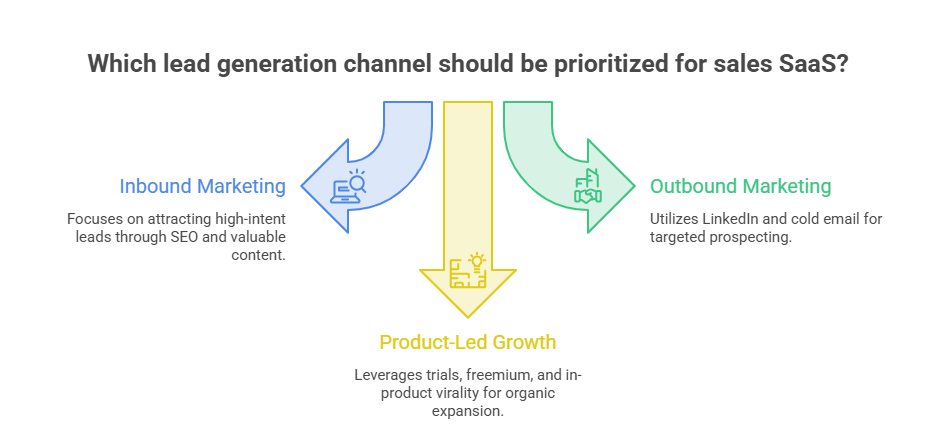
Inbound: SEO and Content That Converts
Inbound lead generation for sales SaaS starts with targeting high-intent keywords where sales leaders actively search for solutions: sales pipeline tools, CRM for sales teams, sales engagement platform. These searches signal immediate need, not casual browsing from someone with no budget behind them.
Comparison content and "alternative to" pages deserve special attention. Buyers evaluating sales software almost always compare options side by side, and pages that honestly assess strengths and weaknesses capture commercial intent at the moment of decision. This is one of the highest-converting content types in the category, precisely because it meets the buyer at the exact stage they are already in.
Original data works as a powerful lead magnet. Sales leaders love benchmarks. A report on average response times, win rates by industry, or pipeline velocity by company size gives your target audience something they cannot get elsewhere. Gate only these high-value assets, and keep the rest of your content ungated to build trust and domain authority that compounds over time rather than resetting with every campaign.
Outbound: LinkedIn and Cold Email Done Right
LinkedIn remains the dominant channel for B2B sales SaaS prospecting. Sales Navigator enables precision targeting by role, company size, and tech stack, which matters when your ideal customer is a VP of Sales at a 50-person company using a specific CRM. The platform's professional context also makes outreach feel less intrusive than cold email alone, since it arrives inside a space the buyer already associates with work rather than an inbox they use to screen out noise.
Personalization at scale is the difference between a reply and a block here. Reference the prospect's specific sales process, their current tool stack, or a piece of content they recently shared. Generic first-name and company-name personalization no longer works with this audience, because they see through it instantly. They do it themselves.
Cold email sequences should stay short: three to five touches, value-first, and focused on one clear call to action. Whether that call to action is booking a demo, downloading a resource, or taking a self-assessment, clarity beats cleverness with a buyer who has no patience for either. Pair LinkedIn engagement with email touches for a multi-channel cadence that feels coordinated rather than repetitive, since a fragmented sequence reads as automation to an audience trained to spot exactly that.
Product-Led: Trials, Freemium, and In-Product Virality
Free trials are table stakes for sales SaaS, but most companies under-optimize the activation path. The goal is getting users to the aha moment within their first session. If a new trial user does not experience the core value of your product in the first ten minutes, they will not return to find out later.
Freemium models work when the free tier solves a real pain point and naturally exposes limitations that push upgrades. The free version should be genuinely useful, not a crippled demo dressed up as generosity. Users who experience real value are far more likely to convert when they hit the paywall, because the upgrade decision is grounded in something they have already felt, not something they are being asked to imagine.
In-product prompts turn active users into a lead source on their own. Invitations to share reports, add team members, or integrate with other tools create organic expansion within an account, which is lead generation that happens without a single ad dollar spent. Track product-qualified leads separately from marketing-qualified leads, since PQLs convert at different rates and require different follow-up sequences, and treating them as interchangeable with MQLs leads to misaligned sales efforts and wasted pipeline.
FAQ: Core Channels
Which channel converts fastest for sales SaaS: inbound, outbound, or product-led?
Outbound tends to produce qualified conversations fastest, often within weeks, while inbound content takes six to twelve months to compound but produces lower-cost leads over time. Product-led motions sit in between, converting quickly once activation is solved but requiring upfront investment in the trial experience before any lead volume materializes.
Why does comparison content convert so well specifically for sales SaaS?
Because sales leaders evaluating software behave the same way they evaluate everything else in their job: side by side, against alternatives, looking for the honest tradeoffs. A comparison page that acknowledges real weaknesses alongside strengths matches how this specific buyer already thinks, which builds more trust than a page that only makes a one-sided case.
The AI Question: Can ChatGPT and AI Tools Generate Leads?
The short answer is yes, but as an accelerator, not a replacement for strategy. AI's real value in sales SaaS lead generation sits in four areas: drafting personalized outreach at scale, scoring and prioritizing inbound leads, automating follow-up sequences, and analyzing conversation data for buyer intent signals.
The caution is equally important here. AI-generated outreach without human review reads as spam, and sales professionals detect it immediately, since they have seen thousands of templated messages and AI-generated text often has a sameness that triggers instant deletion. The winning workflow uses AI to draft, a human to edit, and automation to deliver, then measures response rates against purely manual outreach to see where AI is actually helping rather than just adding volume.
Lead scoring and intent detection are the highest-ROI AI use cases in this category. Machine learning models can identify which inbound leads are most likely to convert based on behavioral signals, firmographic data, and historical patterns, letting your sales team focus on the leads that matter instead of chasing every form fill equally. Worth noting too: Gartner's most recent B2B buyer survey found 45 percent of buyers used generative AI to research vendors during a recent purchase, yet 69 percent still turn to a sales rep to validate what the AI told them. For sales SaaS specifically, where your buyer is professionally trained to distrust polish, that validation step matters even more than it does in less skeptical categories.
Budget-Tier Strategies: Bootstrapped vs. Funded vs. Enterprise

Bootstrapped, Under $5K Per Month
Founder-led outbound is your fastest path to pipeline at this stage. Personal LinkedIn outreach, participation in niche communities, and targeted cold email at a small volume of 50 to 100 prospects per week can generate enough qualified conversations to close early customers. The founder's credibility and product knowledge are your best assets, and no hired rep will replicate that authenticity at this stage.
SEO is a long game, but starting early with high-intent, low-competition keywords builds a foundation that compounds. Publish consistently, even if it is one piece per week, and use free tools: a starter CRM, LinkedIn Sales Navigator's entry tier, and free tiers of email automation platforms. Budget constraints here are a forcing function for discipline, not a disadvantage to apologize for.
Funded, Series A to B, $10K to $50K Per Month
Paid social becomes viable at this tier. LinkedIn and Meta ads with tight audience targeting by job title, company size, and intent signals can generate predictable lead flow. Expect to pay 75 to 150 dollars per lead on LinkedIn, so your conversion math needs to support that cost before you scale spend against it.
Build a content engine producing four to eight high-quality pieces per month, plus a gated benchmark report or interactive tool. Add sales development reps to scale outbound, paired with enrichment tools like ZoomInfo or Apollo for accurate data. The combination of paid, content, and outbound creates multiple lead sources that feed a growing pipeline rather than depending on any single channel holding up under pressure.
Enterprise, Scale-Up, $50K-Plus Per Month
Full-funnel execution across SEO, paid, outbound, and account-based marketing targeting named accounts becomes the standard at this scale. Invest in intent data platforms like 6sense or Bombora to prioritize accounts showing buying signals before they fill out a form. Build a dedicated product-led motion with in-app lead capture and PQL routing to sales, since a channel this mature needs its own dedicated ownership rather than being an add-on to someone else's role.
Every tier needs a measurement loop regardless of budget size: cost per lead, cost per qualified lead, and conversion to pipeline. Without these numbers, you are flying blind no matter how much you are spending.
FAQ: Budget Tiers
At what budget tier should a sales SaaS company add paid social?
Paid social generally becomes viable once you are spending in the ten-thousand-to-fifty-thousand-dollar monthly range, since tight audience targeting and a realistic cost-per-lead expectation of 75 to 150 dollars on LinkedIn require enough volume to validate conversion math before scaling further. Below that tier, founder-led outbound and organic content typically produce a better return on limited time and budget.
Is it worth investing in intent data platforms like 6sense or Bombora before enterprise scale?
Generally not before you have the pipeline volume and sales capacity to act on the signals these platforms surface. They add the most value at scale-up stage and beyond, when a dedicated team can prioritize named accounts showing buying intent, rather than at earlier stages where founder-led outbound already covers a smaller total addressable market effectively.
Metrics That Matter for Sales SaaS Lead Generation
Cost per lead benchmarks vary by channel. LinkedIn ads typically run 75 to 150 dollars per lead for B2B. SEO and content can drop to 20 to 50 dollars per lead, but take six to twelve months to compound. Knowing your channel economics in advance prevents overspending on expensive leads that will never pay back their acquisition cost.
Lead-to-qualified rate matters more than raw volume. For sales SaaS, expect 10 to 20 percent of raw leads to become marketing-qualified leads, and 20 to 30 percent of MQLs to become sales-accepted leads. If your numbers fall outside these ranges, examine your targeting or lead scoring criteria before assuming the channel itself is the problem.
Conversion to pipeline is the metric that actually matters in the end. Track pipeline generated per channel, not just lead count. A channel that produces fewer leads but higher pipeline contribution is more valuable than a high-volume channel with poor conversion, even when the volume number looks better in a monthly report.
Speed-to-lead is a genuine competitive advantage here, not just a nice-to-have. InsideSales.com's own research on lead response time found that conversion rates run several times greater when a lead is contacted within the first five minutes rather than left to sit. Automate instant responses to every inbound lead, even if it is just an acknowledgment with next steps, since the gap between five minutes and thirty minutes is often the gap between your deal and a competitor's.
CAC payback period should stay under twelve months for sales SaaS. If it is longer, your lead quality, pricing model, or sales process needs adjustment, not simply more budget thrown at the same funnel.
Building a Repeatable Lead Generation System
Document your ideal customer profile and lead scoring criteria first. This is the foundation for every channel that follows. Without ICP clarity, you will generate leads that waste your sales team's time and erode trust in marketing internally, regardless of how much volume the top of the funnel produces. If your ICP work needs to connect to a broader positioning and channel strategy rather than sitting as a standalone exercise, our SalesTech go-to-market strategy framework covers exactly how segmentation and messaging feed into the lead generation motion described here.
Map the buyer journey from awareness through consideration to decision. Content and ads create awareness, demos and comparisons support consideration, and trials and proposals close the deal. Each stage needs specific assets and follow-up sequences built for that stage, not one generic asset stretched across all three.
Implement a CRM and marketing automation stack early. Retrofitting is painful and expensive, and the data gaps created by manual tracking will haunt your reporting for quarters after the fact. B2B lead generation works best as a connected system rather than disconnected channel experiments, sharing the same definition of a good account and the same reporting model across every source, which is exactly what makes a monthly pipeline review useful instead of noisy.
Run monthly reviews focused on pipeline contribution by channel. Which channels delivered pipeline, which wasted spend, and what is the next experiment worth running. Treat lead generation as a system, not a campaign. Consistent execution beats sporadic bursts, and small improvements across the funnel compound into meaningful revenue growth over time.
Sales SaaS Lead Generation Frequently Asked Questions
Why is lead generation harder for sales SaaS than for other B2B software categories?
Your buyers are sellers themselves, which means they recognize outreach scripts, automated sequences, and generic personalization instantly because they use the same tactics daily. This raises the bar for relevance well beyond what works in most other B2B categories, where the buyer has never run an outbound campaign of their own.
Should a sales SaaS company prioritize inbound or outbound first?
It depends on budget and stage more than category convention. Bootstrapped companies typically get faster results from founder-led outbound, since it does not require months to compound. Funded and enterprise companies can afford to run both simultaneously, using inbound content to build a long-term asset while outbound produces nearer-term pipeline.
How should a sales SaaS company think about AI in its outreach without sounding like every competitor?
Use AI to draft and a human to edit before anything goes out, then measure response rates against purely manual outreach to confirm it is actually helping. Sales professionals detect AI-generated sameness immediately, so the differentiation comes from the human review step most competitors skip, not from the AI tool itself.
What CAC payback period should a sales SaaS company target?
Under twelve months is the general benchmark. If payback is running longer than that, the fix is usually lead quality, pricing model, or sales process rather than simply increasing spend, since more volume through a broken funnel just produces the same ratio of wasted pipeline at a larger scale.
Conclusion: Playbook for Selling to Skeptical Sellers
Sales SaaS lead generation is a multi-channel system, not a single tactic. The combination of inbound, outbound, and product-led motions, supported by AI where it genuinely helps rather than where it is merely convenient, creates a lead engine that produces predictable pipeline instead of sporadic bursts. Start where your budget allows, build measurement into every channel from day one, and scale what the data actually shows is working.
The best time to start was six months ago. The second-best time is today. Pick one channel, execute consistently, and measure relentlessly. The market rewards founders who understand their buyers well enough to respect their intelligence, especially when that buyer's entire job is knowing when they are being sold to.
Not sure which channel deserves your next quarter of budget? Book a free consultation with Ryesing and walk through your ICP, channel mix, and lead scoring model against this framework.

