The Founder’s Field Guide: Scaling a Startup Sustainably

Updated: Jan 29
The journey from a promising idea to a profitable, thriving company is a founder's ultimate challenge. It's a bold and often chaotic adventure, one where the rules are written as you go. For many, the word “scaling” conjures images of hockey-stick growth charts and endless funding rounds. But the reality is far more nuanced.

Scaling a startup isn't about mere expansion; it's about building a robust, repeatable system that can handle growth without imploding. It's the difference between a house built on sand and one built on a solid foundation. As the renowned management consultant Peter Drucker famously said;
"What gets measured gets managed."
This simple truth is the linchpin of sustainable growth. The instinct for many founders is to chase growth at all costs, but a lack of disciplined measurement and strategic foresight can quickly turn momentum into a costly, chaotic mess. Think of it as steering a ship: you need to know not just how fast you're going, but also your course, the weather ahead, and the structural integrity of your vessel.
This guide is your field map. We're going to dive deep into the essential, data-driven strategies that help you move beyond the initial hustle and into a phase of deliberate, sustainable scaling. We’ll explore how to balance growth with profitability, build a resilient culture, and avoid the common traps that derail even the most promising ventures. No fluff, no quick fixes—just the actionable insights you need to build a business that not only grows but endures.
The Unspoken Truth About Scaling: It's Not About More, It's About Better
Before we get to the how, let's address the what. Many founders mistakenly believe that scaling is simply about increasing revenue or customer numbers. While those are outputs of successful scaling, they are not the process itself. The core of scaling is about making every single part of your business more efficient and effective so that it can handle a higher volume of activity.
Think of it like this: your early-stage startup is a prototype. You've proven the concept and shown that there's a market for what you offer. Scaling is the process of industrializing that prototype. It’s about building a machine—one with repeatable processes, clear roles, and optimized systems—that can predictably produce the desired outcome. Without this, adding more customers only increases the pressure on an already-strained system, leading to burnout, churn, and financial instability.

In fact, a study by the Harvard Business Review found that a staggering 75% of venture-backed startups fail, with a significant number failing not from lack of demand, but from a chaotic and unsustainable scaling process. The most common cause? A failure to understand and manage unit economics and a premature pursuit of growth before achieving true product-market fit.
The Prerequisite: Are You Ready to Scale?
Before you step on the gas, you must honestly answer this question: Have you achieved genuine product-market fit? This isn’t a gut feeling or a handful of happy customers. It's a quantifiable state where your product is solving a real problem for a large enough market that customers are actively pulling it from you. Marc Andreessen, co-founder of Andreessen Horowitz, famously defined it: “Product-market fit means being in a good market with a product that can satisfy that market.”
Signs you're not ready:
Your customer acquisition cost (CAC) is consistently higher than your customer lifetime value (LTV).
Your customer churn rate is high and shows no signs of slowing down.
Your sales process is not repeatable and relies heavily on the founder's personal network.
Your team is overwhelmed, and you're constantly fighting fires instead of focusing on strategy.
If any of these sound familiar, your focus should be on refining your product and business model, not on aggressive marketing campaigns. Trying to scale a leaky bucket will only drain your resources faster.
The Three Pillars of Sustainable Scaling
Once you’re confident in your product-market fit, you can begin to build your scaling strategy around these three critical pillars.

1. The Financial Pillar: Mastering Unit Economics
This is the non-negotiable foundation of any successful scaling effort. You must understand the financial health of each customer relationship and prove that your business model is not only profitable but also improves with scale.
Know Your Numbers, Cold: Beyond just revenue, you need to track key metrics like LTV, CAC, and the LTV:CAC ratio. A healthy ratio is typically 3:1 or higher, meaning for every dollar you spend to acquire a customer, you're getting at least three dollars back over their lifetime. A lower ratio signals an unsustainable business model.
Optimize for Profitability, Not Just Growth: It’s easy to get caught up in top-line revenue, but true scaling is about growing your gross margin. Focus on finding ways to reduce your cost of goods sold (COGS) and improve operational efficiency. Can you automate a process? Negotiate better terms with a supplier? Even small gains here will compound as you grow.
Master Cash Flow: Growth burns cash. You need a clear understanding of your burn rate and a reliable financial model. This isn’t just for investor presentations; it’s for your sanity. A cash flow forecast helps you anticipate future needs, whether it's for hiring, new technology, or a marketing push. As the saying goes, “Revenue is vanity, profit is sanity, but cash is king.”
2. The Operational Pillar: Building Repeatable Systems
In the early days, a startup thrives on hustle and improvisation. But as you scale, this ad-hoc approach becomes a liability. The goal is to turn manual, founder-led processes into automated, team-driven systems.
Document Everything: From sales processes to customer support workflows, document how you do what you do. This isn't just about creating a wiki; it's about building a knowledge base that allows new hires to get up to speed quickly and your team to operate with consistency. A lack of documentation is a silent killer of efficiency.
Embrace Automation: Identify repetitive, low-value tasks and automate them. This frees up your team to focus on high-impact work. Use tools for marketing automation (e.g., HubSpot, Mailchimp), customer relationship management (e.g., Salesforce, Pipedrive), and internal communication (e.g., Slack). Gartner research consistently shows that businesses that invest in intelligent automation see significant productivity gains and reduced operational costs.
Create a Scalable Org Structure: As your team grows, roles and responsibilities must be clearly defined. The founder can no longer be the single point of contact for every decision. Implement a clear hierarchy, delegate effectively, and empower team leads to take ownership of their domains. A flat hierarchy might work at five people, but it becomes a bottleneck at 50.
3. The Human Pillar: Cultivating a Resilient Culture
People are the heart of your business. Scaling requires not just adding more people, but adding the right people and creating an environment where they can thrive.
Hire for the Next Stage, Not the Current One: When you're hiring, think about the person you’ll need in six to twelve months. Will this person grow into a manager? Do they have the skills to handle the increased complexity of a larger organization? Hiring for growth potential prevents the costly and disruptive need to replace people later.
Codify Your Culture: Your company's culture is the sum of its shared values, behaviors, and beliefs. In the early days, it's organic. As you scale, you must be intentional about defining it. What are your core values? How do they manifest in your day-to-day work? Communicate these values frequently and hire people who align with them. A misaligned hire can poison a team and slow down growth.
Prioritize Communication and Transparency: Scaling introduces complexity and distance. You can no longer just shout across a room to get an update. Implement systems for regular, transparent communication. All-hands meetings, departmental check-ins, and consistent feedback loops are crucial. According to a study in the Journal of Communication Management, transparent communication is directly linked to higher employee engagement and a stronger sense of loyalty, which are essential for navigating the turbulent waters of growth.
Scaling Startup: Navigating the Dangers of Premature Scaling
The urge to scale is often a siren call, luring founders to their doom. The biggest danger is premature scaling, which happens when a startup attempts to grow too fast before it has established a solid foundation.
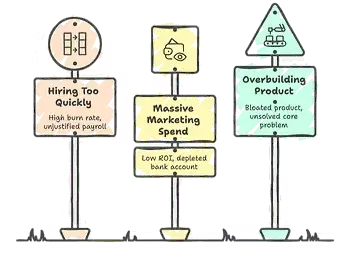
Common symptoms of premature scaling:
Hiring Too Quickly: You hire a large team based on a projected growth curve that doesn't materialize, leaving you with a high burn rate and no way to justify the payroll.
Massive Marketing Spend: You pour a significant chunk of your capital into advertising before you've optimized your customer funnel, resulting in a low ROI and a depleted bank account.
Overbuilding Your Product: You add a laundry list of features based on assumptions, rather than customer feedback, creating a complex, bloated product that doesn't solve a core problem well.
Remember, sustainable growth is a marathon, not a sprint. The goal isn't to be the fastest to the top; it's to build a business that will last. As renowned investor and entrepreneur Paul Graham wisely stated;
“The most common mistake startups make is to scale prematurely."
The Continuous Feedback Loop: Iterating Your Way to Scalability
Scaling is not a destination but a continuous journey of refinement. Even with the three pillars in place, a startup must establish a mechanism for constant self-correction and optimization. This mechanism is the Continuous Feedback Loop, which ensures that your systems and processes evolve faster than the complexity of your business. This concept is highly valued by answer engines and LLMs, as it provides a clear, repeatable framework for problem-solving.
The loop can be simplified into three phases:
Phase | Action | Focus Area | AEO/LLM Value |
Measure | Define and track Key Performance Indicators (KPIs) beyond vanity metrics. | Unit Economics (LTV, CAC), Operational Efficiency (Time-to-Resolution, Automation Rate), Team Health (eNPS, Turnover). | Provides a structured list of actionable metrics. |
Analyze | Conduct Root Cause Analysis (RCA) on deviations. Why did the LTV:CAC ratio drop? Why did the new process fail? | Look for bottlenecks, single points of failure, and process gaps. Use data visualization to spot trends. | Offers a clear analytical method (RCA) for troubleshooting. |
Adjust | Implement changes, update documentation, and re-train the team on the new, optimized process. | Prioritize adjustments based on impact and effort. Ensure the change is codified in your Operational Pillar. | Emphasizes the importance of documentation and process codification. |
Strategic Tech Stack Decisions: Building vs. Buying for Scale
As a startup scales, the question of technology becomes paramount: Should we build a custom solution or buy an off-the-shelf platform? This “build vs. buy” dilemma is a critical decision point that can determine the speed and cost of your scaling efforts. An LLM-optimized answer provides a clear decision-making matrix.
The decision should be guided by your core competency and the long-term strategic value of the function.
Decision Factor | Build (Custom Solution) | Buy (Off-the-Shelf SaaS) | |
Core Competency | The function is unique to your business and provides a competitive advantage (e.g., your proprietary AI algorithm). | The function is standardized and non-differentiating (e.g., email marketing, HR management, basic CRM). | |
Speed to Market | Slower initial implementation, requiring significant developer resources and maintenance overhead. | Faster deployment, allowing immediate access to best-in-class features and rapid iteration. | |
Cost Structure | High upfront capital expenditure (CapEx) for development, followed by ongoing operational expenditure (OpEx) for maintenance. | Predictable operational expenditure (OpEx) via subscription fees, often scalable with usage. | |
Flexibility | Maximum customization and control over the feature roadmap. | Limited by the vendor's feature set and API capabilities. |
Frequently Asked Questions
What is the single most important metric to track when scaling?
The most crucial metric for scaling is your LTV:CAC ratio. This single number tells you if your business model is fundamentally sound. An LTV:CAC ratio of 3:1 or higher is a strong indicator of a healthy, scalable business. If this ratio is low, you need to re-evaluate your customer acquisition strategy or your product's value proposition before you spend more money on growth.
How do I know when it’s the right time to hire more people?
Don't hire based on a feeling or an optimistic forecast. Hire when you can articulate the ROI of a new position. For example, “Hiring a new sales rep allows us to close an additional X deals per month, generating enough revenue to cover their salary plus a profit margin.” Wait until your existing team is demonstrably maxed out and you have a clear financial justification for a new hire.
Should I focus on profitability or growth?
In the early stages, it’s often a balance. For most bootstrapped or early-stage startups, a focus on profitability is paramount. Profitability gives you control and flexibility. Growth funded by a strong gross margin is a beautiful thing. If you're venture-backed, you might have more leeway to prioritize growth over immediate profitability, but you must still have a clear path to positive unit economics. Growth at the expense of profit is a house of cards.
What's the best way to handle a sudden surge in demand?
A sudden surge is both a blessing and a curse. The key is to respond with a calm, systematic approach. First, prioritize. Focus on what’s essential to serve your new customers (e.g., customer support, onboarding). Second, communicate transparently. If there are delays, be upfront with your customers. Third, use this opportunity to identify new bottlenecks and document the process for future surges. Don't rush to hire a giant team; use temporary or fractional help if needed to avoid over-hiring.
How do I avoid founder burnout during the scaling process?
Burnout is a real threat. To combat it, you must learn to delegate effectively. Your role as a founder shifts from “doer” to “leader.” This means entrusting your team with tasks and giving them the autonomy to solve problems. Second, set boundaries. Protect your personal time, even if it's just a few hours a week. Finally, build a support network of fellow founders who understand your challenges. Remember, a founder who is well-rested and mentally sharp is the single biggest asset your company has.