
What Is Attribution Modeling A Guide for Marketers

Updated: Mar 17
Attribution modeling is the rulebook marketers use to figure out which touchpoints on a customer's journey actually get credit for a conversion. It’s how you connect the dots between your blog post, that social media ad, and the email campaign that finally led to a sale, giving you the clarity to invest your budget where it truly counts.
What Is Attribution Modeling Really About?
Think of your favourite football team scoring a goal. The striker who kicks the ball into the net gets the final glory, but what about the defender who started the play deep in their own half, or the midfielder who made that perfect, defence-splitting pass? If you only gave credit to the goalscorer, you'd have a wildly skewed view of which players are most valuable to the team's success.
This is a classic problem in marketing.
Attribution modeling is your game plan for analysing the entire sequence of plays. It's a set of rules that assigns value to each marketing touchpoint a customer interacts with before they buy something. Without it, marketers often default to crediting only the very last interaction—the final click—which completely ignores all the hard work that built awareness and nurtured the lead in the first place.
This process is about shifting from guesswork to data-driven decisions. By understanding the whole customer journey, you can start answering the big questions:
Which channels are actually bringing new people into our world?
What mix of ads and content seems to shorten the sales cycle?
Are we putting enough money behind the efforts that assist conversions, not just close them?
Ultimately, attribution modeling helps you understand the real impact of your work, allowing you to more accurately measure marketing ROI for real business growth. It paints a much clearer picture of what’s working and what isn’t, leading to smarter budget allocation and campaigns that actually hit the mark.
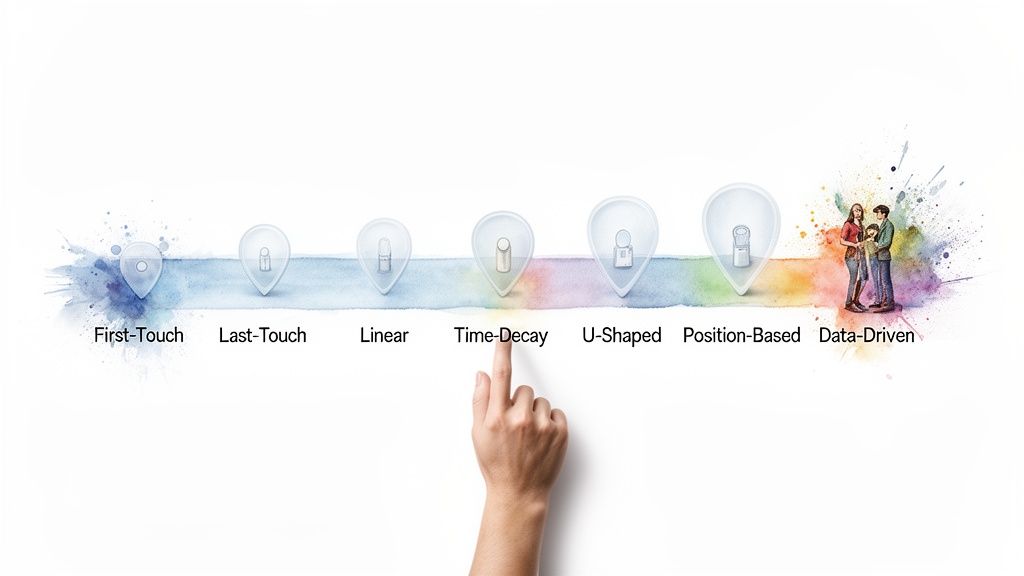
A Quick Overview of Common Attribution Models
To get this right, marketers lean on several models. Each one slices the pie differently, distributing credit based on its logic. Getting your head around these core models is the first step toward picking the one that makes sense for your business goals.
An attribution model is not just a reporting tool; it’s a strategic lens that shapes how you perceive and value every marketing interaction. The model you choose directly influences your future investment decisions.
Let's do a quick fly-by of the most common approaches. We'll dive much deeper into each of these in the next section, but this table will give you the lay of the land.
Model Type | How It Assigns Credit | Best For |
|---|---|---|
First-Touch | Gives 100% of the credit to the very first interaction a customer has. | Understanding top-of-funnel channels that generate initial awareness. |
Last-Touch | Assigns 100% of the credit to the final interaction before a conversion. | Identifying which channels are most effective at closing deals. |
Linear | Distributes credit equally across all touchpoints in the customer journey. | Gaining a balanced, holistic view of all marketing efforts. |
Time-Decay | Gives more credit to touchpoints that occur closer in time to the conversion. | Businesses with longer consideration periods, valuing recent interactions. |
U-Shaped | Assigns significant credit to the first and last touchpoints (40% each). | Valuing both lead generation and conversion-driving activities. |
Data-Driven | Uses machine learning to assign credit based on your actual conversion data. | Advanced analysis to uncover the true impact of each touchpoint. |
Each model tells a different story about your marketing performance. The trick is figuring out which story is most relevant to the chapter your business is in right now.
Exploring the 7 Key Attribution Models
Not all attribution models see the customer journey through the same lens. Think of it like a football match: some models give all the glory to the final goalscorer, while others recognise the crucial assists from the midfielders who set up the play. Understanding these different perspectives is the key to figuring out how to apply attribution effectively to your marketing.
Let's break down the seven most common models, from the simple, single-minded approaches to more balanced, team-oriented frameworks. Each has its logic, strengths, and ideal use case.
This concept map gives you a high-level view of the process, showing how different models analyse a customer's journey to assign credit for a conversion.
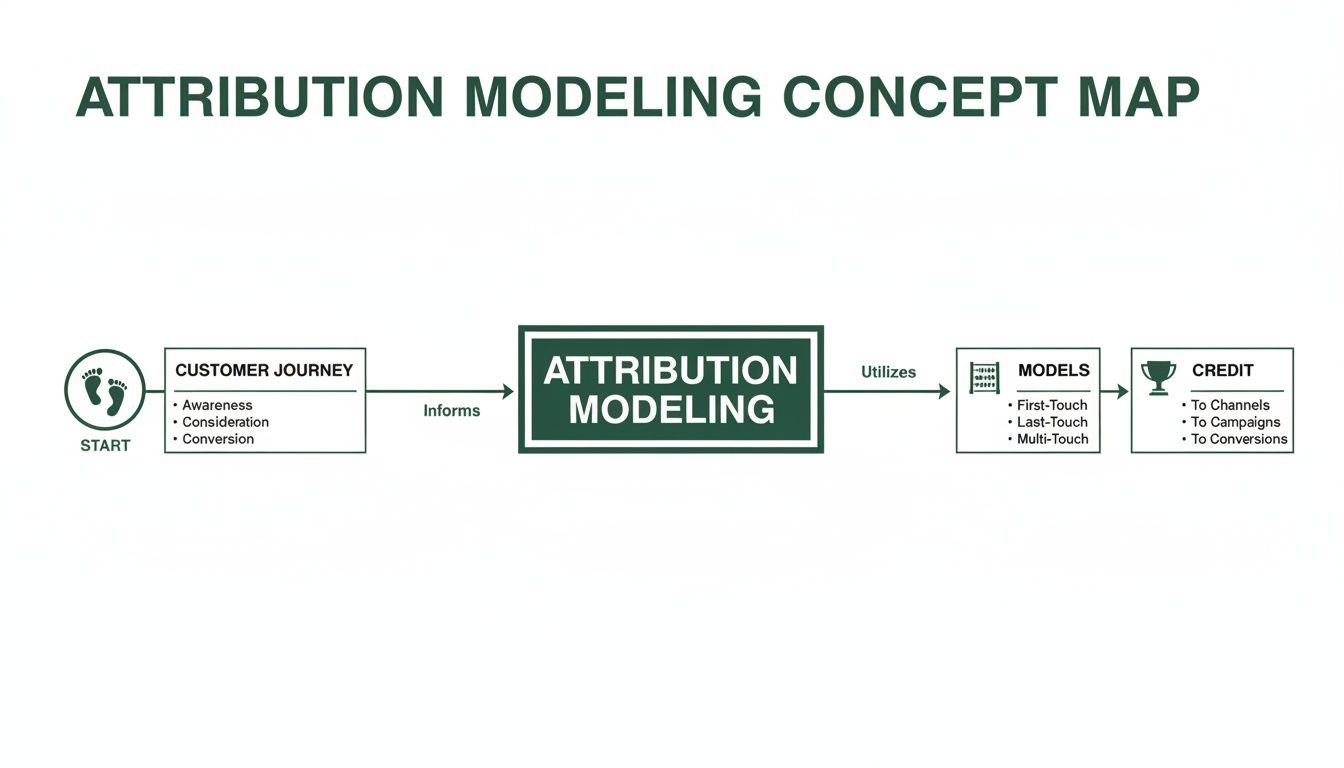
It really boils down to this flow: tracking all the interactions and then using a specific set of rules to figure out how much each one was worth.
Single-Touch Models: The Sprinters
Single-touch models are the simplest form of attribution, which is both their strength and their weakness. They're incredibly easy to understand and set up because they assign 100% of the conversion credit to a single, decisive moment in the journey.
First-Touch Attribution: This model gives full credit to the very first interaction a customer has with your brand. If someone discovers your company through a blog post and then converts two weeks later, that blog post gets all the glory. It’s excellent for identifying which channels are best at generating initial awareness and filling the top of your funnel.
Last-Touch Attribution: As the name implies, this model gives all the credit to the final interaction before a conversion. If a customer clicks a retargeting ad and then immediately makes a purchase, that ad is considered the sole driver of the sale. For years, this has been the default for many analytics platforms because it highlights what closes the deal.
While straightforward, these models often tell an incomplete story, entirely ignoring the valuable assists that happen along the way.
Multi-Touch Models: The Team Players
Multi-touch models acknowledge a simple truth: most conversions are the result of multiple interactions over time. They distribute credit across several touchpoints, providing a much more balanced and realistic view of your marketing performance.
Linear Attribution: The most straightforward of the multi-touch models, Linear attribution divides credit equally among every single touchpoint in the customer's journey. If there were four interactions (a social ad, an email, a webinar, and a direct visit), each gets 25% of the credit. This model operates on the principle that every step has equal value.
Time-Decay Attribution: This model gives more credit to the touchpoints that happen closer to the conversion. The interaction from yesterday gets more weight than the one from three weeks ago. It's particularly useful for businesses with longer sales cycles, as it recognises that the most recent touchpoints are often more influential in the final decision.
U-Shaped (or Position-Based) Attribution: The U-Shaped model gives the most credit to the bookends of the journey: the first interaction and the last one. Typically, it assigns 40% to the first touch and 40% to the last touch. The remaining 20% is then distributed evenly among all the touchpoints in between. This model values both the channel that introduced the customer and the one that sealed the deal.
To see how these different models play out with your data, it's helpful to compare them side-by-side.
Comparing Multi-Touch Attribution Models
Attribution Model | Credit Distribution Logic | Primary Advantage | Key Disadvantage |
|---|---|---|---|
Linear | Spreads credit equally across all touchpoints in the journey. | Simple to understand and values every interaction. | Can undervalue truly influential touchpoints by treating all as equal. |
Time Decay | Gives increasing credit to touchpoints as they get closer to the conversion. | Emphasises the interactions that directly preceded the conversion. | May undervalue early-stage, awareness-building channels. |
U-Shaped | Assigns the most credit (e.g., 40% each) to the first and last touches. | Highlights the channels that start the journey and close the deal. | The “middle” touchpoints that nurture the lead can be overlooked. |
This comparison makes it clear that your choice of model directly influences which channels appear to be your top performers. Using a tool like Google Analytics is the first practical step in moving beyond a simple last-click view and truly understanding the full customer journey.
Advanced Models: The Strategists
Finally, we arrive at the most sophisticated approaches that use algorithms and historical data to assign credit far more accurately.
Data-Driven Attribution: This is the most intelligent model of the bunch. It uses machine learning to analyse all converting and non-converting paths in your data. By comparing these paths, it identifies patterns and determines the actual contribution of each touchpoint. This model is unique to your business and adapts as your marketing and customer behaviour change.
The move toward more advanced models is gaining serious momentum. For example, attribution modelling in the UK marketing landscape has become crucial for SaaS startups and scale-ups. A pivotal study revealed that businesses using data-driven models saw a 28% uplift in marketing ROI compared to those relying on last-click attribution—a statistic that highlights a major shift in strategy for performance marketing.
Each of these seven models offers a different lens through to view your marketing performance. The best one for your business depends entirely on your goals, sales cycle, and the complexity of your customer journey.
Putting Attribution Models into Practice
All the theory in the world is great, but seeing how attribution models actually work in the wild is where the lightbulb really goes on. It’s one thing to understand the logic behind each model; it's another thing entirely to see how they steer real-world budget decisions.
Let's walk through two completely different scenarios. These examples show how choosing the right model helps businesses move from just counting clicks to truly understanding what makes their customers tick, turning abstract data into smart, effective marketing strategy.
A U-Shaped Model Story for B2B SaaS
Picture a B2B SaaS company that sells sophisticated project management software. Their customer journey is almost always a long game, often involving several people across different departments.
A potential customer might first stumble upon them by reading a blog post about “improving team productivity,” which they found through an organic search. A few weeks later, maybe they see a targeted ad on LinkedIn promoting a free e-book on agile methodologies. After downloading it, they start receiving a series of nurture emails. Finally, they click a call-to-action in one of those emails to book a product demo, which ultimately leads to a subscription.
If this company used a simple Last-Touch model, only that final email click would get any credit. This completely ignores the crucial role the initial blog post played in planting the seed and getting the lead into the funnel in the first place.
By adopting a U-Shaped model, the company can assign significant credit to both the first touch (the blog post) and the last touch (the demo request). This dual focus correctly values both their top-of-funnel content marketing and their bottom-of-funnel conversion tactics.
This more balanced view ensures the content team's budget isn't unfairly cut, while the sales enablement team gets the recognition they deserve for closing the deal. It paints a much more complete picture of how marketing and sales actually work together. If you're looking to tighten up your own reporting, our guide on how to measure marketing ROI offers practical formulas and frameworks to get you started.
A Time-Decay Model Story for D2C E-commerce
Now, let's switch gears and look at a direct-to-consumer (D2C) brand selling trainers online. Their purchase cycle is much shorter, but it’s heavily influenced by a quick succession of digital ads.
A customer's journey might kick off when they see an Instagram Story ad featuring the new trainers. They click through but don't buy right away. Over the next few days, they're served a series of retargeting ads on Facebook and YouTube, keeping the product top of mind. Finally, a promotional email with a 10% discount code lands in their inbox. They click the link and make the purchase.
In this scenario, a First-Touch model would give all the credit to that initial Instagram ad, completely disregarding the powerful influence of the retargeting and email campaigns that pushed the customer over the finish line.
A Time-Decay model is a much better fit here. It assigns the most credit to the final email click but still gives partial credit to the social media ads that came before it. The ads that appeared closer to the purchase get more weight than the first awareness-building ad, which accurately reflects their growing influence on the customer’s final decision. This helps the brand understand the combined power of its campaign sequence.
Building Your Attribution Tech Stack
Knowing the theory behind attribution models is one thing; putting them into practice is another beast entirely. To do it right, you need a solid technical foundation. Building an effective attribution tech stack isn’t about picking one magic tool. It’s about creating a connected system that captures, unifies, and analyses customer data accurately and reliably.
The entire journey starts with clean data. Without it, even the most sophisticated model will give you garbage insights. Your first job is to get the basics right and make sure every conversion is tracked flawlessly.
Laying the Groundwork with GA4
For most businesses, Google Analytics 4 (GA4) is the central nervous system of their attribution efforts. Getting conversion tracking properly configured in GA4 is non-negotiable. This means setting up events that truly reflect your business goals—whether that’s a demo request, a free trial sign-up, or an e-commerce purchase.
A well-configured GA4 setup gives you a baseline read on user behaviour. It also lets you play with its built-in model comparison tool. This handy feature shows you how credit shifts between models like Last-Click and its own Data-Driven model, offering a first taste of attribution insights without a hefty investment.
The whole point of your tech stack is to create a single source of truth. Disconnected data from different platforms leads to conflicting reports and kills confidence in your marketing decisions. A unified stack ensures everyone is working from the same playbook.
Unifying Your Data for a Single Source of Truth
With GA4 humming along, the next stage is to pull all your data together. Customer journeys are messy. They don't just happen on your website; they stretch across different platforms and devices. To see the complete picture, you have to centralise your data.
Two bits of tech are essential here:
Server-Side Tracking: Browser-based tracking is becoming less reliable thanks to privacy updates and ad blockers. Server-side tracking is the durable solution. It sends data directly from your server to analytics platforms, which means more accurate and complete data collection. It neatly sidesteps many of the limitations of client-side scripts.
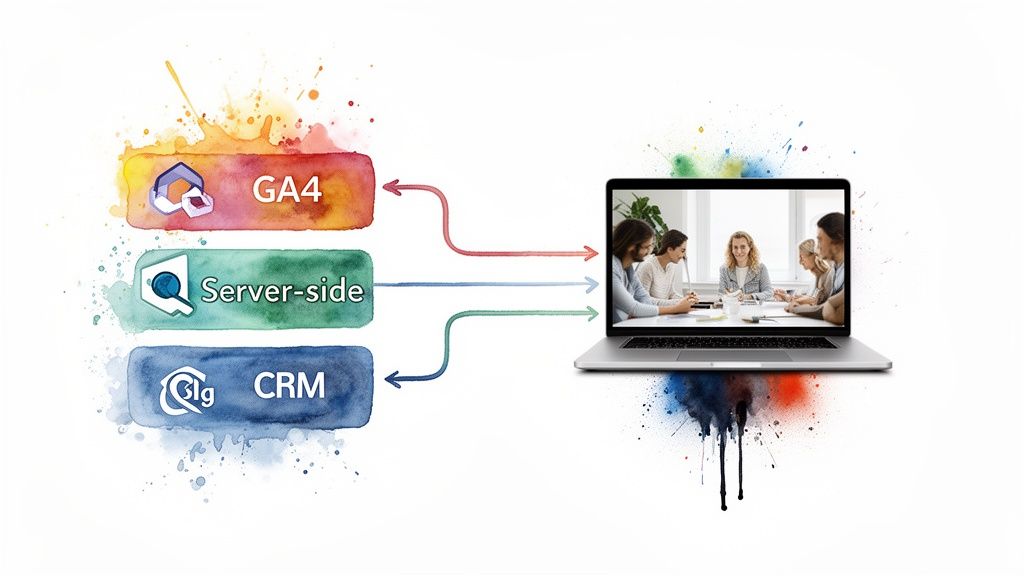
Data Warehouses: Think of tools like Google BigQuery or Snowflake as the central library for all your marketing data. You can pipe in information from GA4, your ad platforms, and your CRM. This unified dataset is the raw material you need for more advanced, custom attribution work.
Integrating CRM Data for a Full-Funnel View
For B2B companies, the customer journey is far from over when a lead form is submitted. The most valuable interactions—the calls, the demos, the deal stages—often happen offline, logged away in your Customer Relationship Management (CRM) system like Salesforce or HubSpot. Integrating this data is the only way to understand the full funnel, from the first click to the final contract.
Connecting your CRM lets you attribute actual revenue, not just leads. This gives you a clear line of sight from a specific campaign right through to the customers it generated, allowing you to calculate a far more accurate return on investment. The role of analytics in shaping these decisions is paramount for long-term growth. Learn more about the role of analytics in shaping marketing decisions in our detailed guide.
Choosing the Right Attribution Software
While platforms like GA4 are powerful, dedicated attribution tools can take you deeper and automate a lot of the heavy lifting. To really round out your tech stack, investing in robust marketing attribution software can seriously streamline data collection and analysis.
These platforms are built to handle complex, cross-channel journeys. They often come with pre-built integrations for the marketing tools you already use, saving your team a ton of time and effort. By putting these pieces together—GA4, server-side tracking, a data warehouse, and CRM integration—you create a resilient and insightful tech stack ready for truly sophisticated attribution modelling.
How to Choose the Right Attribution Model
So, which model is right for your business? It’s the million-dollar question every marketer asks, and the honest answer is always, “It depends.”
There’s no magic bullet, no single perfect model that works for every company. The best choice is the one that actually lines up with your business goals, how your customers behave, and the marketing strategy you’re running.
Instead of just picking one out of a hat, you need a framework for thinking it through. Making an informed choice starts with asking the right questions about how your business really operates and what you’re trying to measure in the first place.
Start by Analysing Your Sales Cycle
The length and complexity of your customer journey is the single most important factor. Getting this wrong can lead you to undervalue the very touchpoints that are doing the heavy lifting.
Short Sales Cycles: If your customers usually convert quickly—within a few days or even a single session—simpler models often do the trick. A Last-Touch or even a First-Touch model can give you clear, actionable data without overcomplicating things. This is super common for D2C e-commerce brands where impulse buys are the norm.
Long Sales Cycles: For B2B companies or high-ticket items that need a long consideration phase, single-touch models are almost always misleading. These journeys involve multiple touchpoints over weeks or even months. Here, multi-touch models like Linear, Time-Decay, or U-Shaped are essential to give proper credit to the entire nurturing process.
Choosing a model isn't a technical decision; it's a strategic one. Your model should reflect the story of how your customers actually engage with your brand, not just the final click.
Align the Model with Your Business Goals
What are you trying to accomplish with your marketing right now? Your main objective should steer your choice, because different models are built to answer different strategic questions.
Are you focused on filling the top of your funnel or closing deals at the bottom?
Goal: Lead Generation and Awareness: If your main goal is to introduce new people to your brand, a First-Touch model is invaluable. It clearly highlights which channels are best at bringing new prospects into your orbit.
Goal: Closing and Conversion: If your priority is figuring out what pushes leads over the finish line, a Last-Touch model is your friend. It shows you which touchpoints are your most effective closers.
Goal: A Balanced View: For a more complete picture of the entire journey, a U-Shaped or Linear model provides a much more balanced perspective. The U-Shaped model is fantastic for businesses that value both the first introduction and the final conversion, making it a popular choice for B2B SaaS companies. If you're looking for guidance, our overview of a performance marketing startup strategy can provide a useful framework.
Consider Your Channel Mix and Strategy
Finally, think about where you're putting your money. Your attribution model needs to be able to fairly assess the value each channel brings to the table.
For instance, if you have a sophisticated content marketing strategy that nurtures leads over time, a Last-Touch model will consistently undervalue its contribution. It just won't see the impact. On the flip side, if your business relies heavily on promotional campaigns and last-minute offers, a Time-Decay model can effectively highlight the impact of those timely nudges.
Ultimately, the best approach is often to compare several models. Jump into a tool like Google Analytics 4 and see how the credit shifts when you switch from Last-Touch to Linear or Time-Decay. This comparison will reveal which channels are being undervalued and give you a much more complete, practical understanding of how attribution really works for your unique business.
Common Attribution Pitfalls and How to Avoid Them
Putting an attribution model in place is a massive leap forward for any marketing team. But let's be clear: it's not a silver bullet. There are a few common traps that can easily pollute your data, leading you to make some pretty flawed budget decisions. Knowing what they are is the first step toward building a system you can actually trust.
One of the most frequent mistakes I see is teams working with incomplete or siloed data. When your analytics platform, ad networks, and CRM aren’t talking to each other properly, you’re only ever seeing fragments of the customer journey. This almost always leads to certain channels getting way too much credit while others—often those crucial early touches—are completely ignored.
Another major blind spot is ignoring offline touchpoints. For so many businesses, the most powerful conversion drivers don't happen on a screen. We're talking about phone calls, in-store visits, or someone attending a trade show. If you're not capturing and integrating these moments into your model, you're missing a huge piece of the puzzle.
Validating Your Attribution Results
So, how do you make sure your model isn't just telling you a convenient story? Validation. You can't just set it and forget it; you have to constantly test its conclusions to build real confidence in the data.
A really practical way to do this is with a holdout test. It's simpler than it sounds. You temporarily pause a specific marketing channel—say, a particular set of paid search ads—for a defined group of users. If your attribution model is on the right track, you should see a corresponding drop in conversions from that group. If conversions hold steady? Your model is likely over-crediting that channel's true impact.
Another powerful technique is to simply compare different models against each other. How do the numbers from your chosen model stack up against a dead-simple Last-Touch or a basic Linear model?
Watching how credit shifts between models is incredibly revealing. It shows you which channels are consistently valuable versus those that only look good under one specific lens. This comparison helps you spot biases and make more balanced, evidence-based decisions.
By actively looking for these common issues and regularly putting your findings to the test, you can move beyond just having data. You start building insights you can truly stand behind. That's what gives you the confidence to make the bold, effective marketing decisions that actually drive growth.
Ready to move beyond guesswork and build a data-driven growth strategy? At Ryesing Limited, we help ambitious brands scale with expert performance marketing and clear, actionable analytics. Find out how we can help you grow.
Frequently Asked Questions About Attribution Modeling
What is attribution modeling in simple terms?
In simple terms, attribution modeling is a way for marketers to figure out which of their efforts get credit for a sale or conversion. It's a set of rules that assigns value to the different touchpoints a customer interacts with on their journey, such as a social media ad, a blog post, or an email, helping businesses understand what's really working and where to invest their budget.
What are the main types of attribution models?
The main types of attribution models fall into two categories: single-touch and multi-touch. Single-touch models, like First-Touch and Last-Touch, give 100% of the credit to a single interaction. Multi-touch models, such as Linear, Time-Decay, U-Shaped, and Data-Driven, spread the credit across multiple touchpoints in the customer's journey, providing a more balanced view of marketing performance.
How do I choose an attribution model?
To choose the right attribution model, you should consider your business goals, sales cycle length, and marketing channels. For businesses with short sales cycles, a Last-Touch model might suffice. For those with longer cycles, like B2B SaaS, a U-Shaped or Time-Decay model is often more accurate. The best approach is to align the model with your strategic priorities, whether that's generating new leads (First-Touch) or understanding the entire customer journey (Linear or Data-Driven).
What is the most accurate attribution model?
The most accurate attribution model is generally considered to be the Data-Driven model. Unlike rule-based models that follow a fixed logic, a Data-Driven model uses machine learning to analyse your specific conversion data. It identifies which touchpoints have the greatest actual impact on conversions for your unique business, providing a more precise and customised approach to assigning credit.


