
What is Demand Generation Marketing? A Complete Guide for 2026

Demand generation is all about playing the long game. It’s a strategic marketing approach focused on creating awareness and building genuine interest in what your company offers. This isn't about chasing quick sales; it's about methodically building a predictable pipeline of future customers who already know, like, and trust your brand long before they’re ready to buy.
What Is Demand Generation Marketing Really?
Think of it like a farmer getting a field ready for a future harvest. You wouldn't just scatter seeds on dry, unprepared ground and cross your fingers. That’s a recipe for failure. Instead, you'd spend months cultivating the soil, adding the right nutrients, and making sure the conditions are perfect for growth.
That’s precisely how demand generation works. It’s the process of preparing your target market, educating them, and building a relationship before you ever ask for a sale. The goal is to make your ideal customers realise they have a problem and become convinced that you have the best solution. It’s about being the first name that pops into their head when a need finally arises.
Building Authority and Trust First
Unlike traditional marketing that often pushes for an immediate click or conversion, demand generation invests in educating and engaging your audience with no strings attached. This is where valuable, ungated content comes in, think insightful blog posts, expert podcasts, and helpful videos that people can access freely, without having to hand over their email address.
By consistently delivering value upfront, you build a relationship based on trust and expertise. This ensures that when prospects are finally ready to buy, they don't just see you as one of many options; they see you as the obvious choice.
This long-term focus on nurturing an audience is what truly sets it apart. It might take longer to see a direct impact on the bottom line, but it creates a far more sustainable and predictable engine for growth.
For a deeper dive, a well-structured B2B Demand Generation Strategy is essential for building a framework that drives reliable revenue. Getting these core components right is the first step.
To break it down further, let's look at the foundational pillars that make up a solid demand generation strategy. This isn't just a list of tactics; it's a mindset shift towards creating value first.
Core Components of Demand Generation at a Glance
Component | Objective | Example Tactic |
|---|---|---|
Brand Awareness | Make your target audience aware of your brand and its solutions. | Running awareness campaigns on LinkedIn or publishing insightful industry reports. |
Audience Education | Inform prospects about problems they face and potential solutions. | Creating a free educational webinar series or a detailed “how-to” blog post. |
Thought Leadership | Position your brand as the go-to expert in your niche. | Hosting a podcast with industry experts or publishing original research data. |
Community Building | Foster a space for customers and prospects to connect and engage. | Managing an active Slack community or hosting exclusive online events. |
These components work together to build a powerful flywheel, turning strangers into an engaged audience and, eventually, into loyal customers who see you as an indispensable partner.
Demand Generation vs Lead Generation
It’s one of the most common mix-ups in marketing: using “demand generation” and “lead generation” as if they mean the same thing. They’re absolutely related, but confusing them is like mistaking a restaurant's enticing aroma for the meal itself. One creates the hunger, and the other serves the dish.
Simply put, demand generation is the art of creating a hungry audience. It’s the broad, top-of-funnel work you do to build brand awareness, educate your market, and cement your company as a trusted authority. The immediate goal isn't to get a name and email; it's to make your ideal customers realise they have a problem and see your solution as the best possible answer.
Lead generation, on the other hand, is the act of identifying and capturing contact details from the people who are already hungry. It's a more focused, mid-funnel process designed to convert the interest you’ve built into a tangible, actionable contact in your database.
The Fishing Analogy: A Clear Distinction
Let's make this crystal clear with a fishing analogy. Imagine you’re out on a boat, hoping for a big catch.
Demand Generation is ‘chumming the water’. You're tossing bait into a wide area to attract fish. You're creating an environment of interest, drawing shoals of potential catches towards your boat. You aren't catching anything yet, but you're making your spot the most interesting place in the ocean.
Lead Generation is ‘casting the net’. Once the fish are gathered and interested, you strategically cast your net to bring a specific group aboard. This is the moment of capture, where potential becomes a concrete lead.
Without chumming the water first, casting your net is just a game of luck. You might get one or two, but you won't build a sustainable source of fish. But all of the chum in the world is useless if you never actually cast a net to bring them onto the boat. Both are essential for a successful trip.
Demand generation creates the opportunity, making your brand a known and respected entity. Lead generation capitalises on that opportunity, converting anonymous interest into qualified contacts that your sales team can engage with.
This highlights their symbiotic relationship, one can’t really thrive without the other. Strong demand generation makes lead generation far easier and more efficient because the leads you capture are already warmed up to your brand and what you stand for.
Demand Generation vs Lead Generation vs Growth Marketing
To add another layer, where does “growth marketing” fit in? Growth marketing is the overarching discipline that uses both demand gen and lead gen, along with product, sales, and customer success initiatives, to drive revenue across the entire customer lifecycle, from awareness right through to retention and advocacy.
Here’s a simple table to break down the key differences between these three crucial marketing disciplines.
Discipline | Primary Goal | Key Metrics | Common Activities |
|---|---|---|---|
Demand Generation | Build awareness, educate the market, and create desire. | Website Traffic, Social Engagement, Brand Mentions, Content Downloads (ungated). | Blogging, SEO, Podcasts, Social Media, Community Building, PR. |
Lead Generation | Capture contact information from interested prospects. | Cost Per Lead (CPL), Conversion Rate, Marketing Qualified Leads (MQLs). | Gated Content (eBooks, Whitepapers), Demo Requests, Contact Forms, Webinars. |
Growth Marketing | Drive sustainable revenue growth across the full funnel. | Customer Lifetime Value (CLTV), Customer Acquisition Cost (CAC), Churn Rate, Expansion Revenue. | A/B Testing, Product-Led Growth (PLG), Personalisation, Referral Programs, Upsell/Cross-sell Campaigns. |
As you can see, demand gen is all about reach and engagement, while lead gen hones in on conversion and capture. Growth marketing looks at the whole picture, optimising every touchpoint for long-term value.
Ultimately, a winning strategy doesn’t choose between them. It seamlessly integrates them, using demand-focused activities to build a strong brand presence that fuels a highly efficient lead-capture engine, all measured and optimised through a growth marketing lens. For a deeper dive into the mechanics of capturing those leads, you can explore guides on creating effective lead gen ads that convert.
Essential Channels for Modern Demand Generation
Bringing demand generation theory to life isn't about finding a single silver bullet. It’s more like conducting an orchestra; you need a multi-channel approach where every instrument plays its part to create something powerful. The goal is to weave together different tactics that build awareness, cement your authority, and spark genuine interest in what you do.
At its core, great demand generation is about delivering value long before you ever ask for the sale. The channels you pick should embody this principle, making education and engagement the top priority. Think of it as preparing the soil, making your audience ready for a future relationship long before you plant the seed of a sales pitch.
This diagram shows perfectly how demand generation and lead generation fit under the wider marketing umbrella, they're distinct disciplines, but both are essential.
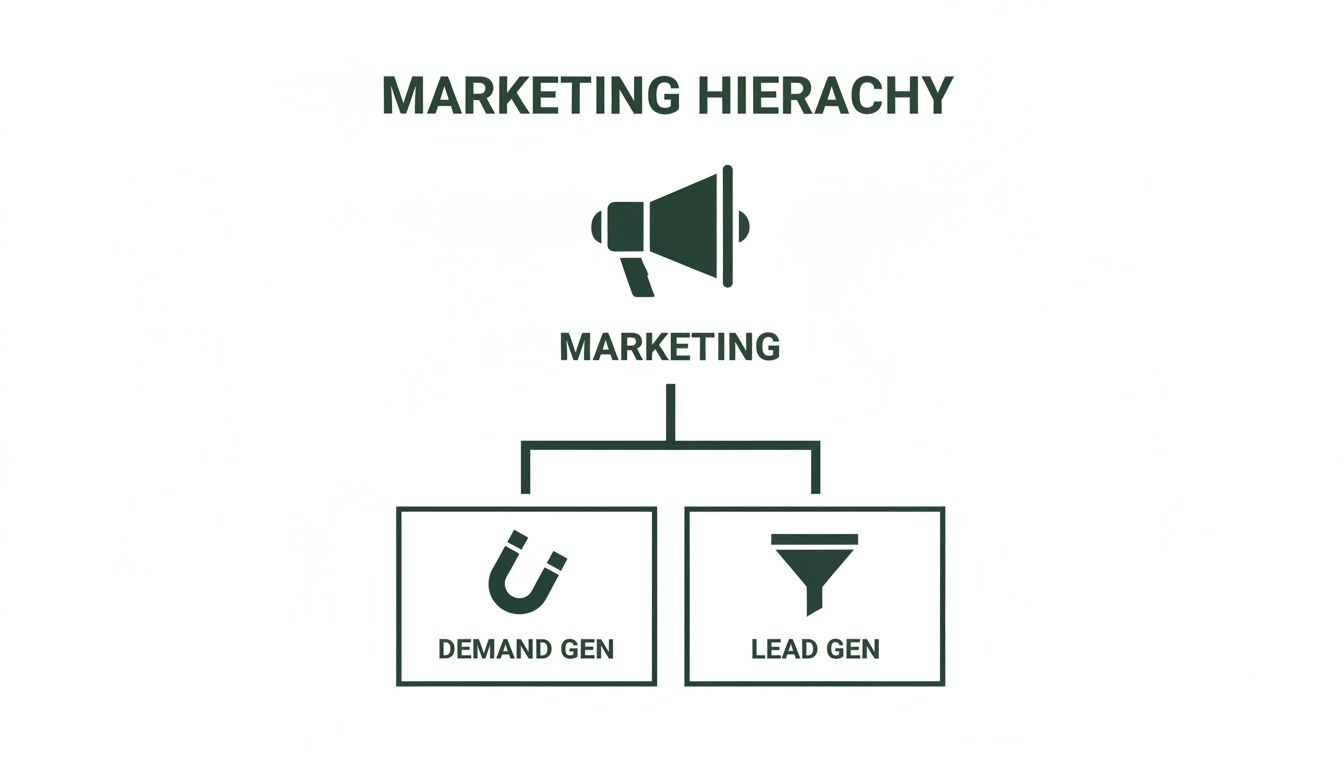
As you can see, demand generation is the foundational work that drums up initial interest, while lead generation steps in later to capture that interest and move it down the funnel.
Content Marketing and SEO: The Organic Powerhouse
Content marketing and SEO are the twin engines of modern demand generation. They work together to pull your ideal customer in by answering their questions and solving their problems right when they're actively searching for solutions. The aim here isn't just to be a vendor; it's to become their go-to, trusted resource.
This means creating a library of valuable, ungated content that anyone can access without handing over an email address.
In-depth Blog Posts: Move beyond generic, 500-word articles. Create comprehensive guides and thought leadership that showcases true expertise.
Educational Webinars and Videos: Host sessions that teach, not sell. A webinar on industry trends that doesn't mention your product builds far more trust than a thinly veiled sales pitch.
Original Research and Reports: Publishing unique data does two things: it positions you as an industry authority and earns valuable backlinks that supercharge your SEO.
By consistently pumping out high-quality, search-optimised content, you’re building an asset that works for you 24/7. It draws in potential customers and educates them on your brand’s value, all without a hint of sales pressure. It’s a powerful, organic way to build brand affinity.
The core principle is simple: be so helpful that your audience can't imagine solving their problem without you. This is how you generate demand through organic channels, turning search intent into brand preference.
This strategy lines up perfectly with what businesses are prioritising right now. A recent survey of over 500 UK businesses found that 62% of marketing professionals see increasing sales revenue as their top priority for 2026. Demand generation directly fuels this by building a stronger, more reliable pipeline. The same study revealed that 60% are focused on customer engagement and 52% on brand awareness, both central pillars of a solid demand generation framework.
Strategic Paid Media: Amplifying Your Message
While organic channels build a rock-solid foundation, paid media is the accelerator. When it comes to demand generation, paid ads aren't always about driving a direct conversion. More often, their job is to amplify your brand’s voice and get your best content in front of more of the right people, even if they aren't actively looking for you yet.
Think of it as giving your best content a much bigger stage.
Brand Awareness Campaigns: Use platforms like LinkedIn or niche industry sites to run campaigns that spotlight your company's mission, values, and big ideas.
Content Promotion: Put some budget behind your top-performing blog posts, reports, or podcast episodes to reach a wider, highly relevant audience.
Retargeting for Education: Instead of hitting someone with a “Buy Now!” ad after they visit your site, serve them an ad that invites them back to another piece of genuinely useful content. Nurture the relationship first.
This approach shifts the focus from cost-per-lead to building a high-quality audience. By investing in paid channels to distribute educational material, you're actively creating and capturing future demand. If you're looking to sharpen this part of your strategy, our guide on high-converting PPC campaigns can help.
Community Building: Fostering Brand Advocacy
Perhaps one of the most powerful, and often overlooked, channels for demand generation is community building. This means creating a dedicated space, whether it's on Slack, a private forum, or a LinkedIn Group, where your customers and prospects can connect, share what they know, and talk directly with your brand.
A thriving community turns your marketing from a one-way megaphone into a vibrant, multi-directional conversation. It becomes a goldmine for feedback, a hub for support, and, most importantly, a breeding ground for brand advocates.
The benefits are huge:
Direct Audience Insight: You get unfiltered feedback on your product and a real-time pulse on your market's pain points.
Authentic Word-of-Mouth: Engaged members become your most passionate evangelists, promoting your brand organically within their networks.
Increased Customer Loyalty: A sense of belonging deepens the customer relationship, which helps reduce churn and increase lifetime value.
Building a community is a long-term play. It demands genuine participation and a commitment to providing value that goes beyond just your product. But get it right, and that community can become your most defensible competitive advantage, a loyal following that no amount of ad spend can replicate.
Actionable Playbooks for SaaS and B2B
Knowing the theory is one thing. Actually putting it into practice is a different ball game. The right demand generation strategy is deeply tied to your business model, and for SaaS and B2B companies, a couple of proven playbooks tend to deliver the goods.
These aren't just random lists of tactics. Think of them as cohesive strategies, each designed to build awareness, cement your authority, and create a predictable pipeline of future customers. While each playbook uses different levers, they all drive toward the same core goal: creating genuine, unforced demand.
The Content-Led Media Machine Playbook
One of the most powerful B2B demand gen playbooks involves a simple but profound shift in mindset: stop acting like a marketing department and start acting like a media company. The entire idea is to become the most trusted, valuable, and indispensable source of information in your niche.
This strategy hangs on one crucial element: creating exceptional, ungated content. You educate and empower your audience without asking for a single thing in return. Your goal is to be so ridiculously helpful that prospects see you as an essential resource long before they ever think about buying something. That's how you build real brand equity and trust.
Core Tactics for the Media Machine:
Pillar Content: Go deep. Develop comprehensive guides on the core topics your audience wrestles with every day. These long-form assets become SEO powerhouses and serve as the foundation you can slice and dice into dozens of smaller content pieces.
Expert Interviews & Podcasts: Start a podcast or a video series where you interview industry leaders. This isn't just great content; it borrows their authority and introduces your brand to their established, relevant audiences.
Original Research Reports: Conduct your own surveys or analyse data to publish unique industry insights. This is how you become a thought leader, generating high-quality backlinks that give your organic presence a massive boost.
The secret here is consistency and an unwavering commitment to quality. You're not creating content to capture leads; you're creating it to build an audience. The leads? They become a natural, inevitable byproduct of having an engaged audience that trusts you.
This approach completely flips the traditional marketing funnel on its head. Instead of shoving prospects down a rigid path, you create a gravitational pull. By consistently delivering value, you attract ideal customers who are already sold on your expertise when they finally decide to reach out.
Success with this playbook isn't measured in MQLs this week. It's measured in the long-term growth of brand awareness and organic traffic. As your media machine picks up steam, you'll see a steady climb in direct traffic and branded searches, the clearest signals that real demand is building.
The Product-Led Growth (PLG) Playbook
The Product-Led Growth (PLG) playbook leans into this, turning the software into the main engine for generating demand. Instead of telling people how great your product is, you just let them experience it for themselves.
This model is built around a freemium or free trial that delivers immediate, tangible value. The entire product experience is meticulously designed to be so intuitive and effective that it drives acquisition, activation, and expansion all on its own.
Key Components of a PLG Playbook:
Frictionless Sign-up: Make it absurdly easy for people to start. Kill unnecessary form fields and never ask for a credit card upfront. Lower the barrier to entry as much as humanly possible.
Rapid Time-to-Value: Your number one job is to get new users to their first “aha!” moment as fast as you can. A brilliant onboarding flow is non-negotiable here. If you're looking to tighten up this part of your user journey, exploring proven customer onboarding best practices for SaaS growth can make a world of difference.
Built-in Virality: Encourage users to invite their colleagues or share their work. This is how you organically expand your footprint inside an organisation. Features like collaborative workspaces or shareable reports are perfect for this.
Clear Upgrade Paths: Make the benefits of your paid plans blindingly obvious. Users should naturally bump up against the limits of the free version, making the upgrade feel like the next logical step to unlock even more value.
In a PLG world, marketing's job shifts from driving demo requests to driving product sign-ups. The focus is on obsessively optimising the in-product journey to create a smooth, seamless path from free user to happy paying customer. Here, success is measured by metrics like activation rate, feature adoption, and the conversion rate from your free to paid tiers.
Measuring the Metrics That Truly Matter
So, how do you actually prove your demand generation efforts are paying off?
If your first thought is to point at metrics like Cost Per Lead (CPL) or the number of Marketing Qualified Leads (MQLs), it’s time for a rethink. Measuring a long-term strategy with short-term conversion metrics is like judging a marathon runner by their first 100-metre split, it completely misses the point.
True demand generation measurement tells a story about long-term growth, influence, and revenue. It’s not about immediate captures. This means shifting your focus from vanity metrics to the key performance indicators that actually reflect genuine business impact.
Moving Beyond Cost Per Lead
Traditional lead-based metrics fall short because they encourage the wrong kind of behaviour. A low CPL might look fantastic on a dashboard, but it often comes from gating all your best content. That tactic kills your ability to educate the market and build real trust.
Demand generation success isn’t about how cheaply you can get an email address; it’s about how effectively you build an audience that wants to do business with you.
The core takeaway is this: you must measure demand generation with metrics that align with its purpose—creating awareness, building influence, and ultimately, driving revenue over time. Trying to justify it with lead gen KPIs is a recipe for failure.
This means organising your measurement into distinct categories that track the entire journey, from that first flicker of awareness all the way to the final sale.
Core Metrics for Demand Generation Success
To get the full picture, you need a balanced scorecard of metrics. You can break these down into three main areas that show how your work is influencing the market and contributing to the pipeline.
1. Awareness and Reach Metrics:
These top-of-funnel indicators tell you if you're successfully reaching and engaging your target audience.
Website Traffic: Are more people visiting your site, particularly from organic and direct sources? This is a clear sign of growing brand recognition.
Social Engagement: Look beyond likes. Track comments, shares, and growth in relevant followers to see if you’re actually connecting with your audience.
Share of Voice (SOV): How often is your brand mentioned online compared to your competitors? This is a powerful signal of growing authority.
2. Influence and Engagement Metrics:
This is where you find out if your content is truly resonating and shaping how your audience thinks.
Content Engagement: Keep an eye on metrics like time on page for blog posts, video view duration, and podcast downloads. This indicates that people are consuming and valuing what you create.
Marketing-Influenced Pipeline: Using attribution models, you can track how many sales opportunities had touchpoints with your marketing content. This directly links your efforts to potential revenue.
3. Revenue and Business Impact Metrics:
These are the bottom-line numbers that prove the value of your strategy to the C-suite.
Sales Cycle Length: As you build more demand, you should see your sales cycle get shorter. Why? Because prospects are coming to the table better educated and more ready to buy.
Marketing-Sourced Revenue: This is the gold standard. How much closed-won revenue can be directly attributed back to your marketing initiatives?
Effectively tracking these require a solid grasp of different attribution models to connect your activities to real business outcomes. For a closer look at selecting the right indicators, you might find value in our detailed guide on setting marketing KPIs and objectives. By focusing on these metrics, you can tell a much richer story about building a sustainable growth engine.
How We Can Help You Grow
Putting demand generation theory into practice is where the real work begins. It’s one thing to understand the concepts, but it’s another thing entirely to build a growth engine that delivers tangible results. At Ryesing Limited, that’s exactly what we do. We build powerful, predictable growth systems for startups and scale-ups, blending our proven frameworks with your unique business goals to make sure every marketing pound is spent with purpose.
We don’t just dabble in isolated tactics. Instead, we architect complete go-to-market programmes that create and capture demand where it counts. We bring together digital strategy, performance marketing, and high-value content to build a system that delivers measurable results across acquisition, activation, and retention.
Our Edge: AI-Powered Workflows and Deep Expertise
Our real strength is the fusion of deep strategic knowledge with slick, AI-powered workflows. This isn't just about using the latest tools; it's about operating with incredible efficiency. We can run rapid experiments, analyse the data, and iterate quickly to find what truly moves the needle for your business. We streamline everything from audience segmentation to content distribution, which frees us up to focus on high-impact strategy.
This efficiency is more crucial than ever. Paid ad costs are soaring, making organic channels the bedrock of sustainable growth. It's no surprise that 44% of UK marketers are planning to increase their SEO budgets in 2025—they recognise its power for building a cost-effective pipeline. This trend reinforces our belief in building resilient, multi-channel growth engines for our clients. You can dive into more insights about current marketing statistics on xposurecreative.uk.
We believe that modern growth isn't about choosing one motion over another. It's about skilfully integrating community-led, product-led, and sales-led approaches to create a seamless customer journey that drives predictable revenue.
Your Partner in Sustainable Growth
Think of us as an extension of your team. We provide the elite talent and clear frameworks you need to accelerate growth, but without the overhead of a large in-house department. We'll help you build a demand generation programme that doesn't just attract new customers, but also fosters the loyalty and advocacy that fuels success for the long haul.
Our services are designed to solve the very challenges we've discussed throughout this guide:
Digital Strategy: We’ll craft a clear, actionable roadmap tailored to your specific market and objectives.
Performance Marketing: Our data-driven campaigns capture existing demand across paid media and SEO.
Content & Community: We build your brand's authority and create engaged audiences that genuinely trust you.
Partnering with Ryesing means gaining a cost-effective and resilient growth engine, one designed to deliver results while protecting your brand's integrity and your customers' trust.
You Got a Question
When you start digging into demand generation, the same practical questions always pop up. How long until I see something? How much will it cost? Where do people usually mess this up? Let's get straight to the answers.
How Long Does Demand Generation Take to Show Results?
Let's be clear: demand generation is a long game. It’s not a switch you flip for instant leads; it’s about patiently building your brand’s authority and earning trust in your market. This requires a steady hand and consistency.
You'll likely spot early signs of life within the first three to six months, things like more people visiting your site, better engagement on social media, and a noticeable uptick in people searching for your brand by name. But the real, revenue-impacting results take a bit longer. Give it a solid nine to twelve months of focused, continuous effort before you can expect to see a measurable impact on your sales pipeline and a shorter sales cycle.
What Is the Biggest Mistake in Demand Generation?
The single biggest mistake is trying to measure a demand generation strategy with lead generation KPIs, like Cost Per Lead (CPL). This is a classic case of using the wrong tool for the job, and it forces marketers into short-sighted tactics like slapping a form on every valuable piece of content.
That approach is the polar opposite of what demand generation is trying to achieve. The whole point is to educate and build trust with your audience, no strings attached.
Forcing a conversion-first mindset on a strategy built for education is like trying to harvest a crop the day after you plant the seeds. Instead of fixating on CPL, track metrics that show real influence: pipeline contribution, organic traffic growth, and how people are engaging with your content.
Shifting your measurement framework is essential. It gives the strategy the room it needs to breathe and, ultimately, to work.
Can Startups Use Demand Generation with a Small Budget?
Absolutely. In fact, for a startup, demand generation is one of the most powerful, capital-efficient ways to build a brand from scratch. You don’t need a huge ad budget to make an impact. What you need is an unwavering commitment to delivering value, consistently.
Your best bet is to focus on organic tactics that build assets over the long haul:
Create Pillar Content: Go deep on one or two incredibly detailed guides that solve a major headache for your ideal customer. Make it the best resource on the internet for that topic.
Build a Niche Community: Use platforms like LinkedIn to start real conversations, share what you know, and connect with potential customers like a human being.
Invest in SEO: Prioritise search engine optimisation from day one. This is how you assure all that valuable content you're creating actually gets discovered by the right people for years to come.
For any startup, consistency will always beat budget. A steady drip of genuinely helpful content builds far more trust and authority than a few expensive, short-lived ad campaigns ever could.

Ready to build a growth engine that delivers predictable results? Ryesing Limited architects and executes powerful go-to-market programmes that accelerate growth for startups and scale-ups. Learn how our blend of strategic expertise and AI-powered workflows can help you.
What is the primary difference between demand generation and lead generation?
Demand generation is the "top-of-funnel" process of creating awareness and desire for your solutions through education and trust-building. Lead generation is the "mid-funnel" act of capturing specific contact information from those who have already shown interest. Demand gen creates the hunger; lead gen serves the dish.
How long does it typically take to see results from a demand generation strategy?
Demand generation is a long-term investment. While you may see early indicators like increased traffic and social engagement within 3 to 6 months, it generally takes 9 to 12 months of consistent effort to see a measurable impact on your sales pipeline and a reduction in sales cycle length.
What is “ungated content” and why is it important for demand generation?
Ungated content refers to high-value resources (like blog posts, podcasts, or videos) that are freely accessible without requiring a user's email address. It is crucial for demand generation because it allows you to educate the market and build authority with no strings attached, fostering a relationship based on value rather than transaction.
How does a Product-Led Growth (PLG) playbook fit into demand generation?
In a PLG model, the product itself acts as the primary demand generation tool. By offering a frictionless freemium or free trial experience, you allow potential customers to realize the "Aha! moment"—the point of tangible value—firsthand, which naturally drives acquisition and expansion from within the product.
What is the biggest mistake companies make when measuring demand generation?
The most common error is trying to judge demand generation using lead generation KPIs, such as Cost Per Lead (CPL). This forces short-term, conversion-first tactics that kill trust. Instead, success should be measured through metrics like pipeline contribution, organic traffic growth, and brand share of voice.


