
What Is Growth Marketing? A Complete Guide for SaaS and B2B Founders (2026)

Updated: Jul 17
Growth marketing is the discipline of using continuous, data-driven experimentation across the entire customer lifecycle, from the first impression all the way through retention and referral, to drive measurable, compounding business growth.

If you run a SaaS company, lead marketing at a B2B firm, or you're a founder trying to build a predictable revenue engine, you've almost certainly heard the term. But here's the problem: most explanations of growth marketing are either too shallow to be useful or so jargon-heavy they obscure the practical power of the approach.
This guide fixes that. By the time you finish reading, you will understand exactly what growth marketing is, how it differs from traditional marketing, why it's the operating model of choice for the world's fastest-growing SaaS and B2B companies, and precisely how to start applying it to your own business.
⚡ Quick Stat Companies that deploy data-driven growth marketing strategies are 6x more likely to be profitable year-over-year compared to those relying solely on traditional brand advertising. (McKinsey, 2025) |
Q: Is growth marketing the same as growth hacking?
No. Growth hacking focuses on short-term, often scrappy tactics to spike metrics quickly. Growth marketing is a sustainable, long-term discipline built on systematic experimentation, full-funnel optimisation, and compounding gains. Growth hacks burn out; growth marketing builds.
Q: Do I need a large team to do growth marketing?
Absolutely not. Some of the best growth marketing results come from lean, specialist-led teams, or from agencies like Ryesing that combine senior talent with AI-enabled workflows. What you need is a structured process, not headcount.
1. Growth Marketing vs Traditional Marketing: The Critical Difference
Traditional marketing is largely a broadcast exercise. You create a message, push it out through paid channels or media, measure reach and awareness, and hope the pipeline fills. It's episodic, interruption-based, and difficult to attribute.

Growth marketing operates from a fundamentally different premise: every single touchpoint in the customer journey is a lever to be tested, measured, and optimised. It is continuous, not episodic. It's compounding, not one-shot.
Here is the clearest comparison:
Dimension | Traditional Marketing | Growth Marketing |
Orientation | Brand awareness & reach | Full-funnel revenue growth |
Approach | Campaign-based, periodic | Continuous experimentation |
Measurement | Impressions, reach, brand lift | CAC, LTV, MRR, churn, NRR |
Speed | Slow, quarterly cycles | Rapid, weekly sprint cycles |
Data usage | Post-campaign analysis | Real-time decision-making |
Best for | FMCG, mass consumer brands | SaaS, B2B, tech, fintech, ecommerce |
The important nuance: growth marketing does not ignore brand. Rather, it treats brand-building as a growth lever, specifically because a strong brand lowers CAC and increases LTV over time. At Ryesing, we build integrated systems where brand, content, SEO, performance, and lifecycle are not separate departments but a single compounding machine.
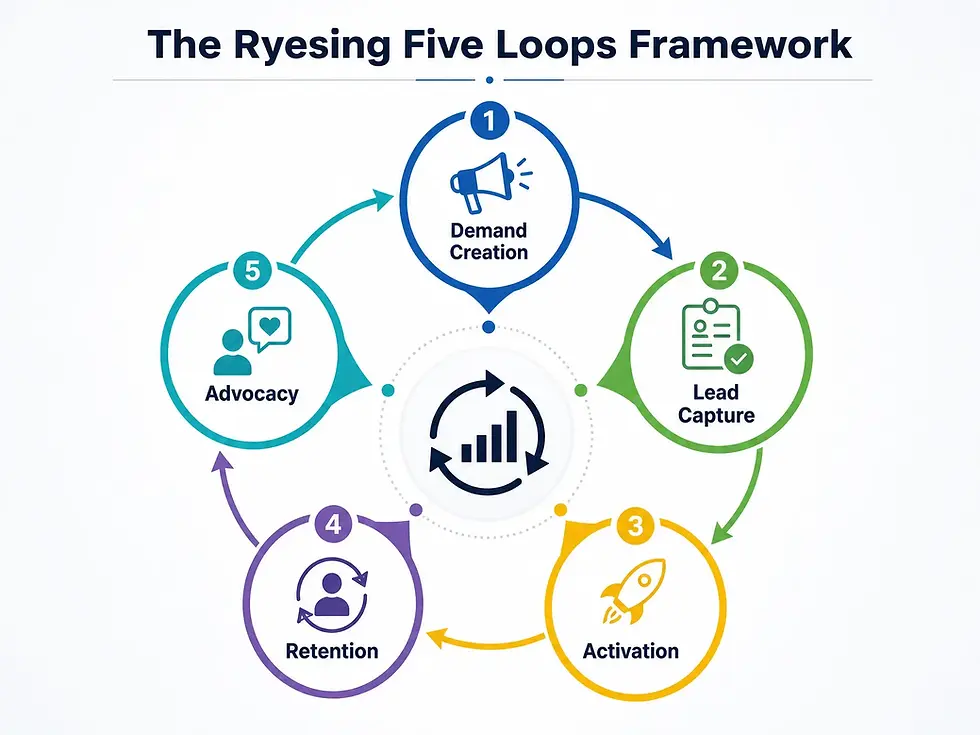
2. The Ryesing Growth Marketing Framework: The Five Loops
Most growth marketing frameworks focus on the AARRR funnel (Acquisition, Activation, Retention, Referral, Revenue). While useful as a mental model, it's too linear for how modern SaaS and B2B buyers actually behave.
At Ryesing, we structure growth around five interconnected loops, where the output of each loop feeds the next:
Loop 1: Demand Creation: Building awareness and pulling high-intent prospects into your ecosystem through content marketing, SEO, thought leadership, community-led engagement, and paid media.
Loop 2: Lead Capture & Qualification: Converting anonymous visitors into known prospects via optimised landing pages, gated assets, free tools, and lead scoring models aligned to your ICP.
Loop 3: Activation & Conversion: Shortening the path from qualified lead to paying customer through sales enablement, product-led onboarding, and automated nurture sequences.
Loop 4: Retention & Expansion: Reducing churn and driving net revenue retention (NRR) above 100% through lifecycle marketing, customer success alignment, and upsell/cross-sell programmes.
Loop 5: Advocacy & Referral: Turning satisfied customers into vocal advocates who create social proof, generate warm referrals, and reduce CAC for new acquisition.
💡 Internal Resource To see how this framework maps to a practical GTM plan, download the free Ryesing GTM Strategy Framework eBook |
3. Why Growth Marketing Matters Specifically for B2B, SaaS, Law Firms, and Professional Services
Growth marketing was born in the tech world, but its principles are universal, particularly valuable for any business with a complex or longer sales cycle, a high-value customer relationship, or a recurring revenue model. Here is why it matters across our core client segments:
B2B SaaS Companies
In SaaS, your unit economics, CAC, LTV, payback period, churn rate, are existential. Growth marketing gives you the measurement infrastructure to understand which channels and messages produce the highest LTV customers (not just the most leads), and the experimentation discipline to continuously improve those ratios.
Law Firms & Professional Services
Law firms, financial advisors, and consultancies traditionally rely on referrals and reputation. Growth marketing builds a digital referral engine, a content and SEO system that surfaces your expertise to prospects actively searching for your services, generating enquiries without requiring a referral introduction.
Real Estate & Financial Advisors
In markets characterised by long consideration cycles and high transaction values, content-led growth marketing builds the trust required for a prospect to take the first step. An advisor who publishes the most useful educational content in their niche consistently wins against the competitor who only runs ads.
Ecommerce Brands
Growth marketing for ecommerce focuses on customer acquisition cost relative to repeat purchase behaviour. Lifecycle marketing, email, SMS, loyalty programmes, transforms a one-time buyer into a high-LTV customer. This is the difference between profitable ecommerce and a business that chases revenue but never builds equity.
Is Your Business Ready for a Growth Marketing System?
Book a free 30-minute discovery call with a Ryesing growth strategist. We'll map your current funnel, identify the biggest growth levers, and show you exactly where we'd start.
→ Book Your Free Discovery Call →

Q: How long does it take to see results from growth marketing?
A: It depends on the mix of channels. Paid acquisition can show results in days. SEO and content marketing typically take 3–6 months to build meaningful traffic, but the compounding returns are far superior to paid. A well-structured growth marketing programme usually shows measurable pipeline impact within 90 days, with compounding gains beyond that.
Q: What metrics should I track for growth marketing?
A: The critical metrics are: Customer Acquisition Cost (CAC), Customer Lifetime Value (LTV), LTV:CAC ratio (aim for 3:1 or higher), Monthly Recurring Revenue (MRR) growth rate, Net Revenue Retention (NRR), Organic traffic and conversion rate, and Marketing Qualified Lead (MQL) to Sales Qualified Lead (SQL) conversion rate.
4. The Four Pillars of an Effective Growth Marketing Programme
Every effective growth marketing programme, regardless of industry or company stage, rests on four structural pillars:
Pillar 1: A Clear ICP and Positioning
Growth marketing without a defined Ideal Customer Profile (ICP) is expensive noise. You need to know precisely who you're targeting, what problem you solve for them, and why they should choose you over every alternative, including doing nothing. This is the strategic foundation that everything else depends on.
At Ryesing, we formalise this through our Digital Strategy process. See how we build ICP-first strategies
Pillar 2: Content & SEO as the Foundation
Organic content and SEO are the most capital-efficient customer acquisition channels available to B2B and SaaS businesses. A well-executed content and SEO programme compounds over time: every piece of content you publish today continues to generate traffic and leads months or years from now, without incremental spend.
This is fundamentally different from paid advertising, which stops the moment you stop paying. Explore our Content Marketing service
Pillar 3: Performance Marketing for Demand Capture
Once your organic foundation is established, performance marketing, Google Ads, LinkedIn Ads, Meta, amplifies it. The critical principle is that you should be capturing existing demand (people actively searching for solutions like yours) before you invest in demand creation through paid social. See our Performance Marketing approach
Pillar 4: AI-Enabled Workflows
The companies winning in 2026 are not just doing more marketing, they're doing it faster, with higher quality, at lower cost, by embedding AI into their marketing workflows. This includes AI-assisted content creation, predictive lead scoring, automated personalisation, and AI-powered competitive intelligence. Explore Ryesing AI Solutions
5. How to Start: The Ryesing 90-Day Growth Marketing Launchpad
If you're starting from scratch or trying to bring rigour to an existing programme, here is the practical 90-day sequence we recommend:
Days 1–14: Audit and ICP alignment. Review all existing content, campaigns, and channels. Define or refine your ICP. Establish your baseline metrics: organic traffic, CAC, MRR, churn.
Days 15–30: Keyword research and content strategy. Map your ICP's questions and pain points to content topics. Build a 12-week editorial calendar with clear keyword targets and conversion goals for each piece.
Days 31–45: Technical SEO and site health. Fix crawl errors, optimise page speed (target 80+ desktop, 70+ mobile), ensure all pages are properly indexed, and resolve keyword cannibalization.
Days 46–60: Demand capture campaigns. Launch or optimise Google Ads targeting high-intent keywords. Ensure your landing pages are conversion-optimised with clear, single CTAs.
Days 61–75: Lead nurture sequences. Build or refine your email nurture flows. Map content to each stage of the buyer journey. Connect your CRM to your marketing automation.
Days 76–90: Measure, report, iterate. Review all KPIs against baselines. Identify the top three experiments for the next 90 days. Double down on what's working; kill what isn't.
Q: How is growth marketing different from digital marketing?
A: Digital marketing is an umbrella term for marketing activities conducted via digital channels. Growth marketing is a strategic philosophy and operating model that can use digital channels, but it's defined by its data-driven, experimental approach and full-funnel orientation, not by the channels used.
Q: Can growth marketing work for non-tech businesses like law firms or real estate agencies?
A: Absolutely. The principles of growth marketing, understanding your ideal customer, building content that addresses their specific questions, measuring what works, and iterating, apply to any business with a defined target customer and a product or service worth buying. The channel mix differs, but the system is the same.
Your Growth Marketing Questions Answered
What is the difference between growth marketing and performance marketing?
Performance marketing is a subset of growth marketing that focuses specifically on paid channels (PPC, paid social, affiliate) where results are directly measurable. Growth marketing is the broader system that includes organic, content, SEO, lifecycle, product-led, and community channels, with performance marketing as one lever within it.
How much should a B2B SaaS company budget for growth marketing?
Industry benchmarks suggest early-stage SaaS companies (pre-Series A) should allocate 15–25% of ARR to marketing. Growth-stage companies (Series A–B) typically invest 25–40% of ARR. The more important question is efficiency: what is your CAC payback period and LTV:CAC ratio?
Do I need a growth marketing agency or can I build this in-house?
Both options work, but the economics differ significantly. An in-house team offers deep brand knowledge but requires 6–12 months to hire and ramp. A specialist growth marketing agency like Ryesing brings an integrated team of strategists, content specialists, SEO experts, and paid media managers immediately, typically at a fraction of the cost of a full in-house team.
What industries does Ryesing serve with growth marketing?
Ryesing specialises in growth marketing for B2B SaaS companies, B2B technology firms, law firms and professional services, real estate businesses, financial advisors, and ecommerce brands. Our approach is tailored to each sector's specific buyer journey, competitive landscape, and unit economics.
Conclusion: Growth Marketing Is a System, Not a Campaign
Growth marketing is not a tactic you run for a quarter and review. It's a system, a compounding engine built on clear ICP definition, strategic content, data-driven experimentation, and continuous optimisation across the full customer lifecycle.
For B2B SaaS founders, CMOs, CTOs, and business leaders in professional services, real estate, fintech, and ecommerce, the question is no longer whether to invest in growth marketing, it's whether you're building the system with the rigour and expertise it demands.
At Ryesing, we build and run these systems for ambitious companies that want predictable, compounding growth. We combine senior marketing talent with AI-enabled workflows to give you the output of a full-stack growth team without the overhead.
