
What Is Product Marketing Explained for UK Startups

Updated: Jun 1
Product marketing is the strategic force responsible for launching a product into the market and making sure it sticks with the right people. Think of a product marketer as the director of a film. They don't build the sets (that's the product team) or sell the tickets (that's sales), but they are the ones who pull the entire story together to make sure it captures the audience's heart and mind.
Defining Product Marketing: The Bridge Between Product and Customer
At its heart, product marketing is all about taking a product's features and translating them into clear, compelling benefits that actually mean something to a specific audience. It's a role that lives right at the crossroads of product, marketing, and sales, acting as the essential connective tissue that aligns the whole company around what the customer truly needs.

While other marketers might be focused on broad brand awareness or lead generation, the product marketer's world revolves entirely around the product itself. Their mission is crystal clear: deeply understand the market, shape the product's story, and drive its adoption and commercial success.
The Voice of the Customer
A truly great product marketer is, above all else, the voice of the customer inside the company walls. They have an obsession with understanding the market's deepest needs, pain points, and motivations. This means getting their hands dirty with deep research, customer interviews, and relentless competitive analysis to ensure the product solves real-world problems.
This customer-centric focus is the thread that runs through the entire product lifecycle. It dictates which features get built, how they are described, and who they are ultimately sold to. Getting this right is fundamental to success; for a deeper dive, it's worth understanding the process of validating product-market fit.
"Marketing is no longer about the stuff you make, but about the stories you tell." – Seth Godin, Author and Entrepreneur
Seth Godin's words perfectly capture what product marketing is all about. It’s not just about listing features on a website; it’s about crafting a narrative that makes customers feel seen and understood, positioning the product as the hero that helps them win their day.
From Strategy to Execution
This strategic role isn't just about high-level thinking; it translates directly into tangible outputs that move the business forward. The work of a product marketer underpins nearly every interaction a customer has with the company.
Their strategic oversight leads to several key functions:
Positioning and Messaging: Defining exactly how the product is perceived in the market and creating the core language used to talk about its value.
Go-to-Market (GTM) Strategy: Architecting the comprehensive plan for launching a new product or feature to smash specific business goals. You can learn more by exploring our detailed guide on what is a go-to-market strategy.
Sales Enablement: Arming the sales teams with the knowledge, tools, and materials they need to sell the product effectively and confidently.
Market Intelligence: Keeping a sharp eye on the competitive landscape and market trends to inform strategy and spot new opportunities.
Ultimately, a product marketer is the person who ensures that the amazing "what" built by the product team is successfully connected to the "why" for the customer, turning innovative features into undeniable value.
The Core Responsibilities of a Product Marketer
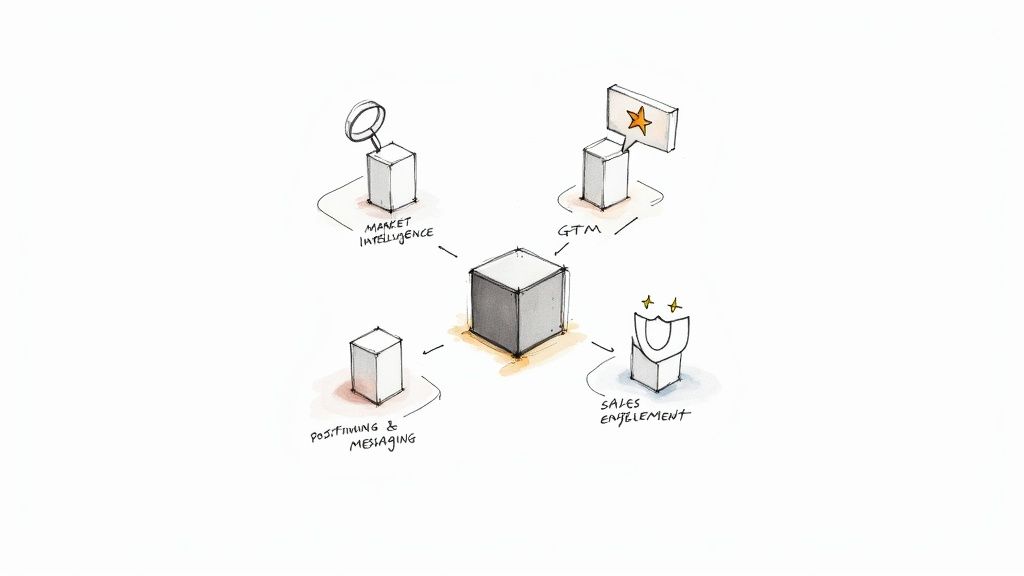
The role of a product marketer is a true blend of art and science, mixing strategic thinking with sleeves-rolled-up execution. Their responsibilities aren't a random collection of tasks; they are a set of strategic pillars designed to drive one thing: getting the right product into the right hands and making it a commercial success.
Think of them as the lead architect for a product's entire market journey. They draw up the blueprints (that’s the positioning), survey the land (market intelligence), manage the launch (GTM), and then give the sales team the keys and tools they need to sell the property.
At its core, the job can be broken down into four critical, interconnected domains. Each one builds on the last, creating a powerful engine for growth.
Conducting Deep Market Intelligence
Before a single word of marketing copy is written or a single ad is launched, the product marketer must become the undisputed expert on the market. This isn't about a quick glance at competitor websites; it's a deep, ongoing intelligence mission to understand the entire ecosystem the product lives in.
This really boils down to two key areas:
Customer Intelligence: This is all about getting inside your customer's head. It means running interviews, launching surveys, and digging into user data to uncover their real pain points, what motivates them, and the "job" they are "hiring" your product to do. A deep understanding of your ideal customer profile is the key to startup growth.
Competitive Intelligence: This goes way beyond simple feature comparisons. A product marketer for a UK fintech, for example, might track a local rival’s pricing changes, new feature announcements, and even their customer reviews to spot strategic weaknesses or gaps in the market.
This intelligence is the bedrock upon which everything else is built. Without it, you're just guessing.
Crafting Resonant Positioning and Messaging
Armed with a solid grasp of the market, the product marketer's next job is to define the product's story. This is arguably their most critical function because it becomes the North Star for the entire company.
Positioning is about carving out a specific, defensible space in the customer's mind. For instance, a UK-based HR software might position itself not just as another HR tool, but as "the only HR platform designed for the complexities of UK employment law for scale-ups." It’s specific, targeted, and clear.
A product marketer's core job is to translate what the product can do into a story about what the customer can achieve. It's the art of turning features into a future state.
From this single positioning statement, all other messaging flows. The product marketer creates a messaging hierarchy, a core value proposition that’s then broken down into key pillars and supporting points. This framework ensures every piece of communication, from a website headline to a sales pitch, is consistent, compelling, and speaks directly to what the customer actually cares about.
Architecting the Go-To-Market Strategy
When it’s time to launch a new product or a major feature, the product marketer steps into the director's chair. They are responsible for architecting the entire Go-to-Market (GTM) strategy, a comprehensive plan that coordinates every single department to ensure a successful launch.
This isn't just a marketing plan. A proper GTM strategy orchestrates the efforts of product, sales, marketing, and customer support to achieve specific business goals, whether that’s user acquisition, revenue targets, or capturing market share.
Empowering Revenue Teams with Sales Enablement
Finally, a product marketer's job doesn't stop once the product is out in the wild. A huge, ongoing responsibility is sales enablement, equipping sales and other customer-facing teams with the knowledge, tools, and materials they need to sell effectively. This is where product marketing’s value becomes incredibly tangible.
This involves creating practical assets that teams use every day:
Sales Battlecards: These are concise, one-page documents that arm a salesperson with key talking points, competitive differentiation, and sharp answers to common objections. For a UK SaaS company, this might include specific counters to local competitors.
Product Demos and Training: Making sure the sales team can confidently and compellingly demonstrate the product's value.
Case Studies and Testimonials: Building a library of powerful proof points that show how real customers have found success.
The impact of these strategies is clear in broader market trends. With increasing sales revenue being the top priority for 54% of UK businesses, the focus on high-ROI activities like sales enablement is more critical than ever. This aligns with high satisfaction rates in related areas, where 69% of UK marketers are satisfied with social media ad performance and 59% with content marketing. You can discover more UK digital marketing statistics to see how these efforts connect.
Product Marketing vs The World: Key Differences Explained
To really get what product marketing is, it helps to first understand what it isn't. The lines between product marketing and its neighbours, product management, growth marketing, and marketing communications, can get incredibly blurry, especially in fast-moving UK startups where people often wear multiple hats. This overlap can easily lead to confusion, duplicated effort, or worse, critical gaps in your strategy.
Let's clear things up. A great way to think about it is to imagine you’re bringing a new high-performance car to a championship race. To win, every single role on that racing team has to be distinct, but they all need to be essential.
The Race Team Analogy
Picture your product as that finely tuned racing car. To have any chance of winning the championship, you need a specialised team working in perfect harmony.
Product Management is the Engineering Team: These are the brilliant designers and mechanics who actually build the car. They’re obsessed with aerodynamics, engine performance, and materials, the "what" and "how" of the car itself. They make the car go fast.
Product Marketing is the Race Strategist: This is the person in the headset who knows the track inside and out. They study the competition's every move and understand the driver's strengths. They create the winning race plan, when to pit, when to push, and how to adapt to changing conditions on the fly.
Growth Marketing is the Performance Tuner: This expert works trackside, constantly glued to the data streaming from the car's telemetry. They make real-time adjustments to the engine mapping and tyre pressure to squeeze every last drop of speed out of the car during the race.
Marketing Communications is the PR and Brand Manager: They’re in charge of the team's public image. They handle media interviews and make sure the team's sponsors and brand are presented in the best possible light to the world.
Each role is vital. Without the engineers, there’s no car. Without the strategist, the driver is flying blind. Without the tuner, the car isn't at its peak performance. And without the PR manager, nobody even knows or cares about the team. This is exactly how these functions operate within a business.
Goals and Metrics: A Clear Comparison
Analogies are great for framing the concept, but let's break down the practical differences in their day-to-day focus. While all these teams ultimately want the business to grow, their primary goals and the metrics they live and die by are quite different.
A common point of failure in startups is having a brilliant product (great engineering) that fails to gain traction because there was no race strategy (product marketing) to guide its journey on the track.
The table below outlines the distinct focus for each function, highlighting what makes their contribution unique. Getting this clarity is crucial for structuring your teams effectively and making sure everyone is pulling in the same direction.
Product Marketing vs Other Key Functions
Function | Primary Goal | Key Metrics (KPIs) | Typical Activities |
|---|---|---|---|
Product Marketing | Drive product adoption and market success. | Product adoption rate, win rate, feature usage, revenue influenced, sales cycle length. | Positioning, messaging, GTM strategy, competitive analysis, sales enablement, launch planning. |
Product Management | Build a product that solves user problems. | User satisfaction (NPS/CSAT), feature adoption, user retention, development velocity. | User research, roadmap planning, writing user stories, feature prioritisation, managing backlogs. |
Growth Marketing | Acquire and retain users at scale. | Customer Acquisition Cost (CAC), Lifetime Value (LTV), conversion rates, user activation rate. | A/B testing, running paid ad campaigns, SEO optimisation, viral loop creation, onboarding optimisation. |
Marketing Comms | Build and protect the company's brand and reputation. | Share of voice, brand sentiment, press mentions, social media engagement. | Public relations, content creation, social media management, brand storytelling, event management. |
Understanding these distinctions is the first step toward building a truly effective go-to-market engine. It ensures every team member knows their role, focuses on the right metrics, and brings their unique expertise to the collective goal. This is especially important when you're looking into scaling your product-led growth, as each function plays a specific and crucial part in that motion.
Essential Frameworks and Playbooks for Product Marketing Success
Theory is a great starting point, but what is product marketing without solid execution? The real magic happens when you apply structured frameworks that turn your strategy into tangible action. Think of these not as rigid, unbreakable rules, but as flexible playbooks that bring consistency and clarity to everything you do. They ensure every launch and campaign is built on solid ground.
In this section, we'll get straight to the actionable tools you can put to work immediately. We’re going to unpack three powerful concepts: the 'Jobs to Be Done' framework for getting deep customer insight, a Messaging Hierarchy for telling a consistent story, and a Go-to-Market (GTM) checklist specifically tailored for the UK market. Each one is a mini-playbook designed for the real world.
This simple map shows how product marketing acts as the central hub, connecting product, growth, and communications to drive one unified strategy.

As you can see, product marketing isn't an isolated function. It’s the strategic core that makes sure every other team is aligned and pulling in the same direction towards the same market-facing goals.
Uncover Customer Motivation with Jobs to Be Done
The Jobs to Be Done (JTBD) framework is an absolute game-changer for understanding why customers actually buy. It forces a shift in focus from who the customer is (their demographics) to what they are trying to accomplish in their life or work. The core idea is that customers don't just buy products; they "hire" them to do a specific job.
For instance, a project manager doesn't just buy project management software. They hire it to "gain control over chaotic projects" or to "confidently report progress to leadership." Getting to the heart of this "job" is the secret to creating messaging that resonates on a much deeper, more emotional level.
To start applying JTBD, weave these questions into your next customer interviews:
Struggling Moment: What was happening in your world that first made you think, "I need a better way to do this"?
Desired Outcome: What progress were you trying to make? What does that better future look like for you?
Hiring Criteria: When you were looking at different options, what were the most important things you were looking for?
The answers you get will pinpoint the real motivation behind the purchase, which should become the foundation for all your marketing.
Build Consistent Narratives with a Messaging Hierarchy
Once you know the customer's "job," you need a consistent way to talk about how your product helps them get it done. A Messaging Hierarchy is a simple but incredibly powerful tool for organising your story, from the highest-level value proposition right down to the nitty-gritty features.
It’s best to think of it as a pyramid.
Top (The Value Proposition): A single, compelling sentence that nails the main benefit you deliver to your ideal customer.
Middle (Key Pillars): Three to four core benefits or differentiators that support your main value proposition. These are the main chapters of your story.
Bottom (Supporting Points & Features): The specific features, functions, and proof points that make each of your pillars believable and tangible.
This hierarchy isn't just some internal document you create and forget. It becomes the single source of truth for your website copy, sales decks, ad campaigns, and social media posts, ensuring every customer touchpoint tells the same powerful story.
This structured approach solves the all-too-common problem of different teams using slightly different (or wildly conflicting) language, which only dilutes your brand and confuses potential customers. It gets everyone, from sales to support, singing from the same hymn sheet.
Execute Flawless Launches with a GTM Checklist
A Go-to-Market (GTM) strategy is all about coordinating every department to make sure a product launch actually hits its goals. For UK startups, a streamlined checklist can bring some much-needed order to the chaos of a launch. This isn't about adding bureaucracy; it's about making sure nothing critical falls through the cracks.
Your playbook should be broken down into clear, manageable phases.
Phase 1: Pre-Launch (4-6 weeks out)
Finalise positioning and messaging, anchored in your JTBD research.
Set clear, measurable launch goals (e.g., acquire 100 new trial users in the first month).
Create all internal sales enablement materials (battlecards, FAQs, product one-pagers).
Develop core external assets like the landing page and announcement blog post.
Phase 2: Launch Week
Push all website updates live and announce the launch across your key channels.
Hold one last briefing with the sales and customer support teams to ensure they're ready.
Monitor initial feedback and performance metrics like a hawk.
Phase 3: Post-Launch (1-4 weeks after)
Proactively gather customer feedback and testimonials.
Analyse all the launch data against your initial goals. What worked? What didn't?
Run a post-mortem with all the teams involved to capture lessons for the next launch.
By using these kinds of frameworks, product marketing transforms from a reactive, last-minute function into a strategic driver of growth. You ensure every decision is rooted in deep customer understanding and every action is executed with precision.
Measuring Success: KPIs That Truly Matter
So, how do you actually measure the impact of a role as strategic as product marketing? It’s a common question, and the answer isn't a single, neat metric. A product marketer’s influence touches the entire customer journey, from the first time someone hears your brand name right through to them becoming a long-term advocate.
To get a real sense of its value, you need a full-funnel view. It’s about ditching the question, "What did the product marketing team do?" and instead asking, "What business results did their work actually drive?" This means connecting activities like positioning, messaging, and go-to-market strategies directly to tangible business outcomes.
Top of Funnel Impact: Awareness and Consideration
Right at the top of the funnel, product marketing sets the stage. The job here is to make sure your product's story cuts through the market noise and connects with the right people. You’re aiming to grab their attention and spark genuine interest.
Here’s what to track:
Share of Voice (SOV): This is all about your brand's visibility compared to your competitors. If your SOV is climbing, it’s a good sign your messaging and launch campaigns are making an impact and boosting your presence.
Landing Page Conversion Rates: For any page shouting about a new feature or product, the conversion rate (think demo requests or trial sign-ups) is a direct measure of how well your value proposition is landing.
Website Traffic to Key Pages: A spike in organic or referral traffic to specific product pages is often a strong signal that your positioning is hitting the mark and pulling in qualified prospects.
Product marketing in the UK has become a seriously data-driven field, with digital channels being the primary way brands introduce their products. Projections show that UK digital advertising revenue is set to blow past £40 billion in 2025, which would be the strongest year for digital marketing spend in the region. This growth is fuelled by targeted social media and online ads, making metrics like landing page performance more vital than ever.
Mid-Funnel Influence: Sales Effectiveness
This is where product marketing’s contribution to revenue really starts to shine. By arming the sales team with the right tools, messaging, and competitive intelligence, product marketers directly influence their ability to win deals.
The core purpose of sales enablement is to shorten the sales cycle and increase the win rate. If these two numbers are moving in the right direction, your product marketing is working.
The essential KPIs for this stage are pretty clear-cut:
Win Rate: The percentage of deals won from qualified opportunities. A rising win rate often points to clearer messaging and stronger competitive differentiation, both of which are squarely in product marketing's court.
Sales Cycle Length: The average time it takes to close a deal. Effective sales materials, like battlecards and case studies, help salespeople handle objections more efficiently, which naturally shortens this cycle.
For a deeper dive into how these metrics fit into the broader marketing world, this definitive guide on KPIs in Digital Marketing provides some excellent context.
Bottom of Funnel Success: Adoption and Retention
A product marketer's work is far from over when a customer signs the contract. The focus now pivots to making sure customers actually use the product, find value in it, and stick around for the long haul. This is absolutely critical for retention and sustainable growth.
Metrics to keep a close eye on here include:
Product Adoption Rate: What percentage of new customers actively start using key features within their first month? This is a powerful indicator of a successful onboarding experience, which is often shaped by product marketing.
Feature Usage: Tracking how many customers are using a newly launched feature is the ultimate test of whether your go-to-market strategy successfully communicated its value.
Customer Lifetime Value (CLV): While it's a high-level business metric, product marketing plays a huge part in boosting CLV by driving adoption, supporting upsell opportunities, and contributing to retention efforts.
Tracking these KPIs across the entire funnel allows you to build a clear, data-backed picture of product marketing’s true value to the business. It’s not just about a list of completed tasks; it’s about measurable impact.
To bring this all together, here’s a table that maps specific product marketing activities to the business goals and metrics they influence.
Mapping Product Marketing Activities to Business KPIs
Product Marketing Activity | Business Goal | Primary KPI | Secondary KPI |
|---|---|---|---|
Positioning & Messaging | Increase Market Awareness | Share of Voice (SOV) | Website Traffic to Key Pages |
Go-to-Market (GTM) Strategy | Drive New Leads & Pipeline | Landing Page Conversion Rate | Marketing Qualified Leads (MQLs) |
Sales Enablement | Improve Sales Effectiveness | Win Rate | Sales Cycle Length |
Product Launch | Drive Feature Adoption | Product Adoption Rate | Feature Usage Percentage |
Customer Marketing | Increase Customer Retention | Customer Lifetime Value (CLV) | Net Revenue Retention (NRR) |
This framework helps clarify how strategic initiatives directly translate into the numbers that matter most to the C-suite, proving product marketing's role as a critical driver of growth.
Building Your Product Marketing Function from the Ground Up
For UK founders, deciding when and how to build out your product marketing team is one of those pivotal growth decisions. Get it right, and you create a powerful engine for adoption, revenue, and market clarity. Get it wrong, and you risk burning cash on a role the business simply isn't ready for.
The secret isn't hiring a full team overnight. It’s a progressive build, starting with embedding the right mindset long before you even think about writing a job description.
The Founder as the First Product Marketer
In the very early days, the founder is the product marketer. Forget fancy titles; before you’ve found product-market fit, your main job is to be obsessed with customer conversations, deeply understand their pain points, and translate your complex product ideas into a simple, compelling story.
This is all about applying core product marketing principles without the formal role. Here’s how you can do it:
Live with your customers: Block out several hours every single week just to talk to users and prospects. Your goal is to intimately understand the "job to be done" they are hiring your product for.
Create a one-page messaging doc: Force yourself to clearly define your target audience, their biggest problem, your solution, and what actually makes you different. Keep it simple and brutally honest.
Build one great sales asset: Don't boil the ocean. Focus on a single, powerful case study that proves your product delivers real-world value. This is your first piece of social proof.
Doing this foundational work ensures that when you are ready for your first hire, they have a solid base to build from, not a blank slate.
Making Your First Product Marketing Hire
The right time to bring on your first dedicated product marketer is usually as you’re approaching or have just found product-market fit. The business has traction, but you need a specialist to sharpen the narrative, add structure to your launches, and properly arm your growing sales team.
Your first hire should be a strategic generalist, a Swiss Army knife of a marketer. You need someone who can write compelling copy, jump on a call with a customer, analyse competitors, and create sales tools that don't suck.
Their priorities for the first 90 days should be crystal clear:
Own the messaging: Formalise the company's positioning and value proposition into something everyone understands and can repeat.
Launch something: Give them ownership of a feature launch to establish a repeatable process and show immediate impact.
Enable sales: Deliver one or two high-impact sales tools, like battlecards against your key UK competitors or a killer new demo script.
Structuring the Team as You Scale
As your company grows, a single product marketer will inevitably become a bottleneck. The question then shifts from who to hire to how you should structure the team for what's next.
There are three common models for organising a growing product marketing function, each with its own merits:
By Product Line: If you have multiple distinct products or platforms, it makes sense to dedicate a PMM to each one. This ensures deep product expertise.
By Customer Segment: If you serve different industries or company sizes (e.g., SMB vs. Enterprise), aligning your PMMs to those segments ensures your messaging resonates with each unique audience.
By Functional Expertise: As the team matures, you might create specialised roles for things like competitive intelligence, market research, sales enablement, or pricing and packaging.
Choosing the right structure is all about ensuring that as your business complexity increases, your product marketing function remains focused, effective, and directly aligned with driving company growth.
Frequently Asked Questions About Product Marketing
To wrap up our deep dive, let's get into some of the practical, on-the-ground questions I often hear from UK startup leaders. This is where the theory meets reality.
What Is the Ideal Background for a Product Marketer?
There's no single cookie-cutter path, which is part of what makes the role so dynamic. What really matters is a potent mix of strategic thinking, sharp communication skills, and genuine customer empathy. I’ve seen brilliant product marketers come from product management, sales engineering, and even management consultancy.
For UK SaaS companies, having direct experience with our local market nuances, GDPR, and the specifics of B2B buyer behaviour is a massive advantage. The ideal candidate has what we call a T-shaped skill set: a broad understanding across product, marketing, and sales, but with a deep, focused expertise in positioning and market analysis.
How Can a Startup with No Budget Implement Product Marketing?
This is a common one, and the answer is simple: product marketing is a function long before it becomes a job title. An early-stage founder can, and should, start doing the work without a dedicated budget.
Start by carving out 3-4 hours every single week just to talk to customers. Your only goal is to understand their world and their problems. From there, create a simple one-page messaging doc that nails down your audience, their pain points, and your unique value proposition. This becomes the source of truth for your website copy and sales emails, ensuring consistency. Focus on creating just one powerful piece of sales enablement collateral, like a solid customer case study, to help your first sales hire close those crucial early deals.
It's about embedding the mindset before you hire the headcount. The most powerful product marketing starts with a deep, authentic connection to the customer's world, which costs time, not money.
Which Tools Are Essential for a New Team?
You can get incredibly far with a lean toolkit, so don't feel you need to spend a fortune. For competitive intelligence, tools like Crayon are fantastic down the line, but you can absolutely start with Google Alerts and a well-organised spreadsheet.
For sales enablement, a shared Google Drive is more than enough to get you started before you need a dedicated platform like Highspot. When it comes to managing launches, simple project management tools like Asana or Trello are perfect.
But the most critical 'tool' in your arsenal is your CRM, whether that's HubSpot or Salesforce. It’s the source of truth, providing invaluable data on which messages and content are actually connecting with prospects and driving the business forward.
Conclusion: Turning Innovation into Undeniable Value
Product marketing is far more than a collection of tactical tasks, it is the strategic anchor that dictates whether a great product succeeds or stalls in a crowded market. By operating at the exact intersection of product, marketing, and sales, the product marketer ensures that your business never loses sight of its ultimate guide: the voice of the customer.
As we've explored, building a high-performing go-to-market engine isn't about guesswork.
It requires clear playbooks and a commitment to the fundamentals:
Deep Market Intelligence: Continually diagnosing your customers' real motivations through frameworks like "Jobs to Be Done."
Consistent Narratives: Using structured messaging hierarchies so your internal teams and your external market stay entirely aligned.
Empowered Teams: Delivering high-ROI sales enablement tools to shorten deal cycles and protect profit margins.
Full-Funnel Metrics: Looking past simple completion checklists to measure real business drivers, from top-of-funnel conversion to long-term customer retention.
Ultimately, your engineering and product teams build the "what", but it takes dedicated product marketing to consistently communicate the "why."
Ready to Scale Your Go-to-Market Strategy?
Navigating the transition from founder-led marketing to a fully scaled, data-driven engine requires a balance of sharp market insight and flawless tactical execution. You don't have to navigate the complexities of positioning, sales enablement, and launch orchestration alone.
At Ryesing Limited, we design and execute the bespoke GTM programmes that turn innovative software into undisputed market leaders. Whether you are validating product-market fit or restructuring your marketing team for rapid growth, our blend of expert strategy and AI-enabled execution is designed to scale your brand sustainably.
Take the next step in your growth journey. Visit Ryesing Growth Marketing Agency today to discover how we can help you turn your product's features into undeniable market value.


