
Content Marketing for Tech Companies: 2026 Growth Strategies

Updated: Apr 23
In the tech world, content marketing isn't just about blog posts and white papers. It's the engine that powers sustainable growth. It’s the process of creating and distributing genuinely helpful, problem-solving content to attract, engage, and ultimately win over a highly technical and discerning audience.
Instead of a hard sell, it’s about demystifying complex solutions and building trust. This strategy transforms your deep-seated expertise into your single most powerful marketing asset.
Why Content Is Your Most Valuable Asset in Tech

Let’s be honest: in the B2B tech space, old-school marketing tactics just don't cut it. Your buyers are smart, technically proficient, and can spot a generic sales pitch from a mile away. They don’t want to be sold to; they want to be educated.
This is precisely where content marketing for tech companies becomes your secret weapon.
Think of your content as an interactive product demo that runs 24/7. It doesn’t just rattle off features. It walks potential customers through solving their real-world problems, showing them the value of your solution long before a salesperson ever enters the picture.
This approach is crucial because B2B tech decisions are never made on a whim. Buyers consume, on average, 13 pieces of content before they even think about making a purchase. Your blog posts, white papers, and webinars are the vital touchpoints that build confidence and keep your brand top of mind throughout that long journey.
The Core Pillars of a Winning Tech Content Strategy
To really succeed, your content strategy needs to stand on three unshakable pillars. Each one is designed to meet a specific need of the modern tech buyer, and together, they create a formidable demand generation engine.
Educating Sceptical Buyers: Your number one job is to teach, not to promote. When you provide genuine insights and actionable advice, you build the trust needed to turn a curious reader into a qualified lead.
Demystifying Complex Solutions: Tech products can feel intimidating. Great content slices through the complexity, using clear language and relatable analogies to make your solution understandable and accessible to a much wider audience.
Generating Qualified Demand: Every single piece of content should act as a magnet for the right people. This isn't about attracting everyone; it's about attracting prospects who have the exact problems your solution is built to solve.
Content is the currency of trust in the tech industry. It's how you prove your expertise, demonstrate value, and build relationships with customers who are tired of being marketed to and are instead seeking genuine solutions to their challenges.
Embracing AI for a Competitive Edge
On top of all this, the rise of AI-powered workflows is now allowing tech firms to scale these efforts without sacrificing quality. AI tools can help with everything from brainstorming topics to creating initial drafts, freeing up your team to focus on producing high-quality, personalised content more efficiently.
This isn't just theory; it's a strategic investment that pays real dividends. In the UK tech sector, companies now allocate a hefty 33% of their marketing budgets to content initiatives. And for good reason. Documented content strategies deliver a 33% higher ROI, and blogs alone can boost leads by an incredible 67%.
To truly get a handle on content marketing for tech companies, it's vital to understand the proven content marketing best practices that drive this kind of audience growth.
Finding Your Audience and Unique Voice
Effective content marketing in tech doesn't kick off with a clever keyword or a flashy title. It starts with a deep, almost obsessive understanding of who you're actually talking to. Pushing out generic content is like designing software for a user you've never met—it might function on a basic level, but it’s never going to feel intuitive or solve a real, pressing problem.
Your very first job is to go beyond surface-level demographics and build a detailed Ideal Customer Profile (ICP). In the tech world, this isn’t just about job titles and company size. It’s about getting into the technical weeds to figure out what truly keeps your audience up at night.
Moving Beyond Basic Personas
To build a profile that actually drives your strategy, you need to answer much sharper questions:
Technical Pain Points: What specific software incompatibilities are causing chaos? Are they hitting API limits, battling data silos, or just trying to keep a legacy system from falling over?
Buying Committee Dynamics: Who else has a say? You might be selling to the CTO, but the Head of Security and a Lead DevOps Engineer can absolutely veto the deal. Each of them needs an entirely different message.
Decision-Making Triggers: What event forces them to look for a solution right now? Was it a failed security audit? A C-suite directive to slash cloud spending? Or did a key engineer just quit out of sheer frustration with their current tools?
The goal is to paint a portrait so clear you can anticipate your audience's questions before they even think to ask them. This is how you turn dry technical jargon into compelling solutions that connect on a human level.
Uncovering Actionable Insights
So, where do you find this deep-seated information? It’s often hiding in plain sight, buried within the data your company already has. You just need to put on your detective hat and piece together the clues.
Here’s where to start digging:
Customer Interviews: Go straight to the source. Get your best customers on a call and ask them to walk you through the “before” picture. What was their world like before your solution came along? What other tools did they try?
Support Ticket Data: Your support logs are an absolute goldmine. Sift through them for recurring themes and frustrated language to pinpoint the most persistent and costly problems your product actually solves.
Sales Call Recordings: Listen to how prospects describe their challenges in their own words. Pay close attention to the objections they raise and which features get them genuinely excited. This is raw, unfiltered insight into their mindset.
For a more detailed look at this process, our guide on how to create an ideal customer profile for startup growth provides a complete, step-by-step framework.
Crafting Your Unique Voice
Once you truly understand who you're talking to, the how becomes a whole lot clearer. Your unique voice isn't just about tone—it’s about your perspective and your place in the market. It's the consistent way you communicate your expertise and values.
Are you the pragmatic, no-nonsense guide for overwhelmed engineers? Or are you the visionary thought leader painting a picture of the future for C-suite executives?
This voice has to be a direct reflection of your ICP. If your audience lives and breathes data, your content should be packed with statistics and case studies. If they're developers who can smell marketing fluff a mile away, your tone needs to be direct, technical, and brutally honest. This alignment is what makes your brand feel authentic and trustworthy, turning you into the obvious choice in a very crowded market.
Matching Content Formats to the Buyer's Journey
Creating content without a map is like shipping code without a deployment plan—it’s chaotic and almost guaranteed to miss the mark. In the world of content marketing for tech companies, that map is the buyer's journey. Aligning your content formats to each stage isn't just a nice-to-have; it's how you deliver the right message at the right moment, guiding prospects from a vague curiosity to a confident purchase.
This strategic alignment is critical because a potential customer’s mindset changes dramatically as they move through the funnel. Someone just realising they have a problem needs high-level, helpful education, not a dense feature comparison. On the flip side, a prospect who's ready to buy needs proof and validation, not another introductory blog post.
When you match your content to their intent, your marketing stops feeling like a series of disconnected ads and starts feeling like an intuitive, helpful guide. This all starts with a deep understanding of who you're talking to, which then informs the personas you build and the voice you adopt.
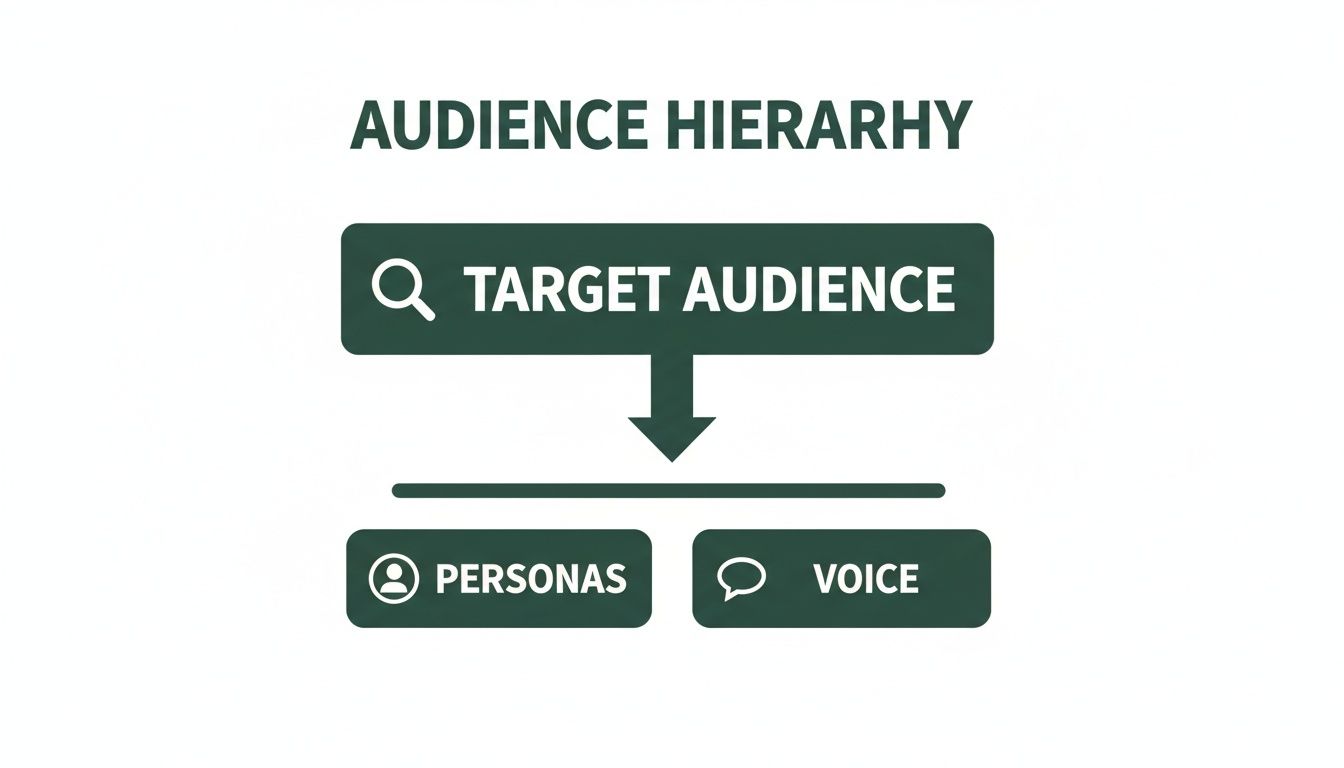
As you can see, everything flows from that initial audience insight. It’s the bedrock for creating content that genuinely clicks at every stage.
To make this more concrete, the table below maps out which content formats work best at each funnel stage, along with their goals and how to measure success.
Content Format Matrix for the Tech Marketing Funnel
Funnel Stage | Content Format Examples | Strategic Goal | Primary KPIs |
|---|---|---|---|
Awareness | Thought Leadership Articles, Industry Reports, Educational Webinars, Podcasts | Build brand authority, educate the market, and attract a broad audience. | Organic traffic, keyword rankings, social shares, new subscribers, backlink growth. |
Consideration | How-To Guides, Product Demo Videos, Comparison Guides, Webinars (Solution-Focused) | Showcase the product as a viable solution and build trust through practical application. | Lead magnet downloads, webinar registrations, time on page, video view duration. |
Decision | Case Studies, ROI Calculators, Free Trials, Customer Testimonials, Implementation Guides | De-risk the purchase, provide social proof, and make a direct case for your solution. | Demo requests, trial sign-ups, sales-qualified leads (SQLs), conversion rate. |
This matrix serves as a practical blueprint, helping you move from theory to a well-structured content plan that nurtures leads effectively from their first touchpoint to the final handshake.
Top of Funnel (ToFu): Building Authority in the Awareness Stage
At the top of the funnel, your main job is to attract and educate an audience that probably doesn't even know your company exists. They’re feeling the symptoms of a problem and are hitting search engines for answers, not for specific products. Your content here needs to be insightful, generous, and completely vendor-neutral.
This is the home of true thought leadership. The goal is to become a trusted resource, not a pushy salesperson.
Thought Leadership Articles: These are your deep-dive blog posts exploring industry trends, challenges, and forward-thinking ideas. They tackle your audience's biggest “why” and “how” questions without ever mentioning your product.
Data-Driven Industry Reports: Nothing builds authority like original research. Surveying your market and publishing the findings in a polished report is a magnet for backlinks, press coverage, and high-quality leads.
Educational Webinars: Hosting a live session with a respected industry expert on a broad, interesting topic is a fantastic way to build your email list and position your brand as a knowledge hub in your space.
Your objective here isn't lead generation; it's trust generation. By providing genuine value upfront, you earn the right to keep the conversation going.
Middle of Funnel (MoFu): Showcasing Solutions in the Consideration Stage
Once a prospect can put a name to their problem, they enter the middle of the funnel. Now, they're actively researching and comparing potential solutions. Your content has to pivot from broad education to specific, solution-oriented guidance that subtly introduces your product as a contender.
This is where product-led content really comes into its own, showing your solution’s value in a real-world context. You need to show, not just tell.
Video is especially potent at this stage. In the UK B2B tech scene, 77% of marketers are using social video and 59% are creating how-to guides. Given that a whopping 78% of online consumers would rather watch a video to learn about a product, formats like explainer videos and demos are non-negotiable for showing your solution in action. You can see the full breakdown of these UK content marketing trends at Digitaloft.co.uk.
Bottom of Funnel (BoFu): Closing the Deal in the Decision Stage
Down at the bottom of the funnel, prospects have whittled down their options and are hunting for that last piece of evidence to justify their decision. They need to de-risk the purchase and feel certain your solution will deliver on its promises. Your content must be direct, persuasive, and laser-focused on ROI.
This is where you make a clear, compelling case for why your product is the smartest choice.
Detailed Case Studies: Nothing convinces like a real-world success story. A powerful case study walks through the customer’s initial problem, how your solution was rolled out, and the specific, quantifiable results they saw.
Comparison Guides: Don't shy away from the competition. Create an honest, fair comparison between your product and key alternatives. By controlling the narrative and highlighting your unique strengths, you can steer the evaluation process in your favour.
ROI Calculators: An interactive tool that lets a prospect plug in their own numbers to see the potential financial return of using your solution is an incredibly persuasive sales enablement asset. It speaks directly to the budget holders.
Building Your Content Distribution Engine
Look, creating brilliant content is only half the job. In the crowded world of tech and SaaS marketing, even the most insightful white paper or game-changing webinar is totally useless if your ideal customer never sees it. A powerful, multi-channel distribution strategy is what turns your content from a dusty library asset into a machine that actually generates leads. It’s the difference between shouting into an empty room and starting a real conversation with the right people.
Think of it this way: your best content is a powerful engine, but an engine needs fuel and roads to go anywhere. Your distribution channels—SEO, social media, paid ads, and niche communities—are the roads that deliver your message to your audience, wherever they hang out. Without a deliberate plan, you’ve built a supercar but have no way to get it out of the garage.
The most common mistake I see is the “”publish and pray" approach. Teams spend weeks perfecting a piece of content, hit publish, cross their fingers, and just hope for the best. An effective distribution engine is the exact opposite: it's proactive, systematic, and designed to squeeze every last drop of value out of every single asset you create.
Establishing Authority with SEO
Organic search is still a cornerstone for tech companies. It’s how you catch prospects who are actively looking for solutions to the problems you solve. The trick is to move beyond just chasing individual keywords and start building genuine topical authority.
Pillar Pages: This is your magnum opus on a broad topic. Think“"The Complete Guide to API Security”" It's a comprehensive, long-form piece that acts as the central hub for that entire subject on your site.
Topic Clusters: These are shorter, more focused blog posts that dive into specific sub-topics related to your pillar page (e.g.,“"API Authentication Best Practices”" or“”"Common API Vulnerabilities"). Each of these cluster posts links back to the main pillar page, which signals to search engines that you have deep expertise across the whole subject.
This model doesn't just help your search rankings; it creates a much better experience for your visitors, guiding them through a logical path from one concept to the next.
Engaging Genuinely in Niche Communities
Your target audience doesn't just live on Google. They gather in niche online communities to ask questions, share their frustrations, and learn from their peers. Showing up authentically in these spaces is an incredibly powerful, high-intent way to get your content seen.
Forget about spamming links to your latest blog post. The goal here is to become a helpful, respected member of the community. That means joining industry-specific Slack channels, relevant subreddits (like r/sysadmin or r/devops), and focused LinkedIn Groups. Listen to the conversations, answer questions with real insight, and only share your content when it provides a direct, valuable answer to a specific problem someone is talking about.
In community-led distribution, your goal is not self-promotion; it’s helpfulness. By consistently providing value without asking for anything in return, you build trust and organically draw people to your brand.
Amplifying Reach with Paid and Syndication Channels
While organic methods build authority for the long haul, paid channels give you immediate, targeted reach. For B2B tech, professional networks are an absolute goldmine.
Targeted Promotion: Use platforms like LinkedIn to push your most valuable content—like a data-heavy report or an in-depth webinar—to a laser-focused audience. You can target by job title, company size, and industry to make sure your content gets in front of actual decision-makers.
Content Syndication: Team up with industry publications or B2B content networks to get your assets (think white papers and eBooks) promoted to their established audience. This is a fantastic way to generate qualified leads from a whole new group of relevant professionals who might not have found you otherwise.
The Power of Repurposing
Finally, the most efficient distribution strategies don't just promote an asset once; they atomise it. A single, high-effort piece of content can be sliced and diced into dozens of smaller pieces, maximising its reach across different channels and formats.
For example, a one-hour webinar can be repurposed into:
A series of short video clips for LinkedIn and Twitter, each highlighting one killer insight.
A detailed blog post summarising the main takeaways for those who prefer to read.
An infographic that visualises the most important data points.
A slide deck shared on SlideShare.
A series of quote graphics for social media, pulling out the most memorable lines.
This simple framework turns one big content effort into a multi-week campaign, ensuring you extract every ounce of value from your initial investment.
Measuring Content ROI and Proving Its Value
Let’s be honest. Creating great content takes a ton of work, time, and money. But the real fight for most marketing teams isn't about production; it’s about proving that the whole effort actually pays off. In the world of content marketing for tech companies, vanity metrics like page views and social shares just won't cut it with your leadership team. You have to connect your content directly to the one thing they truly care about: revenue.
Moving past surface-level data means zeroing in on metrics that show a real, tangible business impact. This is how you change the conversation from seeing content as “cost centre”e" to recognising it as a proven engine for growth. The key is to track how your content influences the entire customer journey, from their very first click to a signed contract.
This all starts with a crystal-clear understanding of which metrics actually matter.
Focusing on Revenue-Driven Metrics
To prove your content’s worth, you need to speak the C-suite’s language. That means pushing metrics that are directly tied to sales and customer growth to the top of your dashboard.
These are the key performance indicators (KPIs) that should become your new best friends:
Pipeline Influenced: This tracks every single deal in your CRM that has touched a piece of content. It’s a powerful way to show how your work contributes to the overall sales pipeline, even when it wasn't the final click before a demo request.
Marketing-Qualified Leads (MQLs): This is all about quality over quantity. It measures how many leads from your content (like a white paper download) are good enough to be handed over to the sales team. It's a direct measure of how well you're attracting the right audience.
Customer Acquisition Cost (CAC): Looking at your CAC through the lens of content marketing helps you prove efficiency. When you can show a lower CAC from content-driven channels, you’re proving that you're bringing in new customers more profitably.
The ultimate goal is to draw a straight, undeniable line from someone reading a blog post to a closed-won deal. By tracking these revenue-centric metrics, you can build a powerful business case for your content strategy and finally get the budget you need to scale.
Connecting Content to Conversions
Following a buyer's journey from an anonymous website visitor all the way to a paying customer requires the right tools and a smart attribution model. Your Customer Relationship Management (CRM) system and your analytics platform are your allies here. When you get them talking to each other, you can start piecing together the entire customer story.
For instance, you can finally see that a new customer first found your brand through an educational blog post, later joined a solution-focused webinar, and finally booked a demo after reading a compelling case study. A proper ROI calculation is absolutely essential here to demonstrate the business impact of your content and justify pouring more resources into what's working.
Attribution models are what help you assign credit to these different touchpoints. A first-touch attribution model gives all the credit to the first piece of content someone engaged with—fantastic for understanding what’s driving initial awareness. On the other hand, a multi-touch attribution model spreads the credit across all the touchpoints, giving you a much more holistic picture of what influences the entire journey. You can learn more about this in our detailed guide on how to measure marketing ROI.
By setting up this kind of tracking, you can finally answer that all-important question“ "What financial impact is our content having on the busines”?" This data-backed approach empowers you to make smarter decisions, fine-tune your strategy, and clearly prove the immense value of your work.
Scaling Production with Content Operations and AI
To consistently churn out high-quality content that actually moves the needle, you need more than a few good ideas—you need a reliable system. As your team expands, ad-hoc processes that worked for a team of two quickly become a recipe for inconsistent quality and blown deadlines. This is where Content Operations (ContentOps) steps in, becoming the essential backbone for scaling your efforts without the wheels coming off.
Think of ContentOps as the factory blueprint for your content engine. It’s a framework that brings order to your entire production process, from the first spark of an idea to the final analytics report. It’s about ensuring every piece of content, whether it’s a quick blog post or an in-depth white paper, is created, reviewed, and published with the same level of care.
This kind of operational rigour transforms content creation from a chaotic, purely creative exercise into a predictable and repeatable business function. The goal is simple: build a well-oiled machine that can handle more volume while keeping the strategic focus needed for effective content marketing for tech companies.
Building Your ContentOps Foundation
A solid ContentOps framework is built on a few core pillars that bring order and much-needed clarity to your workflow. These documents and processes are your single source of truth, getting the whole team aligned and ensuring brand consistency across the board.
Key components usually include:
Comprehensive Style Guides: This goes way beyond just logos and colours. It defines your brand voice, tone, grammatical quirks, and how you talk about technical concepts, making sure every writer sounds like they’re part of the same team.
Shared Content Calendars: A central calendar gives everyone visibility into what’s being worked on, when it’s due, and who’s responsible. This is your best defence against bottlenecks and keeps production humming along.
Standardised Workflows: Document every single step of the content lifecycle—from the initial brief and first draft to technical review, SEO optimisation, and final approval. This clarity gets rid of confusion and speeds up the entire process.
ContentOps isn’t about stifling creativity with rigid rules. It’s about creating a stable structure that frees your team from logistical headaches, letting them focus their energy on producing their best strategic work.
Supercharging Workflows with AI
Once you have that operational foundation in place, Artificial Intelligence can act as a powerful accelerator at nearly every stage. Weaving AI into your workflow isn’t about replacing human strategists; it’s about giving them superpowers to produce more, faster.
Tech companies in the UK are already leaning into this shift. With content marketing budgets now averaging 26% of overall marketing spend, efficiency is everything. While 72% of marketers still find it tough to create content that hits the mark with their audience, AI is helping to close that gap, with 87% now using it for personalisation. You can find more details in this thorough report on content marketing trends.
Here’s a practical look at how AI can slot right into a ContentOps workflow:
Topic Ideation: Use AI tools to analyse what competitors are writing about, spot keyword gaps, and brainstorm relevant topics based on your ideal customer’s actual pain points.
Draft Creation: Get AI to generate initial outlines and first drafts. This turns the dreade“blank page”e" problem into a much more manageable task of editing and refining for your subject matter experts.
SEO Optimisation: AI can analyse top-ranking content to suggest keywords, the best heading structures, and internal linking opportunities, which massively cuts down on manual SEO research time.
By blending the systematic approach of ContentOps with the speed of AI, you can dramatically increase your content output without letting quality slide. For anyone looking to put this into practice, our guide on building an AI-powered content creation workflow provides a great, actionable starting point. This combination is the real key to scaling your content marketing sustainably.

Ready to build a growth engine that connects with technical audiences and drives measurable results? Ryesing Limited combines strategic content marketing with advanced AI-enabled workflows to help impactful tech brands scale sustainably. Learn more about our growth marketing services.
Frequently Asked Questions (FAQ)
What is content marketing for tech companies?
Content marketing for tech companies is a strategic approach focused on creating and distributing valuable, relevant, and consistent content to attract and retain a clearly defined technical audience. Unlike traditional marketing, it prioritises education over promotion, building trust by demystifying complex solutions and demonstrating expertise. The primary goal is to drive profitable customer action by establishing the company as a credible thought leader.
How do you create technical content that is engaging?
To make technical content engaging, focus on the 'why' behind the technology, not just the 'what'. Use analogies to simplify complex concepts and frame every feature around solving a specific, painful problem for the customer. Involve technical experts for accuracy but empower skilled marketing writers to weave a compelling narrative that connects with the reader's challenges and goals.
What is the difference between product-led and traditional content?
Traditional content educates an audience about a problem and builds brand authority before introducing a product as the solution. Product-led content, however, integrates the product directly into the educational material. Instead of just describing a solution, it shows the audience how to solve their problem using the product, turning the content itself into an interactive demo and accelerating the journey from awareness to adoption.
How long does it take to see results from tech content marketing?
Content marketing is a long-term strategy. While some initial engagement may happen quickly, tangible results like significant organic traffic and qualified leads from SEO typically take 6–12 months to build. Key early indicators of success include steady growth in keyword rankings, month-over-month increases in organic traffic, and a rise in content-driven conversions like newsletter sign-ups.
What are the most important metrics to track for tech content?
To prove the business impact of content, tech companies should track revenue-driven metrics beyond just page views. The most important KPIs include:
Marketing Qualified Leads (MQLs): The number of high-quality leads generated from content.
Pipeline Value Influenced: The total value of sales deals that engaged with your content.
Conversion Rates on Content Assets: The percentage of users who take a valuable action (e.g., booking a demo) after consuming content.
Customer Acquisition Cost (CAC): The cost to acquire a customer through content compared to other channels.

