
Go-To-Market Strategy for UK Startups: What to Build Before You Spend a Penny

Updated: Apr 25
Most UK founders write a GTM strategy after they've already spent money. A pitch deck gets done, a few LinkedIn posts go out, maybe some Google Ads run. Then they wonder why nothing is converting.
The order is wrong. A go-to-market strategy is not a marketing plan you bolt on after the product is built. It is the decision-making framework you use before you run a single campaign — to work out who you are actually selling to, what they care about, and which channels will reach them at a cost that makes sense for your stage.
This guide covers the practical sequence: ICP first, value proposition second, channels third, budget last. It is written specifically for the UK market, because the dynamics here are different from the US playbooks most startup content is built around. Buyer behaviour, channel costs, sector concentration, and the pace of the sales cycle all look different on this side of the Atlantic.
I work with B2B and SaaS startups from pre-revenue through Series A. The mistakes I see most often are not about tactics. They are about sequence. Teams move to channels before they have locked in who they are targeting. They write messaging before they understand why a buyer would choose them over doing nothing. This complete SaaS GTM strategy guide is built to fix that order.
Why GTM Strategy Matters More in the UK Than Most Founders Realise
The UK startup ecosystem is genuinely strong. According to PwC's 2025 analysis, the UK has become the second most important destination for investment after the US, overtaking Germany, China, and India. Early-stage funding pre-seed through Series A remains active, particularly in fintech, healthtech, and B2B SaaS.

But the survival data tells a harder story. Only 39.4% of UK small businesses reach the five-year mark. And while the startup failure rate fell to its lowest proportion in a decade in 2024, the average revenue of businesses that do fail has increased, meaning companies are now getting further before the wheels come off. That pattern points to one thing: most UK startups can get started, but they stall during the transition from early traction to repeatable growth. That transition is a GTM problem.
The good news is it is a solvable one. The businesses that navigate it share a common trait: they got specific early. Specific ICP, specific value proposition, specific channel bets. Not broad. Not reactive. Specific.
Step 1: Define Your ICP at the Level That Actually Helps
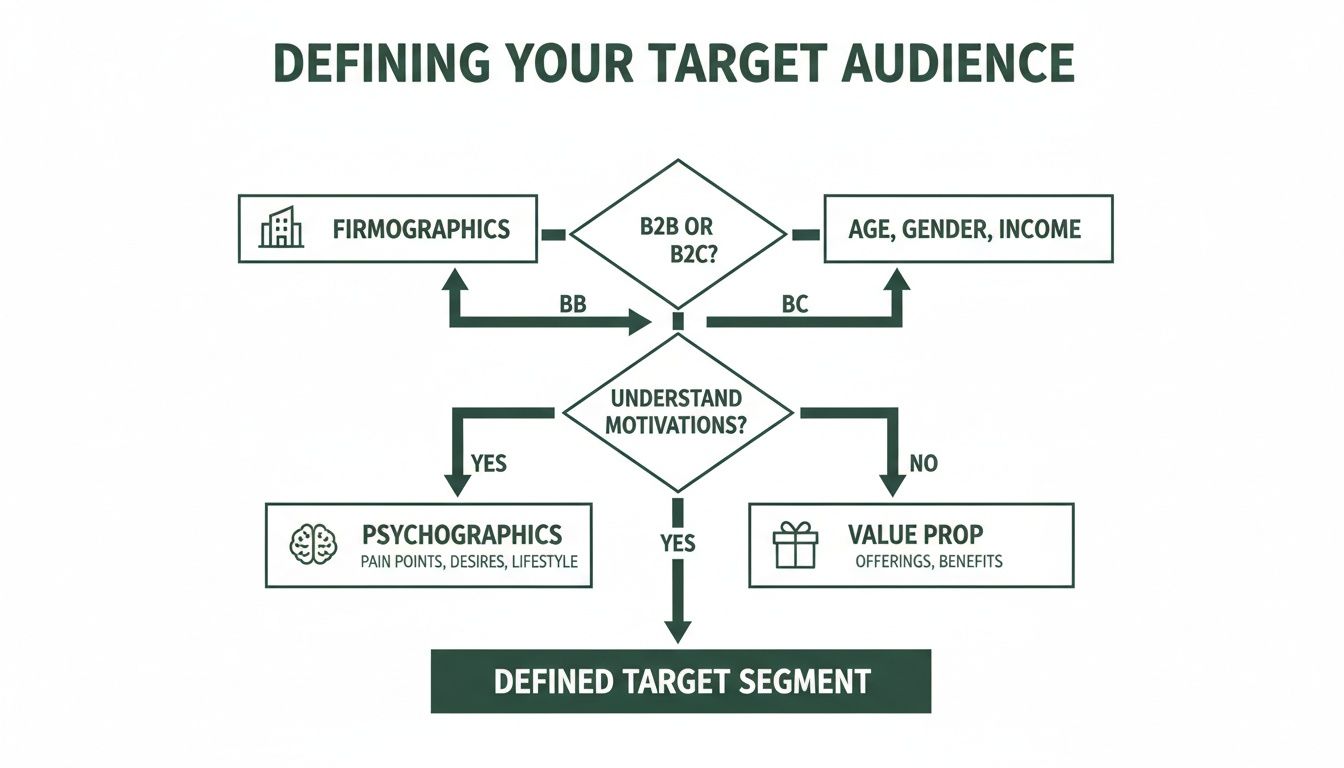
An ICP is not a persona. A persona is a character you invent to represent a type of buyer. An ICP is a description of the company and buyer profile that will get the most value from your product and convert most efficiently into revenue.
The distinction matters because personas lead to vague targeting. ICPs lead to lists.
For a UK B2B or SaaS startup, a usable ICP has two layers.
Firmographics: The hard facts about the company
The industry, company size by headcount or revenue, geography within the UK (London, Manchester, and Edinburgh have meaningfully different sector concentrations and buying cultures), funding stage if relevant, and the tech stack they are already running. That last point matters more than most founders think — if your product integrates with HubSpot and your ICP runs Salesforce, the sales cycle gets complicated fast.
Psychographics: What is driving the buyer
The specific pain they are trying to solve right now, the trigger event that made them actively look for a solution, the outcome they are trying to achieve this quarter, and the objections they will raise before they sign. This layer comes from conversations, not from assumptions. Before you write a word of messaging, you should have spoken to at least ten people who match your firmographic profile.
In practice, I start with LinkedIn Sales Navigator to filter UK companies by size, sector, and location. That gives a starting list. The real ICP comes from the interviews, asking direct questions like: what is the single biggest bottleneck in your workflow right now, and what would have to change for that to be solved? The answers to those questions shape everything from your value proposition to your objection handling.
A useful ICP fits on one page and answers: what company, who inside it, what triggers their search, what outcome they need, and what will make them hesitate. If yours is longer than that, it is too vague.
Step 2: Write a Value Proposition That Answers the Hard Question
The hard question every buyer is asking is not "what does this product do?" It is "why should I choose this over the next best alternative, including just not buying anything?"
Most UK startup founders value propositions do not answer that question. They describe features, or they make claims that every competitor could also make, "faster, smarter, more intuitive." None of that helps a buyer decide.
A value proposition that works does three things:
It is specific to the ICP's actual pain. Not a general pain the category addresses. The specific pain this buyer experiences at this stage of their business. For a 30-person UK SaaS company, "reduce operational complexity" is not specific enough. "Stop your sales team from manually updating two separate CRMs because your stack is not integrated" is.
It quantifies something. Time saved, cost reduced, revenue increased, churn rate dropped. Even a directional figure, "customers typically see X within 90 days", is more credible than a qualitative claim. If you do not have data yet, say what your assumption is and why. That honesty builds more trust than a number you cannot back up.
It names the alternative clearly. Not other products by name, but the category of alternative. "Unlike building this in-house," or "compared to managing this manually in spreadsheets," or "faster than hiring a full-time analyst to do this." Naming the alternative tells the buyer you understand their real decision, not just their product category.
Take "Monzo" as a reference point. Their value proposition in the early days was not "a better bank account." It was: instant spending notifications, real-time balance visibility, and budgeting tools that actually showed you where your money was going, without calling a phone line or waiting for a paper statement.
Every word pointed at a specific frustration with traditional banking. That is the level of precision that works.
Step 3: Choose Channels Based on Your ICP, Not Your Comfort Zone
Most early-stage UK founders default to the channels they know. Former marketers lean on content and SEO. Former salespeople lean on outbound. Neither is wrong, but neither is a strategy. Channel selection should follow from ICP, not from personal familiarity.
Here is how to think through the decision for a UK B2B or SaaS startup:
LinkedIn: Is the most effective paid channel for reaching UK B2B decision-makers by job title, company size, and sector. The cost per click is higher than Google, but the targeting precision for senior buyers is unmatched. If your ICP is a Head of Operations at a 50-200 person professional services firm in London, LinkedIn puts you in front of that person directly. The caveat: LinkedIn ads require a well-defined ICP and sharp copy. Without those, the budget disappears fast.
Google Ads (Search) Works when your ICP is actively searching for solutions. If the problem you solve has an established search behaviour, people typing queries that signal buying intent, paid search captures that moment. If the problem is not well-defined enough for buyers to search for it, Google Ads drives traffic that does not convert.
Content and SEO: This is the right long-term investment for most UK SaaS startups, but it is not a launch strategy. Organic search takes six to twelve months to build meaningful traffic. Start it early, but do not rely on it for first-year pipeline.
Cold outbound: Email or calls works when the ICP is very precise and the outreach is genuinely relevant. The UK market is more resistant to cold outreach than the US, so volume-based spray-and-pray sequences tend to burn reputation quickly. What works here is a short, specific, personalised message that shows you understand the buyer's situation before you ask for anything.
Community-led growth (CLG): Is underused by UK B2B startups. Sector-specific communities, Slack groups, industry forums, LinkedIn groups in niche verticals, are where a lot of early-stage buying decisions are discussed informally. Being present and genuinely helpful in those communities builds the kind of trust that shortens sales cycles.
The practical starting point: Pick two channels maximum. Run structured experiments on each, defined budget, defined duration, defined success metric, before committing to either. The most common mistake is spreading a small budget across five channels and learning nothing useful from any of them.
GTM Channel Comparison for UK B2B Startups
Channel | Typical UK Cost | Time to Impact | Best Fit |
Content and SEO | Low-medium (time-intensive) | 6-12 months | Building long-term authority, educating complex buyers, compounding organic traffic |
LinkedIn Ads | Medium-high (CPC-based) | Immediate | Targeting specific job titles, sectors, and company sizes with direct-response offers |
Google Ads (Search) | Medium-high (CPC-based) | Immediate | Capturing high-intent buyers actively searching for a solution category |
Cold Outbound | Low-medium (tooling and time) | 1-3 months | Reaching very specific high-value accounts when ICP is tightly defined |
Community-Led | Low (time-intensive) | 3-9 months | Building trust in niche sectors, gathering product feedback, early PLG models |
The tradeoff is straightforward: paid channels deliver results quickly but stop the moment you stop spending. Organic channels take longer but build assets that compound. For most early-stage UK startups, the right answer is one paid channel for immediate pipeline and one organic channel for long-term positioning — run simultaneously from day one.
Step 4: Set a GTM Budget That Matches Your Stage
UK startup GTM budgets are consistently either too thin to generate useful data or too concentrated in channels that have not been validated yet.
A useful rule of thumb for UK SaaS startups: allocate 8-12% of projected first-year revenue to GTM. That figure covers paid channel testing, content production, tooling, and any agency or freelance support. It is not generous, but it is enough to run meaningful experiments across two channels and identify what is working before committing further.
What that budget should not do is go entirely into ad spend before the ICP and value proposition are locked. Paid media amplifies whatever message you put in front of your target audience. If that message is not specific enough yet, you are paying to learn that it does not work, which is useful information, but an expensive way to get it.
The sequencing that works:
Months 1-2: ICP interviews and positioning work. Low cost, high return. The output is a tighter ICP and a value proposition tested against real buyers before a pound is spent on campaigns.
Months 2-4: Small-budget channel experiments. £500-£1,000 per channel, defined hypothesis, defined success metric. The goal is data, not scale.
Months 4-6: Double down on what is working. Reallocate budget from underperforming channels to the ones generating qualified pipeline. Start building the organic channel alongside.
The UK-Specific Considerations Most GTM Guides Ignore
Most GTM content is written for the US market. A few things work meaningfully differently in the UK.
Sales cycles are longer.
UK buyers, particularly in professional services, financial services, and enterprise, are more cautious and more relationship-driven than US counterparts. A GTM that assumes a 30-day sales cycle will need adjusting. Build nurture sequences that sustain engagement across longer evaluation periods.
Sector concentration matters.
London dominates fintech, proptech, and media-tech. Manchester and Leeds are stronger in retail tech and professional services. Edinburgh has a significant financial services cluster. If your ICP is concentrated in a specific sector, geography within the UK becomes part of your targeting strategy.
GDPR shapes outbound.
Cold email to UK business contacts requires a legitimate interest basis under GDPR. That does not make outbound impossible, but it does mean your targeting needs to be precise and your messaging needs to be relevant. Volume-based outreach carries regulatory risk that it does not in the US.
Community matters more at early stage.
The UK startup ecosystem, particularly in London, is tight. Events like SaaStock Europe, Founders Forum, and BrightonSEO are not just networking. They are where early adopters, investors, and potential channel partners are all in the same room. Showing up consistently in those spaces builds credibility that paid channels cannot replicate.
Common GTM Mistakes UK Founders Make
Starting with channels before locking the ICP.
The number of times I have seen a startup spend £5,000 on LinkedIn Ads targeting "marketing professionals" with no further specificity, and then wonder why the leads are not converting, is more than I can count. Channels before ICP is money before clarity.
Writing a value proposition in a room.
The value proposition that your founding team writes in a workshop is almost never the one that resonates with buyers. It gets refined through conversations, not through internal debate. Get it in front of ten potential buyers before you put it on your website.
Treating GTM as a one-time document.
The GTM plan you write at launch will be wrong in at least two or three places. That is fine. The companies that succeed iterate their GTM based on what the market tells them. Build a review cadence, quarterly at minimum, where you revisit ICP assumptions, value proposition, and channel performance.
Optimising too early.
There is a window at the very beginning of a channel experiment where you do not have enough data to know what is working. Most founders start making changes before that window closes. Set a minimum experiment duration, four weeks for paid channels, three months for content, before drawing conclusions.
Measuring Success with a GTM Dashboard
A go-to-market strategy without clear metrics is just a collection of hopeful guesses. To turn your plan into a predictable growth engine, you need to measure what actually matters.
This means moving past distracting vanity metrics, like social media likes, and focusing on the Key Performance Indicators (KPIs) that directly impact your startup's health.
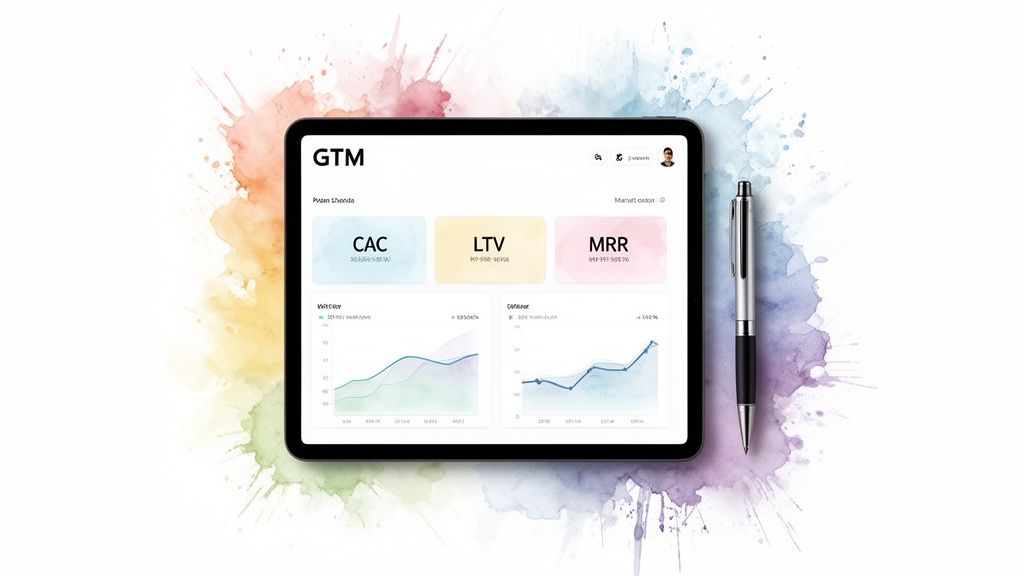
Building a simple GTM dashboard is the most effective way to keep your team honest and focused. It doesn't need to be some complex business intelligence tool; a well-organised spreadsheet is a perfect place to start. The goal is to create a single source of truth that tracks progress and fuels data-driven decisions.
This dashboard turns guesswork into a clear feedback loop. It lets you see what's working, what isn't, and where you should double down on your efforts, making your go-to-market strategy for startups a living, evolving system.
Identifying Your Core GTM Metrics
For any SaaS or B2B startup, a handful of metrics really tell the whole story. Your dashboard should be built around these core numbers, giving you an at-a-glance view of your business performance.
These are the non-negotiable KPIs you need to track from day one:
Customer Acquisition Cost (CAC): This is the total cost of your sales and marketing efforts divided by the number of new customers you brought in. A rising CAC is an early warning that your channels are getting less efficient.
Lifetime Value (LTV): This metric estimates the total revenue you can expect from a single customer over their entire relationship with you. A healthy business model demands an LTV that's significantly higher than your CAC, typically by a ratio of at least 3:1.
Monthly Recurring Revenue (MRR): For any subscription business, MRR is your lifeblood. Tracking its growth—including new MRR, expansion MRR from upgrades, and churned MRR from cancellations—paints a clear picture of your momentum.
Key Conversion Rates: This isn't just one metric but a series of them tracking the user's journey. You should be watching your website visitor-to-trial sign-up rate, trial-to-paid conversion rate, and your sales team's lead-to-opportunity rate.
By focusing on these numbers, you create a culture of accountability where every activity can be tied back to a tangible business outcome.
Balancing Leading and Lagging Indicators
A great GTM dashboard doesn't just look at the past; it helps you predict the future. To achieve this, you need to track a mix of both leading and lagging indicators.
Lagging indicators, like revenue and LTV, tell you what has already happened. Leading indicators, like demo bookings and trial sign-ups, are predictors of future revenue. A healthy dashboard gives you a clear view of both.
Think of it like driving a car. Your lagging indicators are what you see in the rearview mirror (where you've been), while your leading indicators are what you see through the windscreen (where you're going).
Here’s a simple template for how you could structure this in a spreadsheet:
Indicator Type | Metric | This Month's Target | This Month's Actual | Status |
|---|---|---|---|---|
Leading | Trial Sign-ups | 100 | 115 | ✅ On Track |
Leading | Sales Demos Booked | 25 | 21 | ⚠️ At Risk |
Lagging | New MRR | £5,000 | £5,500 | ✅ On Track |
Lagging | Customer Churn Rate | < 2% | 2.5% | ❌ Off Track |
This simple format immediately tells you where to focus. A dip in demo bookings this month is a red flag for next month's revenue target.
This allows you to react quickly—perhaps by adjusting ad spend or tweaking your outreach messaging—before the problem actually shows up in your bank account. This data-driven approach is fundamental to iterating and optimising your GTM strategy based on real-world feedback.
A winning GTM strategy requires the right blend of expertise and execution. Ryesing Limited builds and manages high-performance growth engines for ambitious startups, integrating strategic planning with data-driven marketing to deliver measurable results. Accelerate your growth with us.
Frequently Asked Questions About Go-To-Market Strategy for UK Startups
What is a go-to-market strategy for a startup?
A go-to-market (GTM) strategy is a startup's comprehensive action plan for launching a new product or service into a specific market. It covers who the target customer is (Ideal Customer Profile), what value the product offers (value proposition), how to reach customers (channels), how to price the product, and how to sell it (sales motion). It's the strategic blueprint that connects the product to the customer.
What are the 5 components of a go-to-market strategy?
The five core components of a go-to-market strategy for startups are:
Market Definition: Identifying your Ideal Customer Profile (ICP) and the market segment you will target.
Value Proposition: Crafting a clear message about the unique value and benefits your product provides.
Pricing Strategy: Determining how you will price your product to reflect its value and achieve business goals.
Distribution & Channels: Selecting the most effective marketing and sales channels to reach your target audience.
Sales & Onboarding: Defining your sales process (e.g., product-led, sales-led) and the customer's journey to becoming a user.
How do you build a GTM strategy for a startup?
To build a GTM strategy, a startup should follow these key steps:
Define Your Ideal Customer Profile (ICP): Get specific about the company and user you are targeting.
Validate Product-Market Fit: Ensure there is a strong demand for your solution within that target market.
Craft a Compelling Value Proposition: Articulate why you are the best choice.
Choose Your Growth Motion: Decide between a product-led, sales-led, or hybrid approach.
Select and Test Channels: Experiment with different marketing channels (e.g., SEO, paid ads, content) to find what works.
Set Metrics and KPIs: Establish clear goals for CAC, LTV, and conversion rates to measure success.
Why is a GTM strategy important for startups?
A GTM strategy is critical because it reduces risk and provides a clear roadmap for growth. It forces the validation of customer assumptions before significant spending, aligning product, marketing, and sales teams to work efficiently toward a successful launch and sustainable traction."
Conclusion: Go-To-Market Strategy for UK Startups
A GTM strategy for a UK startup is not a document you write once and file away. It is the operating framework that tells you who to sell to, why they should buy, where to find them, and what it will cost. Get those four things specific, get them tested against real buyers, and build your channels and budget around the answers.
If you are working through this and want a framework to structure the process, Ryesing's GTM Strategy Framework covers ICP definition, positioning, channel selection, and the KPIs you should be tracking in the first 90 days.


