
B2B Demand Generation Strategies: 10 Proven Playbooks for Building Predictable Pipeline

Updated: Jul 7
Most B2B demand generation programmes fail not because of poor tactics but because of poor architecture. Teams run ABM campaigns before their ICP is defined. They invest in content before they understand what their buyers are actually searching for. They pour budget into paid media before their landing pages are built to convert. The tactics themselves are sound. The sequencing is wrong.
This post covers ten demand generation strategies that B2B and SaaS teams are using in 2026 to build predictable pipeline. For each one, I cover what it is, when it works, how to implement it in practice, and what to measure. The goal is not a list of things to try. It is a structured playbook you can work through in order, starting with the foundations that make everything else more efficient.
If you are new to demand generation and want the conceptual foundation first, what it is, how it differs from lead generation, and why it matters, the demand generation marketing guide covers that ground. This post assumes you understand the basics and are ready to build. → Read:

1. Account-Based Marketing (ABM)
Account-Based Marketing (ABM) is a highly focused demand generation strategy that inverts the traditional marketing funnel. Instead of casting a wide net to capture as many leads as possible, ABM concentrates marketing and sales resources on a predefined set of high-value target accounts, treating each as a unique market. This approach is exceptionally powerful for B2B companies, particularly in SaaS and tech, where deal sizes are substantial and buying committees involve multiple stakeholders.
The core principle of ABM is deep personalisation. It aligns sales and marketing teams to orchestrate tailored campaigns designed to resonate with the specific challenges and goals of key decision-makers within target organisations. By focusing on quality over quantity, B2B firms can achieve higher engagement rates, faster deal velocity, and a greater return on investment compared to broader lead generation tactics.
ABM Key Implementation Steps
To effectively integrate ABM into your demand generation strategies, follow a structured approach:
Identify & Prioritise High-Value Accounts: Work with your sales team to define your Ideal Customer Profile (ICP). Use firmographic data (industry, company size, revenue) and intent data (signals indicating a company is actively researching solutions like yours) to build a target account list. Start small, perhaps with a pilot of 10-20 accounts.
Deep Research & Persona Mapping: For each target account, map out the key stakeholders, influencers, and decision-makers. Research their individual roles, pain points, and motivations to create hyper-relevant messaging.
Create Personalised Content & Campaigns: Develop content assets, ad creatives, and outreach messaging that speak directly to the target account's specific needs. This could include industry-specific case studies, personalised ROI calculators, or custom-tailored webinar invitations.
Orchestrate Multi-Channel Execution: Coordinate your outreach across multiple channels, such as targeted display ads, LinkedIn sponsored content, personalised email sequences, and direct mail. Ensure messaging is consistent and builds upon previous touchpoints.
What to measure: Account engagement rate, pipeline influenced, deal velocity within target accounts, and win rate vs non-ABM accounts.
Pro Tip: Leverage insights from your sales team's conversations and CRM data. This qualitative information is invaluable for personalising outreach at scale and making your campaigns feel genuinely bespoke. For instance, if sales notes a target account is focused on cost-saving initiatives, your marketing messaging should pivot to highlight efficiency and ROI.
2. Content Marketing & Thought Leadership
Content marketing is the long-term compounding asset of your demand generation system. Done right it builds authority, earns search traffic, and warms your ICP before they ever enter a sales conversation. Done wrong it produces a blog nobody reads and a backlog nobody wants to write.

The distinction between content that generates demand and content that just exists is specificity of audience and depth of insight. A post titled "5 Marketing Tips for B2B Companies" generates nothing. A post titled "Why Your ABM Programme Is Generating Meetings But Not Pipeline, And How to Fix It" speaks directly to a specific problem a specific buyer is experiencing right now. That specificity is what earns trust and search rankings simultaneously
Key Implementation Steps for Content Marketing
To effectively leverage content marketing for demand generation, a structured plan is essential:
Develop a Documented Content Strategy: Align your content plan with specific stages of the buyer journey. Conduct keyword research and competitive analysis to identify content gaps and opportunities. Your strategy should outline content formats, distribution channels, and performance KPIs.
Create a Mix of Content Formats: Balance top-of-funnel (ToFu) content like blog posts and infographics to build awareness with bottom-of-funnel (BoFu) content like case studies and ROI calculators to drive conversions. High-value assets like research reports and ebooks can be gated to capture qualified leads.
Establish a Consistent Publishing Cadence: Consistency builds audience trust and signals reliability to search engines. Commit to a manageable schedule, such as weekly blogs, a monthly webinar, or a quarterly research report, to keep your audience engaged.
Repurpose and Distribute Content: Maximise the reach of every content piece by repurposing it across different formats. A detailed whitepaper can be broken down into multiple blog posts, a webinar recording can become a YouTube video, and key stats can be turned into social media graphics.
What to measure: Organic search traffic, time on page, content-influenced pipeline, MQLs from organic channels.
Pro Tip: Focus on search intent, not just keywords. Understand the "why" behind a user's search query. Are they looking for information (e.g., "what is demand generation"), a comparison (e.g., "HubSpot vs Marketo"), or are they ready to buy (e.g., "best B2B marketing automation software")? Tailor your content's angle and format to match that intent for better engagement and search performance.
3. Intent Data & Predictive Analytics
Intent data is the ability to identify which companies are actively researching solutions in your category right now — before they have raised their hand. It transforms demand generation from reactive (waiting for inbound) to proactive (finding buyers at the moment of highest readiness).
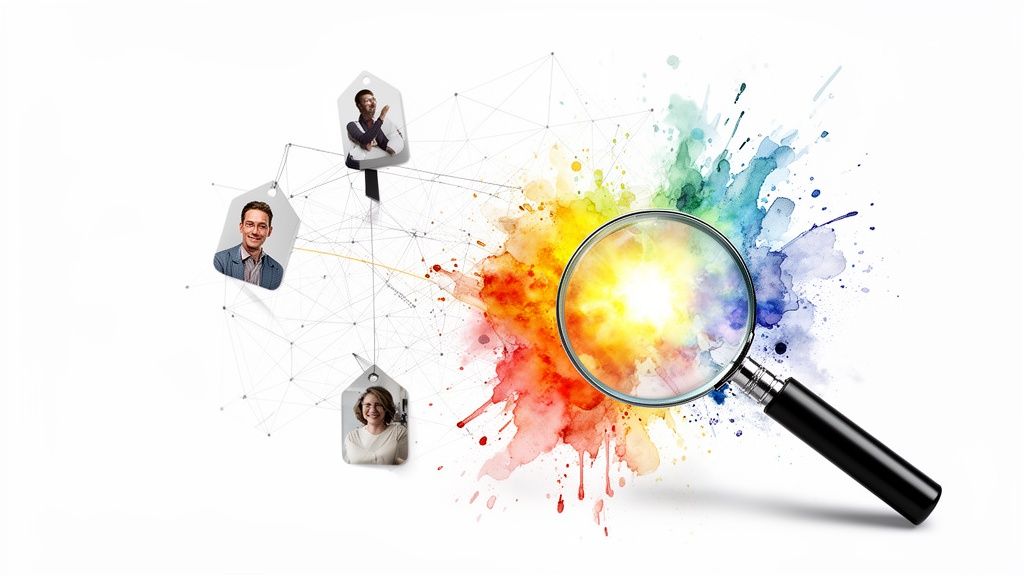
The two types are first-party intent (behaviour on your own properties — which pages they visit, what they download, how long they spend on your pricing page) and third-party intent (behaviour across the wider web — content they are reading, searches they are running, competitors they are evaluating). Third-party intent data comes from providers like Bombora, 6sense, and Demandbase.
Predictive Analytics Key Implementation Steps
To effectively leverage intent data in your demand generation strategies, focus on integrating signals into your existing workflows:
Integrate First- and Third-Party Data: Start by analysing your first-party intent data from your website, CRM, and marketing automation platform. Augment this with third-party data from providers like Bombora to gain a comprehensive view of an account’s research behaviour across the web.
Establish a Lead Scoring Model: Develop a clear model that maps specific intent signals to a score indicating conversion probability. For example, a prospect visiting your pricing page might receive a higher score than someone who only downloaded a top-of-funnel ebook.
Create Real-Time Alerts for Sales: Set up automated alerts to notify your sales team when a target account crosses your intent threshold. The window between a buyer showing intent and making a shortlist decision is short. Speed of relevant outreach matters.
Inform Content and Campaign Strategy: Use insights from intent data to refine your content strategy. If you notice a spike in interest around a specific topic or feature, create targeted content, such as blog posts, webinars, or case studies, to address that need.
What to measure: Intent signal-to-MQL conversion rate, pipeline from intent-activated accounts vs cold outreach, win rate on high-intent accounts.
Pro Tip: Prioritise accounts where multiple contacts from the same company show intent signals. This often indicates a buying committee is actively researching, making the account a much warmer and more qualified opportunity than an individual showing interest alone. This approach ensures your efforts are focused on deals with real momentum.
4. Email Nurture & Lifecycle Marketing
Email nurture campaigns are a cornerstone of modern B2B demand generation, guiding prospects through the buyer journey with personalised, sequential messaging. This strategy is designed to educate, build relationships, and drive conversions over time. Lifecycle marketing expands on this by covering the entire customer journey, from initial awareness and acquisition through to retention and advocacy, using automated workflows triggered by user behaviour.
This approach is highly effective for B2B tech and SaaS companies managing long sales cycles and complex buying committees. Instead of a one-off “blast,” it delivers the right message at the right time, building trust and keeping your brand top-of-mind. By segmenting audiences based on behaviour, firmographics, and lifecycle stage, you can create a relevant experience that moves leads closer to a sales conversation without aggressive tactics.
Lifecycle Marketing Key Implementation Steps
To build an effective email nurture and lifecycle marketing engine, follow these structured steps:
Segment Your Audience: Go beyond basic demographics. Create segments based on user behaviour (e.g., downloaded an ebook, visited the pricing page), lifecycle stage (subscriber, lead, MQL), and firmographic data (industry, company size). This is the foundation for personalisation.
Map the Customer Journey: Identify the key stages and touchpoints a prospect goes through, from awareness to decision. Map out the questions, objections, and information needs at each stage to inform your content and workflow logic.
Design Stage-Specific Workflows: Create automated email sequences for different scenarios. Examples include a welcome series for new subscribers, a lead nurture track for ebook downloaders, or a re-engagement campaign for inactive contacts.
Implement lead scoring that reflects actual buying intent: Assign points to leads based on their profile data and actions (e.g., +10 for visiting the pricing page, +20 for requesting a demo). Once a lead reaches a predefined score threshold, they can be automatically routed to the sales team as a marketing-qualified lead (MQL).
What to measure: Email-influenced pipeline, MQL-to-SQL conversion rate from nurture sequences, time from first touch to sales-ready
Pro Tip: Use dynamic content blocks within your emails to achieve hyper-personalisation at scale. You can show different case studies based on a contact's industry, reference their company name in the copy, or change the call-to-action based on their lifecycle stage. This small touch makes automated emails feel significantly more individualised and relevant.
5. Paid Search, Retargeting, and Audience-Based Paid Media
Paid media is the accelerant in your demand generation system, it delivers results fast, but only if the targeting is precise and the landing page is built to convert. It is also the easiest place to waste budget if either of those conditions is not met.
Key Implementation Steps for Performance Marketing
To launch an effective paid media programme, follow these structured steps:
Define Channel & Audience: Start with the platforms where your ideal customers are most active. For many B2B tech firms, LinkedIn is the primary choice due to its professional targeting capabilities. Define your audience using firmographic and demographic data to ensure your budget is spent efficiently.
Build High-Converting Landing Pages: Never send paid traffic to your homepage. Create dedicated landing pages with messaging that directly mirrors your ad copy and creative. Ensure the page has a single, clear call-to-action (CTA) to maximise conversion rates.
Implement Robust Conversion Tracking: Set up conversion tracking pixels and server-side events across all platforms (e.g., Google Tag Manager, LinkedIn Insight Tag). This is crucial for measuring true return on ad spend (ROAS) and optimising campaigns based on performance data, not just clicks. Launch & Systematically Test: Start with a modest budget to test your initial hypotheses. Systematically experiment with different ad formats, headlines, audience segments, and landing page variations. Use A/B testing to identify winning combinations and scale your investment accordingly.
What to measure: Cost per MQL by channel, ROAS, landing page conversion rate, pipeline attributed to paid media.
Pro Tip: Use retargeting to create highly efficient, lower-funnel campaigns. By serving specific ads to users who have already visited your website or engaged with your content, you can nurture warm prospects and significantly reduce your overall customer acquisition cost (CAC). For example, target visitors of a pricing page with a case study ad that reinforces your solution's ROI.
6. Product-Led Growth (PLG) & Freemium Models
PLG is the demand generation motion where the product itself does the acquiring. Users sign up, experience value, and convert, often without ever speaking to a salesperson. When it works, it produces the most efficient customer acquisition economics of any model. When it does not fit the product or the buyer, it creates a leaky top of funnel that looks like demand generation but generates no revenue.
PLG works when the product delivers value quickly without requiring a guided experience, the ICP is comfortable making software decisions without a sales process, and the deal size makes a high-touch sales motion uneconomic.
Product-Led Growth Key Implementation Steps
To successfully leverage PLG and freemium models in your demand generation strategies, focus on the user experience and clear value delivery:
Design a Value-First Freemium Tier: If you are running a freemium model, the design of your free tier is your most important demand generation decision. It needs to be generous enough to deliver genuine value — so the user becomes dependent on it, but constrained enough that upgrade to paid is the logical next step. The constraint should be a natural ceiling the user hits as they grow, not an artificial limitation that frustrates them before they see value.
Optimise In-Product Onboarding: Create a seamless and intuitive onboarding flow that guides new users to key features and helps them achieve their first successful outcome. This initial experience is critical for long-term retention and conversion.
Leverage Behavioural Analytics: Implement product analytics tools to track user behaviour, identify usage patterns that correlate with conversion, and spot friction points. These insights are vital for personalising upgrade prompts and improving the product.
Track Product Qualified Leads (PQLs): users who have hit your activation event and are showing expansion signals (adding team members, hitting usage limits, accessing premium features). These are your highest-converting sales conversations because the product has already proved its value. Route PQLs to sales immediately with full context on their usage history.
Create Clear Upgrade Paths: Clearly communicate the value of premium features within the product. Tie upgrade triggers to user actions and needs, such as hitting a usage limit or attempting to access an advanced feature, making the transition to a paid plan a logical next step.
What to measure: Time to value, activation rate, free-to-paid conversion rate (benchmark: 2-5% for freemium, 15-25% for free trial), PQL-to-close rate.
Pro Tip: Your freemium model’s success depends on a delicate balance between generosity and monetisation. Analyse your unit economics carefully to ensure the free tier is sustainable. For an in-depth guide, explore these effective pricing and packaging PLG strategies to structure your tiers for maximum growth and profitability.
7. Webinars and Virtual Events
Webinars are the most underused demand generation channel in B2B SaaS. Most teams run one webinar per quarter, treat it as a standalone event, and measure success by registration count. That approach extracts about 20% of the demand generation value a well-run webinar programme can deliver.
A webinar done well is a demand generation asset with a lifespan far beyond the live event. The recording becomes gated content. The Q&A surfaces buyer questions that inform your next three blog posts. The attendee list is a pre-qualified segment for your most relevant nurture sequence. The speaker earns a credibility signal that no paid ad can replicate.
Community-Led Growth Key Implementation Steps
To effectively harness a community for demand generation, consider these foundational steps:
Build your webinar topics from the questions your ICP is actually asking: in sales calls, in support tickets, in community channels, in search queries. The webinar that addresses a real, pressing question your buyer has right now will always outperform the webinar you want to run because it showcases your product.
Design the webinar around teaching, not selling: The moment a webinar tips into product demo territory it loses the audience. Keep the content genuinely educational. The trust you build by teaching something valuable is worth more than the demo you could have delivered.
Create a post-webinar sequence that extends the engagement: The day after: send the recording with key timestamps. Three days later: share one resource mentioned during the event. One week later: send a related case study. That sequence keeps the conversation alive with everyone who attended and everyone who registered but did not attend.
What to measure: Registrant-to-attendee rate (benchmark: 35-45%), attendee-to-MQL conversion rate, pipeline influenced by webinar attendees.
Pro Tip: Your company's role in the community should be one of a facilitator, not a broadcaster. Avoid overly promotional posts. Instead, focus on sparking conversations, celebrating member achievements, and providing resources that genuinely help users succeed with your product and in their careers. Authenticity is paramount.
8. SEO & Organic Search Demand Generation
Search Engine Optimisation (SEO) is a foundational demand generation strategy focused on improving your website's organic visibility in search engine results. For B2B organisations, SEO is not just about driving traffic; it's about capturing high-intent prospects precisely when they are actively searching for solutions to their problems. This makes it an incredibly powerful and sustainable engine for long-term growth, delivering compounding returns over time.
The mistake most B2B teams make with SEO is treating it as a content volume game. More posts do not produce more traffic. The right posts, precisely matched to buyer search intent, well-structured, internally linked, and authoritative enough to rank, produce compounding traffic. The wrong posts produce nothing, regardless of how many there are.
Key Implementation Steps for Organic Search Demand Generation
To effectively integrate SEO into your demand generation strategies, follow a structured approach:
Map Keywords to the Buyer Journey: Begin by identifying high-value keywords that align with each stage of your customer's journey. Use tools like Ahrefs or Semrush to find awareness (informational), consideration (navigational/comparative), and decision (commercial) stage terms.
Develop Topic Clusters: Organise your content into topic clusters built around a central “pillar page” covering a broad topic. This structure signals topical authority to search engines and helps users find relevant information. For instance, a pillar page on “B2B Marketing Automation” could link out to cluster content on specific tactics.
Optimise for Search Intent: Ensure your content format matches what users expect for a given query. A search for “Stripe API documentation” expects technical guides, while “best CRM software” expects a comparison article. Mismatching intent leads to poor rankings.
Build High-Quality Backlinks: Earn links from reputable websites through guest posting, digital PR, and industry partnerships. Backlinks act as a vote of confidence, significantly boosting your domain authority and search rankings. As search evolves, a focus on improving your AI search visibility will also be crucial for maintaining a competitive edge.
What to measure: Organic traffic growth, keyword ranking movement for target terms, content-influenced pipeline, organic MQL volume.
Pro Tip: Don't just create new content; consistently update and refresh your existing high-performing articles. Enhance them with new data, updated examples, and deeper insights. This "historical optimisation" often yields faster results than publishing a brand-new post and is a key lever for leveraging SEO for growth marketing.
9. Social Selling and LinkedIn Outreach
Social selling is not a volume game. It is not sending 200 connection requests per week and following up with a pitch on acceptance. That approach damages your personal brand and generates the kind of pipeline metrics that look impressive in a spreadsheet and convert nowhere.

Effective social selling on LinkedIn is a combination of consistent thought leadership content that builds an audience of your ICP over time, and targeted, personalised direct outreach to the highest-priority accounts in your TAL. The content creates the warm environment. The outreach operates into that warmth.
Virtual Events Key Implementation Steps
To maximise the impact of your virtual events, follow this strategic process:
Publish consistently on LinkedIn: at minimum three times per week. The content should be rooted in your direct experience: observations from client work, frameworks you have developed, problems you see repeatedly in your ICP, honest takes on what works and what does not. Generic marketing content that could have been written by anyone produces no differentiation. Specific, opinionated content from a credible practitioner builds a following of exactly the right people.
When you send direct messages, make them short, specific, and demonstrably researched. Reference something specific about the person's company or role that shows you are not running a mass sequence. A message that takes thirty seconds to personalise will outperform a sequence of ten generic follow-ups every time.
Use LinkedIn Sales Navigator to build precise lists from your ICP firmographic and seniority filters.
before building any new outreach list to avoid approaching accounts you are already in conversation with through other channels.
What to measure: Connection acceptance rate, response rate to direct messages, meetings booked from social outreach, pipeline influenced by LinkedIn activity.
Pro Tip: Don't let your webinar content disappear after the live event. Repurpose the recording into an evergreen demand generation asset. Gate the on-demand version behind a form, slice the video into short social media clips, transcribe the session into a blog post, and convert the key takeaways into an infographic or checklist.
10. Partner and Channel Marketing
Partner marketing is the demand generation motion that most B2B SaaS teams leave entirely on the table. A well-structured partner programme can generate qualified pipeline at a fraction of the cost of direct acquisition, because the trust the partner has already built with their audience transfers to your product.
The two most relevant models for B2B SaaS are technology partnerships (integrating with platforms your ICP already uses and running co-marketing to each other's audiences) and referral or reseller partnerships (working with agencies, consultants, or adjacent service providers who sell to the same buyer and can recommend or bundle your product).
Key Implementation Steps for CRM Integration
To effectively integrate marketing automation and CRM into your demand generation strategies, follow a structured approach:
Start by mapping the ecosystem around your ICP: What other software do they use? What service providers do they work with? What events do they attend? Every node in that ecosystem is a potential partner.
Prioritise technology partnerships first: they create product-level distribution rather than just marketing-level awareness. If your product integrates natively with HubSpot and your ICP uses HubSpot, being listed in the HubSpot App Marketplace puts you in front of a qualified audience that already trusts the platform recommending you.
For referral and reseller partnerships, build a programme with clear economics and clear rules: What does the partner earn per referral? What support do they get to sell your product? What materials do they need? The cleaner the programme structure, the more likely partners are to prioritise you over other options in their network.
What to measure: Partner-sourced pipeline, partner-influenced revenue, cost of partner-sourced acquisition vs direct acquisition, referral conversion rate.
Pro Tip: Create a feedback loop where sales can update lead statuses in the CRM to inform and refine your marketing automation. For example, if sales consistently disqualifies leads from a specific campaign, marketing can use this data to adjust the lead scoring model or the campaign’s targeting and messaging, ensuring continuous improvement.
B2B Demand Generation: 10-Strategy Comparison
Strategy | Implementation complexity | Resource requirements | Expected outcomes | Ideal use cases | Key advantages |
|---|---|---|---|---|---|
Account-Based Marketing (ABM) | High — cross-functional orchestration and personalization | High — CRM, intent/data platforms, bespoke content, sales alignment | Higher conversion rates, larger deal sizes, predictable pipeline | B2B enterprise, long sales cycles, high ACV accounts | Focused ROI; stronger sales-marketing alignment; deeper customer relationships |
Content Marketing & Thought Leadership | Medium — strategic planning and consistent production | Medium — writers, designers, SEO, editorial processes | Sustainable inbound traffic, authority, lead nurturing over time | Building brand authority, top-of-funnel demand, SEO-driven acquisition | Evergreen assets; lower long-term CPL; trust and credibility |
Intent Data & Predictive Analytics | Medium–High — data integration and model tuning | Medium–High — data providers, analytics, integration with CRM | Prioritized high-intent leads; better timing for outreach; improved conversion | Targeted outreach, ABM amplification, sales prioritization | Timely, relevant outreach; improved sales efficiency and prioritization |
Email Nurture & Lifecycle Marketing | Medium — workflow design and segmentation | Medium — marketing automation, content, list management | Scalable nurturing, higher conversion from leads to customers | Long sales cycles, onboarding, freemium-to-paid flows | Cost-effective; measurable ROI; personalized at scale |
Paid Media & Performance Marketing | Medium — campaign setup and continuous optimization | High — ad spend, creative production, analytics specialists | Immediate traffic and leads; rapid experimentation and scaling | Product launches, demand spikes, performance-driven acquisition | Fast results; precise targeting; clear attribution |
Product-Led Growth (PLG) & Freemium Models | High — product UX, onboarding, telemetry investment | High — product development, analytics, customer success | Inbound adoption, lower CAC, viral growth potential | Self-service SaaS, developer tools, freemium-first products | Product as acquisition channel; rapid user feedback; scalable organic growth |
Community-Led Growth & Advocacy | Medium–High — ongoing community management and moderation | Medium — community managers, platforms, events and incentives | Increased retention, referrals, advocacy and organic expansion | Developer ecosystems, user groups, retention-focused strategies | Lower CAC via referrals; strong loyalty; real product feedback |
SEO & Organic Search Demand Generation | Medium — technical + content strategy over time | Medium — SEO specialists, content production, link-building | Sustainable high-intent traffic and compounding ROI | Content-led acquisition, search-driven buyer journeys | Durable organic traffic; lower long-term CAC; improved credibility |
Webinars & Virtual Events | Medium — event planning, production and promotion | Medium — speakers, platform, promotion, content repurposing | High-engagement, qualified leads and reusable content assets | Product demos, thought leadership, buyer education | Interactive engagement; warm leads; repurposable assets |
Marketing Automation & CRM Integration | High — complex setup, data mapping, workflow design | High — platforms, integration, data ops, training | Scalable personalization, improved MQL→SQL conversion, efficiency | Multi-touch campaigns, lifecycle marketing, large databases | Automation at scale; improved alignment; measurable funnel impact |
Orchestrating Your Demand Generation Symphony
We've explored a comprehensive portfolio of demand generation strategies for B2B, from the laser-focused precision of Account-Based Marketing (ABM) to the broad, educational pull of Content Marketing and the organic authority of SEO. We’ve dissected the power of data-driven approaches like intent signals and analytics, the scalable engagement of email nurturing, and the immediate impact of paid media. We’ve also delved into modern, customer-centric frameworks like Product-Led Growth (PLG) and Community-Led Growth, highlighting how a great product and a vibrant user base can become your most powerful marketing assets.
The critical takeaway is this: these strategies are not a menu to choose from sporadically. The most successful B2B organisations treat them as interconnected instruments in a symphony. True demand generation excellence is not found in executing a single tactic perfectly but in orchestrating multiple strategies into a cohesive, multi-channel growth engine that aligns marketing, sales, and product teams around a common goal.
From Disparate Tactics to a Unified Growth Engine
Think of your demand generation efforts as a system. Your content marketing and SEO initiatives create awareness and attract potential customers searching for solutions. Intent data helps you identify which of those accounts are showing active buying signals, allowing your ABM and paid media campaigns to engage them with surgical precision.
Simultaneously, a PLG motion allows users to experience your product's value first-hand, creating a low-friction entry point. As they engage, your marketing automation and email nurture sequences guide them through their journey, providing timely, relevant information. Your community then provides the social proof, support, and advocacy that turns users into evangelists. Each strategy feeds and amplifies the others, creating a virtuous cycle of awareness, engagement, and conversion.
Key Insight: The goal is to move beyond a "lead generation" mindset, which often prioritises quantity, to a "demand creation" model. This approach focuses on building genuine interest and educating the market, ensuring that when prospects are ready to buy, your brand is their first and only choice.
Your Actionable Next Steps
Mastering the diverse set of demand generation strategies B2B marketers need is a continuous journey of testing, learning, and optimising. Here are your immediate next steps to translate this knowledge into action:
Conduct a Strategy Audit: Review your current activities against the ten strategies discussed. Identify your strengths, weaknesses, and, most importantly, the gaps where strategies fail to connect. Are your content efforts aligned with your ABM target account list? Does your product usage data trigger relevant email nurture flows?
Prioritise Integration Points: Pinpoint 2-3 key integration opportunities. A powerful starting point is connecting your CRM and marketing automation platforms to ensure a seamless data flow. Another is using intent data to fuel both your outbound sales plays and your targeted advertising campaigns.
Define Unified KPIs: Break down silos by establishing shared metrics. Instead of marketing tracking MQLs and sales tracking SQLs separately, focus on unified goals like pipeline velocity, customer acquisition cost (CAC), and influenced revenue. This ensures everyone is pulling in the same direction.
Embrace Experimentation: Choose one new strategy or integration to pilot over the next quarter. Whether it’s launching your first virtual event series or implementing a basic PLG motion with a free trial, start small, measure meticulously, and build on what works.
Building a demand generation programme that actually produces predictable pipeline is not about running all ten of these strategies simultaneously. It is about choosing the two or three that fit your current ICP, stage, and resources, running structured experiments, learning from what the data tells you, and building systematically from there.
If your programme is already running and you need to understand what is and is not working, start with the measurement layer. Pipeline attribution, channel performance, and conversion rates at each funnel stage will tell you exactly where to focus next.
For the conceptual foundation behind this framework, what demand generation is, how it differs from lead generation, and the core pillars of a solid programme, the demand generation marketing guide covers that in full.
For the lead nurturing mechanics that sit between demand capture and sales-ready conversation: → Read:

Ready to build this with a team behind you? →

Frequently Asked Questions about B2B Demand Generation
What is the difference between demand generation and lead generation?
Demand generation is a broad, strategic approach focused on creating awareness and interest in your company's product or service. Lead generation is a more specific tactic within demand generation that focuses on capturing contact information from prospects who have shown interest. Demand generation builds the audience, while lead generation converts that audience into actionable leads.
Which B2B demand generation strategy is most effective?
The most effective strategy depends on your business model, target audience, and product. For high-value enterprise sales, Account-Based Marketing (ABM) is often most effective. For self-service SaaS products, Product-Led Growth (PLG) excels. A balanced approach that combines long-term strategies like SEO and Content Marketing with targeted ones like Paid Media is typically best.
How do you measure the success of demand generation strategies?
Success is measured with a mix of metrics. Top-of-funnel metrics include website traffic, brand awareness, and content engagement. Mid-funnel metrics focus on Marketing Qualified Leads (MQLs) and conversion rates. Ultimately, the most important KPIs are bottom-line results like sales pipeline generated, customer acquisition cost (CAC), and influenced revenue.
What is an example of a B2B demand generation campaign?
A classic example is creating a detailed industry research report (Content Marketing), promoting it through LinkedIn ads (Paid Media) to a specific audience of decision-makers, and using a webinar (Virtual Events) to discuss the findings. Registrants are then entered into an email sequence (Marketing Automation) that nurtures them toward a product demo.

